
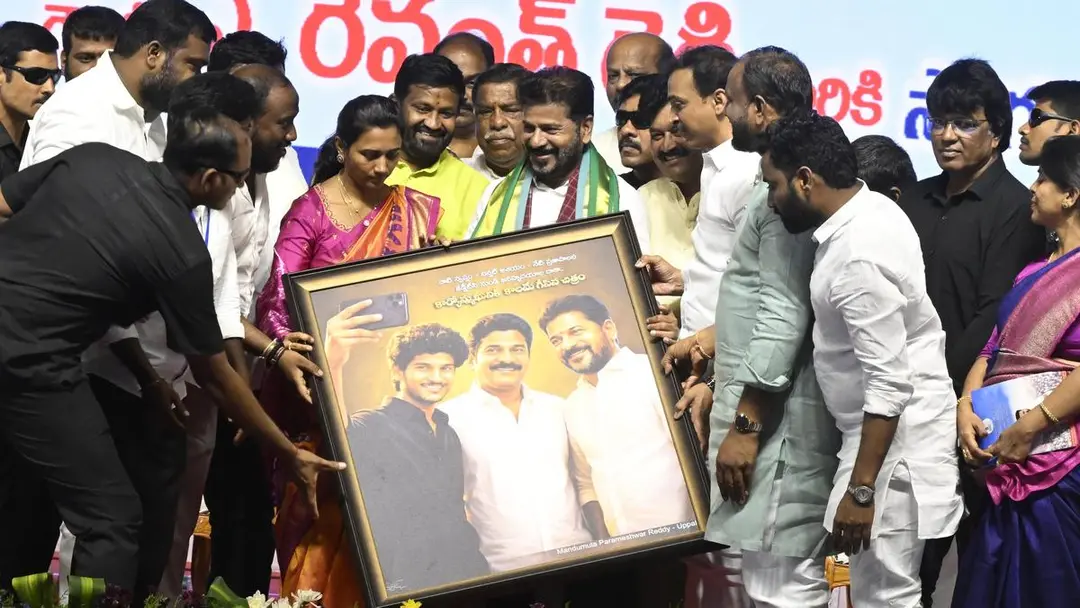
Revanth Reddy launches ₹1,511.5-crore projects in Malkajgiri
Telangana Chief Minister A. Revanth Reddy on Sunday said Hyderabad's future growth depended on decentralised administration, integrated urban planning and large-scale infrastructure investment, as he launched four projects worth ₹1,511.5 crore under the Malkajgiri Municipal Corporation. They include a ₹98-crore corporation office complex, ₹960-crore alternative road works near the AOC Centre, a ₹416-crore six-lane flyover and a ₹37.5-crore 100-bed district hospital. He also launched the CURE-1 citizen services app.
Source
Hyderabad — development · read the original report ↗
Desk check · compared with the source
What the desk checked (5)
- Projects worth ₹1,511.5 crore were launched in Malkajgiri — Figure appears in source and is consistent with the four project costs listed (₹98 cr + ₹960 cr + ₹416 cr + ₹37.5 cr).
- 1.34 crore people live within the 160-km Outer Ring Road limits — Attributed to Chief Minister Revanth Reddy in his speech; no independent data source cited.
- AOC Centre road connectivity works costing ₹960 crore need nearly 49 acres of defence land and over 3,100 sq m of railway land — Project details appear in source without named official document or spokesperson.
- Six-lane, 2.17-km flyover from TKR College Junction to Manda Mallamma Junction sanctioned at ₹416 crore under H-CITI — Figures appear in source; expected benefits stated as expectations, not verified outcomes.
- CURE-1 app will act as a unified payment gateway for property tax, electricity, water, traffic challans — Described in source as the platform's stated design; functionality not independently confirmed.
Analysts’ view opinion
By laying foundation stones for ₹1,511.5 crore of works in Malkajgiri, Revanth Reddy is doing more than announcing infrastructure — he is advancing a political project to shift control of Hyderabad's urban narrative towards the Congress. He framed the decision to create three municipal corporations within the ORR in the language of decentralisation; in practice it reshapes the city's administrative architecture, and opposition pushback on that is predictable. The choice of Malkajgiri — a constituency Revanth Reddy himself has represented in Parliament — carries its own political symbolism.
- Bundling a road corridor, a flyover, a hospital and a corporation office into one event is classic delivery-politics staging, designed to consolidate a development narrative.
- The government presents three corporations as sharper administration, but redrawing corporation boundaries also alters electoral arithmetic — an argument the opposition can be expected to raise.
- His line that an international city cannot be built on rhetoric and branding reads as an unnamed critique of the previous government's urban model.
- The CURE-1 single-window payment app targets the urban middle-class voter with a message of convenience and transparency, a constituency that judges governments on civic services.
- The ₹960-crore AOC Centre alternative road needs defence and railway land, so its pace will depend on State-Centre coordination — a potential friction point.
What to watch — Watch for opposition reaction to the three-corporation split and to defence-railway land acquisition, and for how quickly these projects move from foundation stone to actual execution.
The story does not establish funding sources, timelines, land-acquisition clearances, or any formal opposition response.
Deep dive
Research brief · 8 facts · 2 dates · exam-readyThe brief
Context
Telangana's government is restructuring governance of the Hyderabad urban agglomeration, having decided to create three municipal corporations within the 160-km Outer Ring Road (ORR) limits, one of which is the Malkajgiri Municipal Corporation (MMC). On Sunday, Chief Minister A. Revanth Reddy laid foundation stones for four projects worth ₹1,511.5 crore under MMC at a public meeting at Uppal Baghayath, and launched the CURE-1 citizen services application. He framed the projects as part of a vision to make Hyderabad a globally competitive urban centre through decentralised administration, integrated urban planning and large-scale infrastructure investment.
Key facts
- Four projects worth ₹1,511.5 crore were launched under the Malkajgiri Municipal Corporation (MMC) at Uppal Baghayath.
- The CM said a new governance model is needed to serve 1.34 crore people living within the 160-km Outer Ring Road (ORR) limits.
- MMC office complex at Uppal Bhagayath: ₹98 crore, on 10 acres of government land, G+5 with expansion up to G+8, built-up area 1,23,960 sq ft.
- Alternative road connectivity works around the AOC Centre: ₹960 crore, total length 5.753 km — 3.751 km at-grade plus a 2.002-km elevated corridor.
- The AOC Centre road project needs nearly 49 acres of defence land and over 3,100 sq m of railway land.
- Six-lane flyover from TKR College Junction to Manda Mallamma Junction sanctioned at ₹416 crore under the H-CITI programme; 2.17 km long, 25 metres wide.
- The flyover along the Inner Ring Road corridor is to give signal-free connectivity between LB Nagar and Owaisi Junction.
- A 100-bed Malkajgiri District Hospital will be built at a cost of ₹37.5 crore.
Timeline
- Earlier (date not stated in the source)Telangana government decides to create three municipal corporations within the ORR limits to decentralise governance.
- Sunday (report published June 07, 2026)CM Revanth Reddy lays foundation stones for four MMC projects worth ₹1,511.5 crore and launches the CURE-1 app at Uppal Baghayath.
Who has a stake
- Telangana government / CM A. Revanth Reddy — Owns the decentralisation plan and infrastructure spending aimed at making Hyderabad a globally competitive city.
- Malkajgiri Municipal Corporation — New administrative body that gets a ₹98-crore office complex and delivers the launched civic projects.
- Residents within ORR limits (1.34 crore people) — Access to roads, drainage, drinking water, Metro connectivity, power, policing and civic services closer to citizens.
- Defence establishment (AOC Centre) — Nearly 49 acres of defence land required; road closures through defence land triggered the alternative corridor.
- Railways — More than 3,100 sq m of railway land needed for the alternative road connectivity project.
- Commuters on LB Nagar–Owaisi Junction stretch — Promised signal-free travel, reduced travel time and less congestion via the 2.17-km six-lane flyover.
Why it matters
Hyderabad's expansion beyond the old civic boundary has outgrown a single-corporation model, and the split into three corporations within the ORR is a structural change in how India's fifth-largest urban region is governed. The projects also show how big-city infrastructure increasingly hinges on transferring defence and railway land, a recurring bottleneck in Indian cities. The CURE-1 single-window payment platform tests whether digital governance can replace multiple fragmented portals for property tax, utilities and challans.
UPSC angle
Prelims pointers
- Outer Ring Road (ORR), Hyderabad: 160 km; population within its limits cited as 1.34 crore.
- Telangana has decided to create three municipal corporations within Hyderabad's ORR limits.
- H-CITI = Hyderabad City Innovative and Transformative Infrastructure programme, under which the ₹416-crore flyover was sanctioned.
- CURE-1: citizen-centric urban governance app functioning as a unified payment gateway for property tax, electricity, water and traffic challans.
- Malkajgiri Municipal Corporation office to come up at Uppal Bhagayath on 10 acres, G+5 expandable to G+8.
- AOC Centre alternative corridor: 5.753 km total, needs ~49 acres of defence land.
Mains framing
Hyderabad's case illustrates the governance challenge of rapidly expanding metropolitan regions: a population of 1.34 crore inside a 160-km ring road cannot be serviced by a single, distant civic body, which is why Telangana has split the area into three municipal corporations to bring decision-making closer to citizens. The ₹1,511.5-crore package under the Malkajgiri Municipal Corporation shows the two arms of this approach — institutional capacity (a ₹98-crore corporation headquarters, a ₹37.5-crore 100-bed district hospital) and mobility infrastructure (a ₹960-crore alternative corridor around the AOC Centre and a ₹416-crore six-lane flyover under H-CITI for signal-free LB Nagar–Owaisi connectivity). The CM's own caution that international-city status cannot come from "rhetoric and branding" points to the need for integrated planning across roads, drainage, water, Metro Rail, power and policing rather than isolated works. The binding constraints are visible in the projects themselves: nearly 49 acres of defence land and over 3,100 sq m of railway land must be acquired, requiring inter-governmental coordination. The way forward lies in synchronising land transfers, ensuring the new corporations have matching finances and staff, and making digital platforms like CURE-1 genuinely reduce citizen transaction costs.
Key terms
- Malkajgiri Municipal Corporation (MMC)
- Municipal corporation in the Hyderabad region under which the four ₹1,511.5-crore projects were launched.
- Outer Ring Road (ORR)
- 160-km ring road around Hyderabad; 1.34 crore people live within its limits, per the CM.
- H-CITI
- Hyderabad City Innovative and Transformative Infrastructure programme, under which the ₹416-crore flyover was sanctioned.
- CURE-1
- Citizen-centric urban governance app acting as a single window and unified payment gateway for government dues.
- AOC Centre
- Defence establishment area where road restrictions and proposed closures prompted a ₹960-crore alternative corridor.
- Elevated corridor / at-grade road
- Raised roadway versus road at ground level; the AOC project has 2.002 km elevated and 3.751 km at-grade.
Practice questions
- Does splitting a large metropolitan area into multiple municipal corporations improve service delivery, or merely multiply administrative layers? Examine with reference to Hyderabad's ORR region.
- Discuss how defence and railway land requirements constrain urban infrastructure projects in Indian cities, using the AOC Centre alternative corridor as an example.
- Evaluate the role of unified digital platforms such as CURE-1 in improving transparency and ease of access in urban governance.
Grounded only in the source report — figures and dates are the source's, not inferred.