
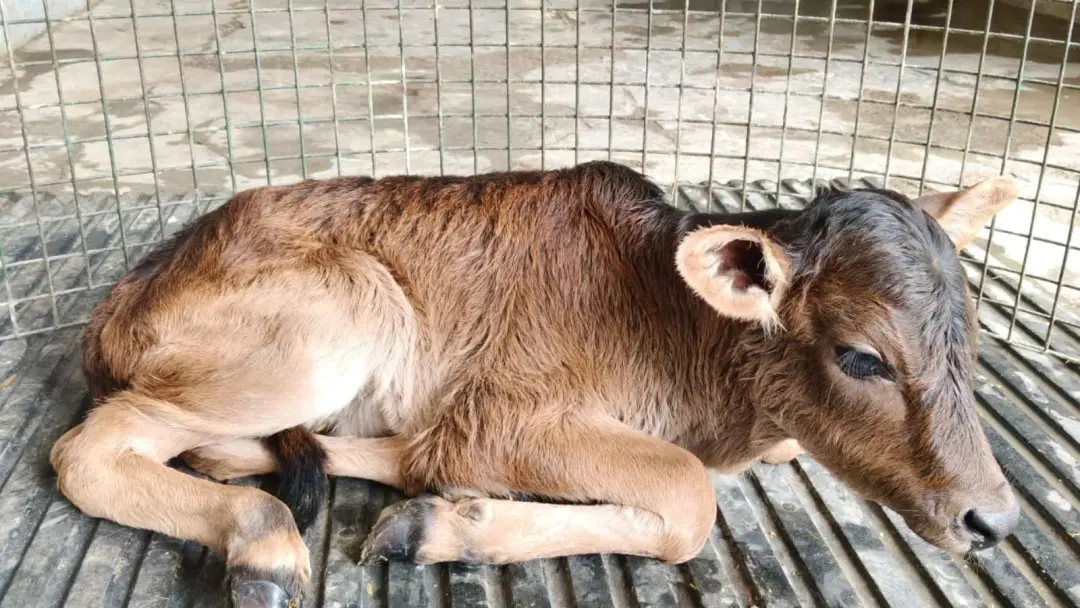
Badri calf born via IVF to Sahiwal cow in Uttarakhand
The Union Agriculture Ministry said on Saturday that a healthy Badri female calf was born on Friday through Ovum Pick-Up and In Vitro Fertilisation (OPU-IVF) technology, after a Badri embryo was transferred into a Sahiwal recipient cow. Badri is an indigenous cattle breed found in Uttarakhand. ICAR-NDRI Karnal and GB Pant University, Pantnagar collaborated, funded by the Uttarakhand Biotechnology Council. Another recipient cow is expected to deliver within 5-7 days.
Source
indianexpress.com · read the original report ↗
Desk check · compared with the source
What the desk checked (5)
- A healthy Badri female calf was born on Friday, September 11, through OPU-IVF technology after a Badri embryo was transferred into a Sahiwal recipient cow. — Attributed to a statement by the Union Ministry of Agriculture and Farmers' Welfare.
- The work was a collaboration between ICAR-NDRI Karnal and GB Pant University of Agriculture and Technology, Pantnagar, with funding from the Uttarakhand Biotechnology Council, Haldi. — Quoted directly from the ministry statement in the source.
- ICAR-NDRI earlier produced calves from Sahiwal and Gir breeds using the same technology. — Attributed to Dr Dheer Singh, Director, ICAR-NDRI, speaking to The Indian Express.
- Another synchronised crossbred recipient cow is expected to deliver a Badri calf within 5-7 days. — Ministry projection reported in the source; forward-looking and unverifiable at publication.
- The programme is exploring cloning of elite high-producing Badri cows and has generated cloned Badri embryos. — Source uses 'reportedly' for the cloning exploration; embryo claim attributed to the ministry statement.
Analysts’ view opinion
This OPU-IVF success is best read as a long-horizon investment in genetic conservation rather than an immediate economic payoff - the aim is safeguarding indigenous germplasm, not short-term output gains. Since it's funded through public research bodies and a state biotech council, costs sit with taxpayers for now, while benefits are projected to flow eventually to breed conservation and, potentially, farmers.
- The technology promises faster multiplication of genetically superior indigenous cattle compared to conventional breeding, which could speed up herd improvement.
- Funding currently comes from public institutions (ICAR-NDRI, a state university, and the Uttarakhand Biotechnology Council), making this a state-subsidised research effort rather than a market-driven one.
- Long-term conservation of hardy indigenous breeds like Badri could offer farmers economic resilience through better climate adaptation and milk traits, though this remains unproven at scale.
- The story gives no cost or scalability figures, so it's unclear how affordable or accessible this technology would be for ordinary farmers.
- A parallel cloning effort is being explored, which could further accelerate multiplication but also raises unanswered questions about future costs and regulatory pathways.
What to watch — Watch how quickly and cheaply this technology scales beyond research institutions to reach farmer-level breeding programmes, and how the cloning phase progresses.
The story does not establish the cost of the procedure, any commercialisation plan, or quantified economic benefits for farmers.
Deep dive
Research brief · 8 facts · 5 dates · exam-readyThe brief
Context
India's indigenous cattle breeds, though hardy and climate-resilient, often have small populations and low milk yields, making conservation and genetic improvement a policy priority. Badri is an indigenous cattle breed found in Uttarakhand. Scientists have now used Ovum Pick-Up and In Vitro Fertilisation (OPU-IVF) — where eggs are collected from elite donor cows, fertilised in the lab and the embryos transferred to surrogate ("recipient") cows — to produce a Badri calf from a Sahiwal recipient cow. The Union Agriculture Ministry announced the birth as a step towards technology-based conservation and multiplication of Badri germplasm.
Key facts
- A healthy Badri female calf was born on Friday, September 11, through OPU-IVF technology, the Union Ministry of Agriculture and Farmers' Welfare announced on Saturday.
- The Badri embryo was transferred into a Sahiwal recipient cow, which delivered the Badri female calf.
- Collaborators: ICAR-National Dairy Research Institute (ICAR-NDRI), Karnal, and GB Pant University of Agriculture and Technology, Pantnagar, Uttarakhand.
- Financial support came from the Uttarakhand Biotechnology Council, Haldi.
- The Badri research programme was initiated in 2023 under Dr M S Chauhan, then Vice-Chancellor of GB Pant University.
- Semen from a genetically superior Badri bull was obtained through the Uttarakhand Livestock Development Board; oocytes were collected by ultrasound-guided ovum pick-up.
- Another synchronised crossbred recipient cow is expected to deliver a Badri calf within the next 5-7 days.
- ICAR-NDRI had earlier used the same technology to produce calves of Sahiwal and Gir breeds, said Director Dr Dheer Singh.
Timeline
- 2023Research programme on Badri cattle initiated under the leadership of Dr M S Chauhan, then Vice-Chancellor, GB Pant University.
- September 11, 2026 (Friday)Healthy Badri female calf born to a Sahiwal recipient cow through OPU-IVF.
- September 12, 2026 (Saturday)Union Agriculture Ministry announces the birth in a statement.
- Within 5-7 days of the announcementAnother synchronised crossbred recipient cow expected to deliver a Badri calf.
- Next phase (planned)OPU-IVF- and cloning-derived Badri embryos to be transferred into Sahiwal, crossbred and Badri recipient cows.
Who has a stake
- Union Ministry of Agriculture and Farmers' Welfare — Announced the achievement; frames it as advancing conservation and genetic improvement of indigenous breeds.
- ICAR-NDRI, Karnal — Lead research institute; had earlier produced Sahiwal and Gir calves via the same technology.
- GB Pant University of Agriculture and Technology, Pantnagar — Collaborating institution where the Badri programme was initiated in 2023.
- Uttarakhand Biotechnology Council, Haldi — Funder of the OPU-IVF Badri programme.
- Uttarakhand Livestock Development Board — Supplied semen of a genetically superior Badri bull used for in vitro fertilisation.
- Uttarakhand's Badri cattle farmers — Stand to gain from faster multiplication of elite germplasm and breed improvement; not stated in the source how many are covered.
- Agrinnovate India (CEO Dr Praveen Malik) — Termed the birth an important milestone in conservation of indigenous breeds.
Why it matters
Indigenous breeds like Badri carry valuable germplasm but multiply slowly through conventional breeding; OPU-IVF allows multiple embryos from a single genetically superior female, sharply raising the rate of multiplication. The use of a Sahiwal cow as a recipient shows surrogate animals of other breeds can be used to expand a small indigenous population. The programme also signals a shift towards laboratory-based conservation, with cloned Badri embryos already generated and transfers planned in the next phase.
UPSC angle
Prelims pointers
- Badri is an indigenous cattle breed found in Uttarakhand; Sahiwal and Gir are other indigenous breeds named in the story.
- OPU-IVF = Ovum Pick-Up and In Vitro Fertilisation; oocytes collected via ultrasound-guided ovum pick-up.
- ICAR-National Dairy Research Institute (ICAR-NDRI) is located at Karnal, Haryana; its Director is Dr Dheer Singh.
- GB Pant University of Agriculture and Technology is at Pantnagar, Uttarakhand.
- Uttarakhand Biotechnology Council, Haldi, funded the Badri OPU-IVF programme; Uttarakhand Livestock Development Board supplied the bull semen.
- Agrinnovate India — its CEO is Dr Praveen Malik (as per the source).
Mains framing
The birth of a Badri calf through OPU-IVF in a Sahiwal recipient cow illustrates how advanced reproductive biotechnology can address a structural problem in Indian livestock development: indigenous breeds with valuable, climate-adapted germplasm exist in small numbers and multiply slowly under conventional breeding, where one elite cow yields few offspring in a lifetime. By harvesting oocytes from selected donor cows through ultrasound-guided ovum pick-up, fertilising them in vitro with semen of a genetically superior Badri bull sourced via the Uttarakhand Livestock Development Board, and transferring embryos into synchronised recipient cows of other breeds, the ICAR-NDRI–GB Pant University team has effectively decoupled the multiplication of elite germplasm from the reproductive limits of the donor. The implications extend to breed conservation, structured breed-improvement programmes and, potentially, higher productivity for hill farmers in Uttarakhand. The way forward, as indicated in the ministry's statement, lies in scaling up: transferring more OPU-IVF and cloning-derived embryos into Sahiwal, crossbred and Badri recipients, institutionalising donor selection and germplasm banks, and building the veterinary and laboratory capacity to take the technology from research stations to the field.
Key terms
- OPU-IVF
- Ovum Pick-Up and In Vitro Fertilisation: eggs are drawn from a live donor cow, fertilised in the lab, and the embryo transferred to a recipient cow.
- Badri cattle
- An indigenous cattle breed found in Uttarakhand, the focus of this conservation and genetic improvement programme.
- Germplasm
- The genetic material of a breed or population, preserved and multiplied for conservation and breeding purposes.
- Recipient (surrogate) cow
- A hormonally synchronised cow into which an embryo is transferred; here, a Sahiwal cow carried and delivered a Badri calf.
- ICAR-NDRI, Karnal
- Indian Council of Agricultural Research's National Dairy Research Institute at Karnal, which earlier produced Sahiwal and Gir calves via the same technology.
- Oocyte
- An immature egg cell collected from the donor cow's ovaries, matured and then fertilised in the laboratory.
Practice questions
- How can assisted reproductive technologies such as OPU-IVF and cloning contribute to the conservation and genetic improvement of India's indigenous cattle breeds? Discuss with reference to the Badri programme.
- Examine the role of central research institutes and state biotechnology bodies in livestock breed improvement, using the ICAR-NDRI–GB Pant University collaboration as a case study.
- 'Technology can multiply elite germplasm, but field adoption determines outcomes.' Critically evaluate this statement in the context of indigenous cattle development in India.
Grounded only in the source report — figures and dates are the source's, not inferred.