
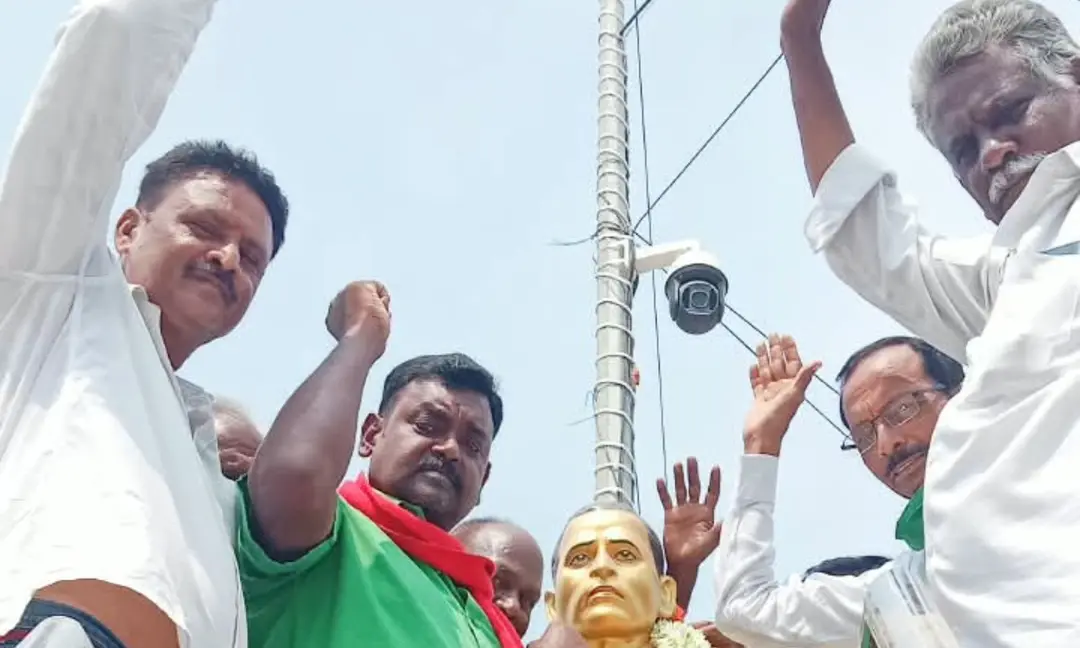
Rythu Seva Samithi pays tribute to Potti Sreeramulu at Mydukur
Rythu Seva Samithi leaders garlanded the statue of Potti Sreeramulu at Market Circle in Mydukur, Kadapa district, at 10 am on Andhra Pradesh Formation Day. District president AV Ramana said Andhra Pradesh was formed on October 1, 1953 with Kurnool as capital, with a High Court at Guntur, a steel plant at Visakhapatnam and a university at Rajamahendravaram under the Sribagh Pact. He alleged development was centralised in Hyderabad from 1956 and later in Amaravati's 29 villages, with Rayalaseema denied funds.
Source
Kadapa — స్థానికం · read the original report ↗
Desk check · some claims need care
What the desk checked (5)
- Rythu Seva Samithi leaders garlanded the Potti Sreeramulu statue at Market Circle, Mydukur, around 10 am on Andhra Pradesh Formation Day. — Attributed to Rythu Seva Samithi Kadapa district president AV Ramana; time and venue appear in source.
- Andhra Pradesh was formed on October 1, 1953 with Kurnool as capital under the Sribagh Pact, with a High Court at Guntur, steel plant at Visakhapatnam and university at Rajamahendravaram. — Figure/date appears in source as stated by the speaker; the source text is loosely worded and mixes the 1953 Andhra State formation with later developments — editor should check.
- Injustice to Rayalaseema resumed from 1956 as development was centralised in Hyderabad. — Speaker's assertion attributed to AV Ramana; no supporting data given.
- After Telangana's separation, development was again centralised under the name Amaravati for only 29 villages. — Unverified political claim attributed to AV Ramana; the 29-village figure has no independent sourcing in the text.
- Chief ministers from Rayalaseema discriminated in allocating funds for the region's irrigation projects and urban development. — Opinion attributed to the speaker; no names or figures provided.
Analysts’ view opinion
On the surface this is a floral tribute; politically it is an attempt to push Rayalaseema's sense of neglect back into public conversation. By combining three potent symbols — Formation Day, the Potti Sriramulu statue and the Sribagh pact — the Raithu Seva Samithi is giving its demand a historical and moral framing rather than a narrowly partisan one. The claim that funds were denied even while chief ministers came from Rayalaseema spreads the blame across the whole political class, which suggests the group is probing for an unfilled regional space.
- Using symbolic occasions and a statue site to build a regional movement is a familiar, low-cost mobilisation strategy for groups without electoral muscle.
- Invoking the Sribagh pact converts a funding grievance into a 'promises broken' argument that is harder for parties to dismiss.
- Stitching Hyderabad-era centralisation to the Amaravati debate reframes the capital question as one of regional inequality.
- The appeal to farmers, youth and students, anchored on irrigation projects and urban funds, points to a deliberate constituency-building plan.
- This was a small event led by mandal and constituency-level office bearers, so its weight for now lies in the message rather than in numbers.
What to watch — Watch whether similar observances spread to other Rayalaseema districts and whether local leaders of the major parties feel obliged to respond to the funding allegations.
The story records one organisation leader's allegations; it offers no supporting data on fund allocation and no response from the government or any party.
Deep dive
Research brief · 8 facts · 4 dates · exam-readyThe brief
Context
On Andhra Pradesh Formation Day, leaders of the Rythu Seva Samithi garlanded the statue of Amarajeevi Potti Sreeramulu at Market Circle in Mydukur town, Kadapa district. Potti Sreeramulu died during the struggle for a separate state for Telugu-speaking areas that were backward in development within the then Madras/Tamil Nadu region. Samithi district president AV Ramana used the occasion to recall the Sribagh Pact arrangement of decentralised institutions and to allege that Rayalaseema has been repeatedly denied its share, first through Hyderabad-centric development after 1956 and later through Amaravati.
Key facts
- Rythu Seva Samithi leaders garlanded Potti Sreeramulu's statue at Market Circle, Mydukur town, Kadapa district, at 10 am on Andhra Pradesh Formation Day.
- District president AV Ramana said Andhra Pradesh was formed on October 1, 1953 with Kurnool as the capital.
- As part of the Sribagh Pact arrangement, a High Court was set up at Guntur, a steel industry at Visakhapatnam and a university at Rajamahendravaram (Rajamundry).
- Ramana alleged injustice to Rayalaseema restarted from 1956, within three years of the state's formation, with development centralised in Hyderabad.
- He said after Telangana's separation, development was again centralised in the name of Amaravati for just 29 villages.
- He alleged chief ministers, including those from Rayalaseema, did injustice in allocating funds for completing Rayalaseema irrigation projects and for urban development.
- Ramana appealed to Rayalaseema farmers, youth and students to be ready for a Rayalaseema movement.
- Participants included Mydukur constituency honorary president and retired principal Moole Ramakrishna Reddy, mandal secretary Tiruvayipati Narasimhulu and town secretary Checkpost Srinivasulu.
Timeline
- October 1, 1953Andhra Pradesh formed with Kurnool as capital, with institutions distributed to Guntur, Visakhapatnam and Rajamahendravaram as per the speaker's account of the Sribagh Pact.
- 1956According to AV Ramana, injustice to Rayalaseema resumed as development was centralised in Hyderabad.
- After Telangana's separationDevelopment again centralised, this time in Amaravati's 29 villages, the speaker alleged.
- Andhra Pradesh Formation Day (day of the event), 10 amRythu Seva Samithi garlands Potti Sreeramulu's statue at Mydukur Market Circle.
Who has a stake
- Rythu Seva Samithi, Kadapa district — Organised the tribute and is pressing the demand for fair fund allocation to Rayalaseema.
- AV Ramana, Samithi district president — Lead voice alleging centralisation of development and calling for a Rayalaseema movement.
- Rayalaseema farmers, youth and students — Asked to mobilise; directly affected by incomplete irrigation projects and urban development funding.
- Successive Andhra Pradesh chief ministers — Accused of unfair fund allocation despite some of them being from Rayalaseema.
- Mydukur town and Kadapa district residents — Local urban development funds are among the grievances raised.
- Amaravati region (29 villages) — Cited as the current focus of centralised capital development.
Why it matters
The protest-tribute shows that regional imbalance within Andhra Pradesh remains a live political grievance decades after statehood, with Rayalaseema invoking the Sribagh Pact's decentralisation promise. Demands over irrigation project funding and capital-centric spending shape both state budget politics and the wider debate on single versus distributed capitals.
UPSC angle
Prelims pointers
- Potti Sreeramulu, called Amarajeevi, died during the agitation for a separate state for Telugu-speaking areas.
- AV Ramana said Andhra Pradesh was formed on October 1, 1953 with Kurnool as capital.
- Sribagh Pact arrangement cited: High Court at Guntur, steel plant at Visakhapatnam, university at Rajamahendravaram.
- Mydukur town, where the tribute was paid, is in Kadapa district of Rayalaseema.
- Speaker alleged Hyderabad-centric development from 1956 and Amaravati-centric development covering 29 villages.
Mains framing
The Mydukur tribute to Potti Sreeramulu frames a long-standing intra-state regional question: whether the decentralisation logic of the Sribagh Pact, which placed the capital at Kurnool, the High Court at Guntur, a steel industry at Visakhapatnam and a university at Rajamahendravaram, was abandoned in practice. The Samithi's case is that from 1956 development was concentrated in Hyderabad, and after Telangana's separation again concentrated in the 29 villages of Amaravati, leaving Rayalaseema's irrigation projects incomplete and its towns underfunded even under chief ministers from the region. The implications are political as well as developmental: perceived fiscal neglect fuels fresh regional mobilisation, as seen in the call to farmers, youth and students to prepare for a Rayalaseema movement. A grounded way forward, as implied by the speakers, lies in transparent and need-based allocation of funds for pending irrigation works and urban infrastructure in Rayalaseema, and in honouring the distributed-institutions principle rather than concentrating investment in a single capital region. The source does not state any government response or counter-data.
Key terms
- Potti Sreeramulu
- Leader honoured as Amarajeevi, who died in the struggle for development of backward Telugu-speaking areas separate from Madras/Tamil Nadu.
- Sribagh Pact
- Agreement cited as the basis for distributing institutions across regions: High Court at Guntur, steel plant at Visakhapatnam, university at Rajamahendravaram.
- Andhra Pradesh Formation Day
- Day marked by the Samithi; speaker dated the state's formation to October 1, 1953 with Kurnool as capital.
- Rythu Seva Samithi
- Farmers' organisation whose Kadapa district unit organised the tribute and raised Rayalaseema's fund grievances.
- Rayalaseema movement
- Agitation AV Ramana urged farmers, youth and students to prepare for, over alleged denial of funds to the region.
Practice questions
- Trace the role of Potti Sreeramulu's sacrifice in the formation of Andhra Pradesh and examine how far the Sribagh Pact's decentralisation principle has been honoured.
- Discuss how intra-state regional imbalance, as alleged in the case of Rayalaseema, affects fund allocation for irrigation and urban development.
- Does capital-centric development, whether at Hyderabad or Amaravati, strengthen or weaken balanced regional growth? Argue with reference to the grievances raised at Mydukur.
Grounded only in the source report — figures and dates are the source's, not inferred.