
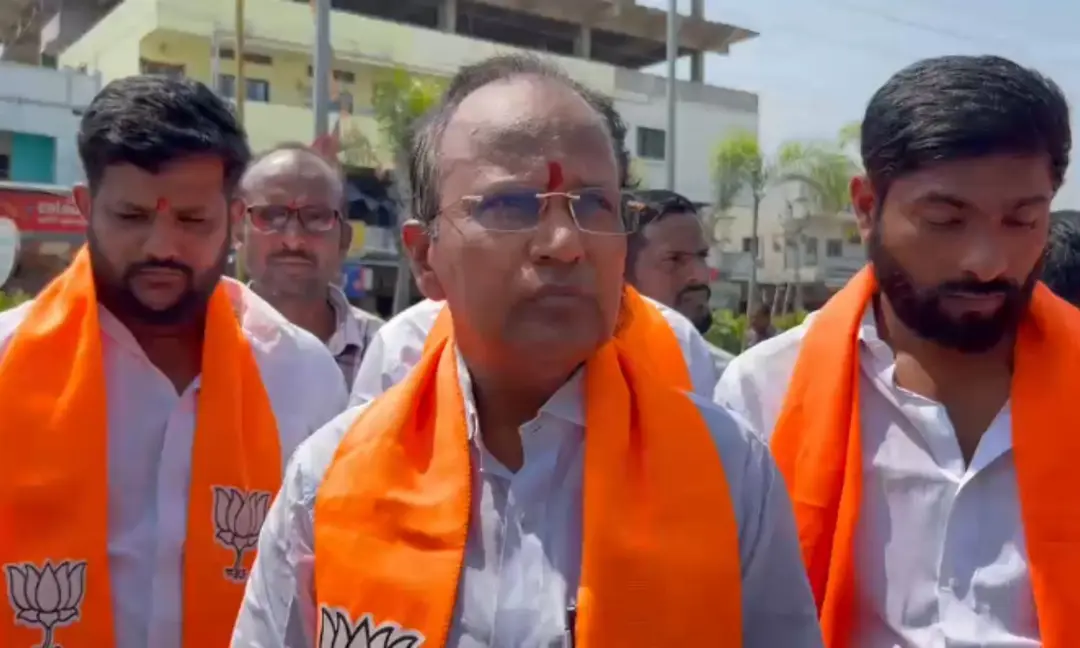
BJP holds rasta roko in Bhainsa over CM Revanth's remarks
BJP and BJYM leaders and workers staged a rasta roko at the main junction in Bhainsa town of Nirmal district, raising slogans against Chief Minister Revanth Reddy and the Congress government. They alleged the CM made improper remarks on Prime Minister Narendra Modi, saying in a national channel interview that Ram is the god of the rich and Shiva the god of the poor. Protesters burned his portraits and demanded a public apology and withdrawal of the remarks.
Source
Nirmal — వార్తలు · read the original report ↗
Desk check · some claims need care
What the desk checked (4)
- BJP and BJYM workers held a rasta roko at Bhainsa's main junction in Nirmal district. — Reported as fact in source; attributed to the event itself, no official or police source quoted.
- Protesters burned effigies/portraits of CM Revanth Reddy and demanded a public apology to PM Modi. — Stated in source as an account of the protest; no named individual attribution.
- CM Revanth Reddy said in a national channel interview that PM Modi says 'Jai Shri Ram' but not 'Har Har Mahadev' because Ram is the god of the rich and Shiva the god of the poor. — Attributed in the source only to BJP leaders' allegations at the protest, not to a verified recording or transcript.
- BJP town president, BJYM leaders and a large number of workers participated. — Figure is vague ('large number'); no names or counts given in source.
Analysts’ view opinion
Though this was a road blockade in a small town, its political purpose is clear — the BJP is using CM Revanth Reddy's remarks to pull the debate back onto its most familiar ground: Hindu religious sentiment. The choice of Bhainsa looks deliberate rather than accidental; agitations in a town known for communal sensitivity travel fast. For the Congress this is an awkward spot — defending the remarks risks unease among Hindu voters, while walking them back hands the BJP a visible win.
- The BJP is using the row to shift the conversation away from governance scrutiny of the state government and towards religious identity, terrain that usually favours it.
- By framing Revanth Reddy's words as a 'rich god–poor god' divide, the party converts what he presented as a socio-economic argument into an alleged religious insult.
- Fronting youth units such as the BJYM is a standard mobilisation tactic to energise cadre at the grassroots, especially with local-body politics in view.
- Burning portraits and demanding a public apology are protest formats designed less for an actual outcome than for images that carry in the news cycle.
- Equally, this remains a town-level agitation; whether it scales into a statewide campaign depends on how much the party leadership invests in it.
What to watch — Watch whether the BJP state leadership extends the protest to other districts, and whether Revanth Reddy or the Congress clarifies, counter-attacks, or simply lets it pass.
The story carries only the BJP leaders' allegations; it does not establish the full context of the CM's remarks, any response from him or the Congress, or the size of the protest.
Deep dive
Research brief · 8 facts · 2 dates · exam-readyThe brief
Context
BJP and its youth wing BJYM staged a road blockade (rasta roko) at the main junction of Bhainsa town in Telangana's Nirmal district to protest remarks attributed to Chief Minister A. Revanth Reddy. According to BJP leaders, in a recent national television interview the Chief Minister said Prime Minister Narendra Modi says "Jai Shri Ram" but not "Har Har Mahadev", because Ram is the god of the rich and Shiva the god of the poor. BJP leaders called this an improper comment on the Prime Minister and an insult to Hindu sentiments, saying gods cannot be divided into rich and poor categories. The protest involved slogans against the Chief Minister and the Congress government, burning of Revanth Reddy's portraits, and a demand for a public apology.
Key facts
- BJP and BJYM leaders and workers held a rasta roko at the main junction of Bhainsa town, Nirmal district, Telangana.
- Protesters sat on the road raising slogans against Chief Minister Revanth Reddy and the Congress government.
- BJP leaders alleged Revanth Reddy made improper remarks about Prime Minister Narendra Modi.
- The disputed remark cited: Modi says 'Jai Shri Ram' but not 'Har Har Mahadev' because Ram is the god of the rich and Shiva the god of the poor.
- BJP said the remark was made recently in an interview on a national channel.
- Protesters burned portraits of Revanth Reddy and demanded a public apology to PM Modi.
- BJP demanded that the Chief Minister immediately withdraw his remarks.
- BJP town president, BJYM leaders and a large number of workers took part in the agitation.
Timeline
- Recently (exact date not stated in the source)CM Revanth Reddy's remarks on Ram and Shiva reportedly made in an interview to a national channel.
- Subsequently (date not stated in the source)BJP and BJYM hold rasta roko at Bhainsa main junction, burn CM's portraits and demand a public apology and withdrawal of the remarks.
Who has a stake
- Chief Minister A. Revanth Reddy — Faces demands for a public apology and withdrawal of his reported remarks on Ram, Shiva and PM Modi.
- Congress government in Telangana — Target of slogans and protest; its handling of the religious-sentiment row is at stake politically.
- BJP and BJYM (Bharatiya Janata Yuva Morcha) — Mobilising on the issue of alleged insult to Hindu sentiments and to the Prime Minister.
- Prime Minister Narendra Modi — The remarks were directed at him, per BJP leaders' allegation.
- Residents and commuters of Bhainsa town — Affected by the road blockade at the main junction; Bhainsa is a communally sensitive town (sensitivity not elaborated in the source).
- Local police and district administration, Nirmal — Responsible for law and order during the rasta roko (action not stated in the source).
Why it matters
Statements touching on deities and religious identity can quickly escalate into street agitations, as this rasta roko shows, raising both law-and-order and free-speech questions. The episode illustrates how religious symbolism is being used in Telangana's Congress-BJP contest, with each side seeking to define who speaks for the faithful and for the poor.
UPSC angle
Prelims pointers
- Bhainsa is a town in Nirmal district of Telangana.
- BJYM stands for Bharatiya Janata Yuva Morcha, the BJP's youth wing.
- A. Revanth Reddy is the Chief Minister of Telangana, heading a Congress government.
- Rasta roko is a protest method involving blocking a road; it typically invites action under laws on obstruction of public ways.
- The protest demand was a public apology to PM Narendra Modi and withdrawal of the remarks.
Mains framing
The Bhainsa protest is a small but telling instance of how religious idiom has become central to competitive politics in Telangana. A Chief Minister's remark contrasting Ram as the god of the rich with Shiva as the god of the poor was read by the BJP as both an attack on the Prime Minister and an injury to Hindu sentiment, prompting a rasta roko, slogans and the burning of portraits. Causally, this reflects the overlap of two mobilisation strategies: an economic-populist framing of faith by the ruling party and a religious-sentiment framing by the opposition, each aimed at the same voter. The implications are twofold: public discourse shifts from governance to symbolism, and localities such as Bhainsa bear the law-and-order cost of road blockades and inflammatory demonstrations. The way forward lies in restraint in public speech by constitutional functionaries, protest within lawful limits that does not obstruct ordinary citizens, and institutional responses – police permissions, timely clarifications, and party-level discipline – rather than escalation. Further details on official action or the Chief Minister's response are not stated in the source.
Key terms
- Rasta roko
- A protest in which demonstrators block a road or junction to press their demands.
- BJYM
- Bharatiya Janata Yuva Morcha, the youth wing of the BJP, which joined the Bhainsa protest.
- Jai Shri Ram / Har Har Mahadev
- Devotional slogans invoking Ram and Shiva respectively, cited in the disputed remark attributed to the Chief Minister.
- Nirmal district
- District in Telangana where Bhainsa town, the site of the protest, is located.
- Hindu sentiments (manobhavalu)
- Religious feelings of the Hindu community, which BJP leaders alleged were hurt by the remarks.
Practice questions
- Comments by constitutional functionaries on religious matters often trigger street protests. Discuss the balance between free speech of elected leaders and the need to avoid hurting religious sentiments.
- Examine how religious symbolism is shaping political competition in southern Indian states, with reference to recent Congress-BJP exchanges in Telangana.
- Protest methods such as rasta roko affect ordinary citizens' right to movement. Critically evaluate how the state should regulate such agitations without curbing democratic dissent.
Grounded only in the source report — figures and dates are the source's, not inferred.