
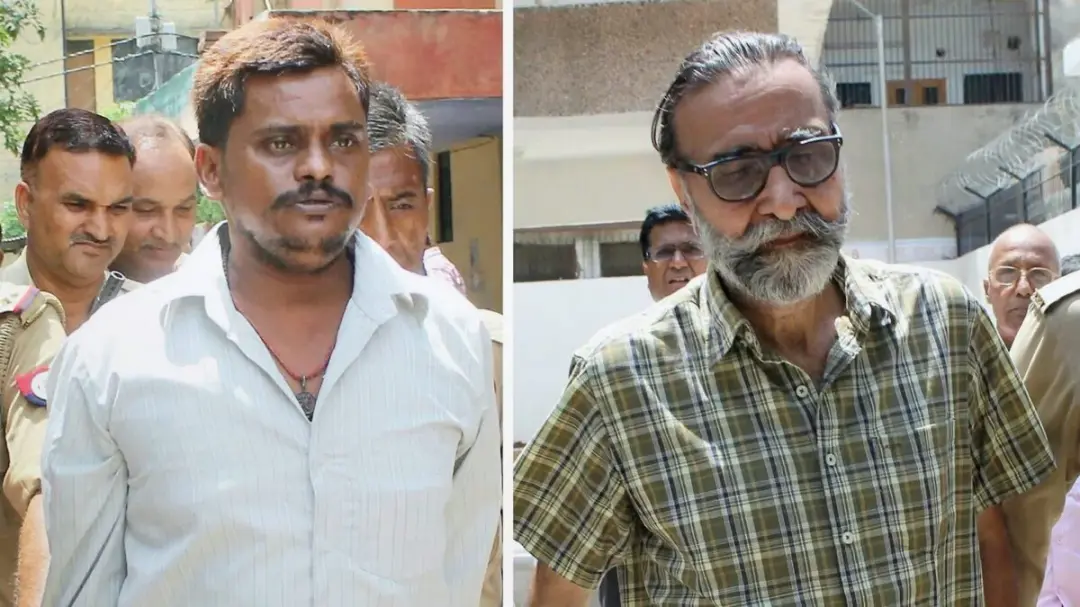
Surendra Koli, acquitted in Nithari case, found dead in Haridwar
Surendra Koli, the main accused in the 2006 Nithari 'House of Horrors' case, was found dead at his tea shop in Haridwar, having hanged himself, according to initial information. At least 19 women and children vanished from Nithari village in Noida between 2005 and 2006. Lower courts sentenced Koli to death 13 times. The Allahabad High Court acquitted him in 12 cases in October 2023 and the Supreme Court cleared him in the final case in November 2025, criticising a botched investigation.
Source
News18 — India · read the original report ↗
Desk check · some claims need care
What the desk checked (5)
- Surendra Koli was found dead at his tea shop in Haridwar, having hanged himself. — Reported in source, partly flagged as 'initial information'; no police official named.
- Koli was sentenced to death 13 times by special CBI courts between 2009 and 2022. — Figure appears in source, attributed to case record; not independently verified here.
- The Allahabad High Court acquitted Koli in 12 cases in October 2023, citing a 'botched-up' investigation. — Attributed to the High Court with quoted wording in the source.
- The Supreme Court cleared Koli in the final case in November 2025, ruling his confession was extracted under illegal police torture. — Attributed to the Supreme Court in the source; date sits oddly against the September 2026 timeline entry.
- At least 19 women and children vanished from Nithari village between 2005 and 2006 and 19 skeletal remains were unearthed. — Figures appear consistently in source narrative; source also cites 16 to 19 CBI cases.
Analysts’ view opinion
Koli's death closes a case that had already become less a story about a killer than a story about how a prosecution can collapse under its own procedural defects. The courts did not merely find the evidence thin; the Allahabad High Court in 2023 and the Supreme Court in November 2025 held that the central plank — a video confession — was tainted by illegal detention and torture, and that recoveries flowing from it were legally unreliable. That reasoning tracks settled Indian criminal law, where confessions to police carry little evidentiary weight and the burden of proof beyond reasonable doubt never shifts to the accused. What remains legally unresolved is the harder question the acquittals raise: 19 sets of remains were recovered, and no one now stands convicted for them.
- The acquittals rest on admissibility and investigative failure rather than on any positive finding about who was responsible, which is a legally distinct and much narrower conclusion than innocence-as-fact.
- A confession retracted as coerced, obtained during prolonged detention without counsel, sits squarely against constitutional protections against self-incrimination and the right to legal representation — precisely why the courts refused to build convictions on it.
- The Supreme Court's route through a curative petition is exceptional in Indian practice and signals how gravely it viewed the risk of an irreversible miscarriage of justice in a death-penalty matter.
- Thirteen death sentences later overturned is itself a data point in the long-running debate over capital punishment and the reliability of confession-driven prosecutions in high-outrage cases.
- The story records judicial criticism that police ignored complaints and alternative lines of inquiry, raising unanswered questions of accountability for the investigating agencies and of remedy for the victims' families, whose cases now have no convicted perpetrator.
What to watch — Watch whether any authority revisits the 19 unsolved deaths or acts on the courts' criticism of the investigation, and whether Koli's death — reportedly by suicide, per initial information — prompts scrutiny of post-acquittal rehabilitation and compensation for those wrongly incarcerated for long periods.
The story does not establish who was responsible for the Nithari deaths, and the circumstances of Koli's death are described only as preliminary information, not as an established or officially confirmed finding.
Deep dive
Research brief · 8 facts · 9 dates · exam-readyThe brief
Context
The 2006 Nithari "House of Horrors" case erupted after human remains were found in drains behind bungalow D-5 in Sector 31, Noida, owned by businessman Moninder Singh Pandher. At least 19 women and children had vanished from the adjacent Nithari slum between 2005 and 2006, with local police largely ignoring parents' complaints. Pandher's domestic help Surendra Koli was projected as the prime accused and sentenced to death 13 times, but higher courts acquitted both men, faulting a "botched-up" investigation and a confession allegedly extracted under torture. Koli, freed after nearly 20 years in jail, was found dead at his tea shop in Haridwar, having hanged himself, according to initial information.
Key facts
- At least 19 young women and children vanished from Nithari village, Noida, between 2005 and 2006; police largely ignored repeated complaints by poor parents.
- In December 2006 two residents found a decomposing human hand in a drain behind Pandher's bungalow; excavations unearthed 19 skeletal remains, skulls and clothing in plastic bags.
- Koli was sentenced to death 13 times by special CBI trial courts between 2009 and 2022 for separate victim cases.
- The Allahabad High Court in October 2023 acquitted Koli in 12 cases together, cancelling those death sentences for lack of reliable evidence.
- The High Court said authorities took the "easy course of implicating a poor servant by demonizing him" to protect a potential organised organ-trading ring.
- The Supreme Court in November 2025 allowed Koli's curative petition in the final (Rimpa Haldar) case, holding convictions rested on "conjecture" and inadmissible evidence.
- Koli's video-recorded confession was retracted; he said it was extracted under severe torture during an illegal 60-day police detention without legal representation.
- The CBI took over the probe in January 2007, registering 16 to 19 distinct cases after negligent local police officers were suspended.
Timeline
- 2005-2006Dozens of children and young adults vanish from Nithari slum; police refuse to register missing person reports, telling some parents their children eloped.
- December 2006Human remains found in drains behind bungalow D-5; 19 skeletal remains unearthed; Moninder Singh Pandher and Surendra Koli arrested.
- January 2007Amid outrage and suspension of local police officers, the CBI takes over the probe, registering 16 to 19 distinct cases.
- 2009A special CBI court hands out the first death sentences to both Koli and Pandher; further trials follow with more death sentences and life terms.
- September 2014 - January 2015Supreme Court commutes one of Koli's death sentences to life imprisonment over delays in processing his mercy petition/death warrant.
- December 2017Special CBI court again sentences both Pandher and Koli to death in the Pinky Sarkar murder trial.
- October 2023Allahabad High Court acquits both Pandher and Koli in the majority of cases (12 for Koli), citing lack of evidence; Pandher released.
- November 2025Supreme Court clears Koli in his last remaining conviction, ruling the confession was extracted under illegal torture and evidence recovery unreliable; he walks free after nearly 20 years.
- September 2026Koli, who had opened a tea shop in Haridwar, is found dead inside the shop, having hanged himself (story first published September 18, 2026).
Who has a stake
- Surendra Koli — Former domestic worker sentenced to death 13 times, acquitted of all charges after nearly 20 years in jail; found dead by suicide in Haridwar.
- Moninder Singh Pandher — Businessman owner of bungalow D-5; convicted and sentenced to death in some cases, acquitted by the Allahabad High Court in October 2023 and released.
- Families of the 19 missing women and children — Poor Nithari residents whose complaints were dismissed; left without any convicted perpetrator after the acquittals.
- Noida police — Faulted for extreme negligence, refusal to register missing reports and a coerced confession; negligent officers were suspended in January 2007.
- Central Bureau of Investigation — Took over the probe in 2007 and secured convictions later dismantled by higher courts as based on conjecture and inadmissible evidence.
- Judiciary (Allahabad High Court and Supreme Court) — Reviewed and overturned 13 death-sentence convictions, exposing systemic failures in investigation and evidence collection.
Why it matters
The Nithari case moved from being India's most notorious serial-killing saga to a case study in wrongful prosecution: two courts found that the entire case against Koli rested on a confession obtained during an illegal 60-day detention. That a man survived 13 death sentences before full acquittal raises hard questions about custodial torture, class bias in policing and the reliability of capital convictions. His death months after release also leaves the disappearance of 19 women and children legally unsolved.
UPSC angle
Prelims pointers
- Nithari case relates to bungalow D-5, Sector 31, Noida, Uttar Pradesh, owned by Moninder Singh Pandher.
- At least 19 women and children vanished from Nithari village between 2005 and 2006; remains found December 2006.
- CBI took over the investigation in January 2007, registering 16 to 19 distinct cases.
- Allahabad High Court acquitted Koli and Pandher in October 2023, calling the probe "botched-up".
- Supreme Court allowed Koli's curative petition in November 2025, acquitting him in the Rimpa Haldar case.
- One of Koli's death sentences was commuted to life imprisonment due to delay in deciding his mercy petition (2014-15).
Mains framing
The Nithari case illustrates how investigative shortcuts can produce both wrongful convictions and unresolved crimes. Its origins lie in police refusal to register missing-person complaints from a poor slum, a class bias the Allahabad High Court captured when it said authorities chose the \"easy course of implicating a poor servant by demonizing him\" while ignoring leads such as an alleged organ-trading ring linked to local clinics. The centrepiece of the prosecution, a video-recorded confession, was obtained during an illegal 60-day detention without legal representation and later retracted; the Supreme Court found the convictions rested on \"conjecture\" and inadmissible evidence, holding it would be a \"travesty of justice\" to sustain the last conviction on the same tainted material. The implications are threefold: the irreversibility risk in capital punishment, since 13 death sentences were pronounced on evidence later held unreliable; the absence of accountability for investigators and of any remedy for exonerees who lose two decades of life; and the fact that 19 victims' families remain without answers. A way forward, grounded in the case's own findings, lies in mandatory registration and prompt investigation of disappearance complaints, safeguards against custodial coercion and legal representation in detention, independent scrutiny of confession-based cases, and rehabilitation and reintegration support for those acquitted after long incarceration.
Key terms
- Nithari 'House of Horrors' case
- The 2006 case of at least 19 women and children who vanished from Nithari, Noida, whose remains were found behind bungalow D-5.
- Curative petition
- The last judicial remedy in the Supreme Court after review; Koli's curative petition was allowed in November 2025, acquitting him.
- Coerced confession
- A confession extracted through torture or pressure; Koli's video confession was held to have been taken during illegal 60-day detention.
- Special CBI court
- Designated trial court hearing CBI cases; it sentenced Koli to death 13 times between 2009 and 2022.
- Commutation of death sentence
- Reduction of a death sentence to life imprisonment; granted to Koli in one case due to delay in processing his mercy petition.
- Necrophilia and cannibalism allegations
- Charges alleged by the prosecution against Koli, which the higher courts found unsupported by reliable evidence.
Practice questions
- The Nithari case shows that investigative failure can cause both wrongful conviction and unpunished crime. Discuss with reference to safeguards against custodial coercion in India.
- Critically examine the implications of the Nithari acquittals for the debate on capital punishment in India.
- How does class bias in policing affect access to justice for the poor? Illustrate using the handling of missing-person complaints in the Nithari case.
Grounded only in the source report — figures and dates are the source's, not inferred.