
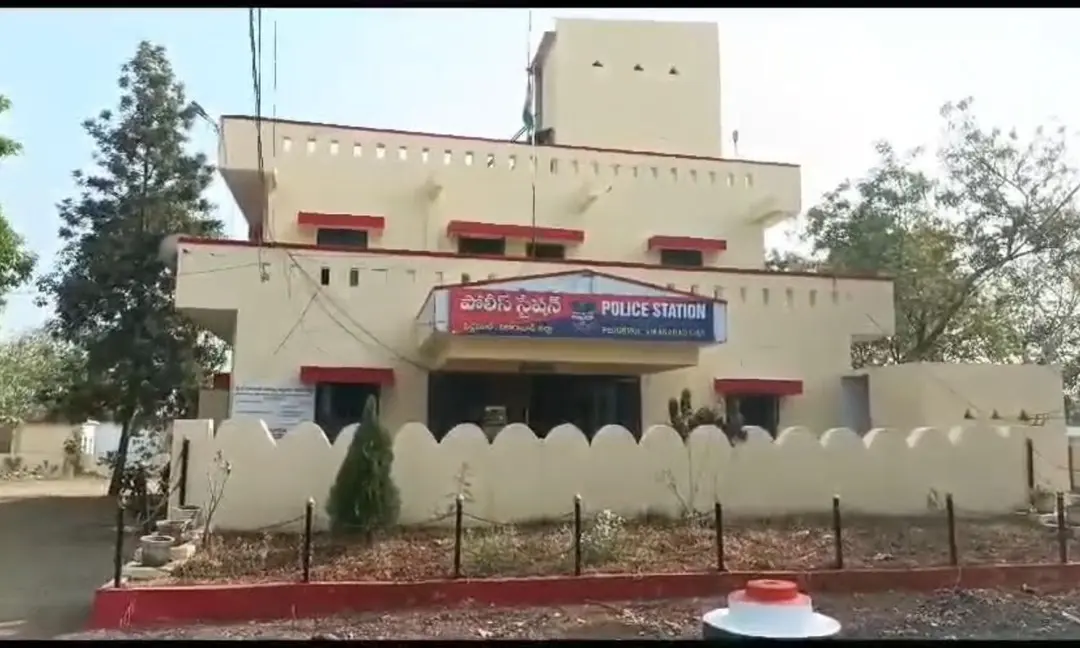
Son kills father with axe in Vikarabad district village
A man hacked his father to death with an axe at Baimidi Thanda in Peddemul mandal of Vikarabad district. According to Tandur Rural CI Praveen Kumar Reddy, Rathod Lokya Naik, an alcoholic, frequently harassed his wife Bikki Bai and daughter. After an attack on Friday, the mother informed her son Sunil Naik, an auto driver in Hyderabad, who reached the village and confronted his father. In the quarrel he struck Lokya Naik on the neck and head, killing him. The accused was arrested and remanded on Saturday.
Source
Tandur — crime & civic · read the original report ↗
Desk check · compared with the source
What the desk checked (5)
- Rathod Sunil Naik killed his father Rathod Lokya Naik with an axe at Baimidi Thanda, Peddemul mandal — Attributed to Tandur Rural CI Praveen Kumar Reddy in the source
- Lokya Naik was addicted to alcohol and often harassed his wife Bikki Bai and younger daughter — Attributed to the police account; no independent corroboration in source
- The mother informed her son, an auto driver in Hyderabad, who then came to the village — Appears in source as part of the police narrative
- The body was sent to the district government hospital in Tandur for post-mortem — Figure/detail appears in source, attributed to police
- The accused was produced in court on Saturday and remanded — Stated by the CI in the source
Analysts’ view opinion
On the police account as reported, this is a homicide case in which the central legal battleground will not be whether the killing happened but how it is characterised in law. The story describes a son confronting his father after an alleged assault on his mother and sister, a quarrel, and then fatal axe blows — a fact pattern that typically triggers argument over intention, sudden provocation and the absence of premeditation. Equally, the use of a weapon lying in the house and injuries to the neck and back of the head are the kind of details prosecutors commonly rely on to press the gravest charge. The remand order tells us only that the court was satisfied for custody purposes; it is not any finding of guilt.
- The decisive legal question is grading of the offence — culpable homicide amounting to murder versus a lesser category where death results from a sudden fight or grave and sudden provocation without premeditation.
- Defence arguments would likely build on the reported sequence: the accused travelled from Hyderabad only after his mother's call, confronted his father verbally, and the weapon was already in the house rather than brought along.
- Prosecution arguments would likely stress the nature and location of the injuries and the choice to strike with an axe, which courts treat as relevant to intention or knowledge.
- The alleged history of harassment of the wife and daughter is legally relevant as background and motive, and any earlier complaints or their absence will matter, but under Indian law private retribution is not a defence to homicide.
- Procedurally the case is at its earliest stage — arrest, registration of the case, production before a magistrate and remand — with the postmortem report, weapon recovery, inquest and the mother's and sister's statements forming the core of the investigation.
What to watch — Watch for the sections invoked in the final police report, the postmortem findings, and whether the accused seeks bail — and how the family members, as both witnesses and alleged victims of the deceased's conduct, testify.
Everything here rests on one police officer's account at the outset of an investigation; no court has tested the evidence, the accused's own version is not on record, and the story does not establish the precise charges, any prior complaints, or the forensic findings.
Deep dive
Research brief · 8 facts · 4 dates · exam-readyThe brief
Context
A patricide in a tribal hamlet (thanda) in Telangana's Vikarabad district has drawn attention to alcohol-driven domestic violence in rural households. Rathod Lokya Naik of Baimidi Thanda in Peddemul mandal, described by police as an alcoholic, allegedly harassed and beat his wife Bikki Bai and their younger daughter repeatedly. After an attack on Friday, the couple's son Sunil Naik, who drives an auto-rickshaw in Hyderabad, returned to the village, confronted his father and hacked him to death with an axe kept in the house. Police arrested him and he was remanded by a court on Saturday.
Key facts
- The killing occurred at Baimidi Thanda in Peddemul mandal of Vikarabad district, Telangana.
- Victim: Rathod Lokya Naik; his wife is Bikki Bai; the couple has three children, as stated by police.
- Police say Lokya Naik was addicted to alcohol and frequently harassed his wife and the younger daughter living at home.
- On Friday, Lokya Naik attacked his wife and daughter indiscriminately, prompting Bikki Bai to call her son in Hyderabad.
- Son Rathod Sunil Naik, an auto-rickshaw driver in Hyderabad, travelled to his native village and questioned his father.
- During the quarrel, Sunil Naik struck his father on the neck and back of the head with an axe from the house; the victim died on the spot.
- Tandur Rural CI Praveen Kumar Reddy and Peddemul SI Prashanth Vardhan visited and inspected the scene.
- The body was sent for post-mortem to the district government hospital in Tandur; the accused was produced in court and remanded on Saturday.
Timeline
- Before the incident (period not stated in the source)Lokya Naik, described as an alcoholic, repeatedly harasses his wife Bikki Bai and younger daughter.
- FridayLokya Naik attacks his wife and daughter; Bikki Bai informs son Sunil Naik in Hyderabad, who reaches the village and confronts his father, then kills him with an axe.
- Friday, after the killingTandur Rural CI and Peddemul SI inspect the scene; police take Sunil Naik into custody; body sent to Tandur district government hospital for post-mortem.
- SaturdayA case is registered and the accused is produced in court and remanded.
Who has a stake
- Rathod Sunil Naik (accused son, auto driver in Hyderabad) — Faces a murder case; arrested and remanded to judicial custody.
- Bikki Bai and the younger daughter — Long-term victims of alleged domestic harassment; now lose the head of the family and face the son's prosecution.
- Rathod Lokya Naik (deceased) — Lost his life in the attack; body sent for post-mortem.
- Vikarabad district police (Tandur Rural CI Praveen Kumar Reddy, Peddemul SI Prashanth Vardhan) — Responsible for scene inspection, case registration, investigation and producing the accused in court.
- Baimidi Thanda residents — The hamlet is shaken by the killing; the case highlights alcohol abuse and domestic violence in the community.
- Tandur district government hospital — Conducted the post-mortem central to the forensic evidence in the case.
Why it matters
The case shows how untreated alcohol addiction and sustained domestic violence inside a home can escalate into a fatal crime, turning victims' families into accused. It also underlines the gap in protective mechanisms for women in remote tribal hamlets, where abuse is often reported only after it turns violent, and the reliance on distant family members rather than police or support services.
UPSC angle
Prelims pointers
- Incident location: Baimidi Thanda, Peddemul mandal, Vikarabad district, Telangana.
- Police officials named in the case: Tandur Rural CI Praveen Kumar Reddy and Peddemul SI Prashanth Vardhan.
- Victim Rathod Lokya Naik and wife Bikki Bai had three children, per police.
- Post-mortem was conducted at the district government hospital, Tandur.
- Accused Rathod Sunil Naik, an auto driver in Hyderabad, was produced in court and remanded on Saturday.
- 'Thanda' refers to a tribal hamlet, typically of Lambada/Banjara communities in Telangana.
Mains framing
This single incident in Vikarabad district illustrates the intersection of alcohol dependence, domestic violence and distress migration in rural India. As per police, the deceased was an alcoholic who repeatedly assaulted his wife and minor-aged daughter at home; the abuse was not resolved through any institutional route but through a phone call to a son working as an auto driver in Hyderabad, whose confrontation ended in a fatal axe attack. Causes visible in the source include habitual alcohol abuse, the normalisation of intra-family violence, the absence of timely intervention, and the physical absence of earning family members who migrate to cities for work. The implications are twofold: the family loses both a member and a breadwinner, and the surviving victims now confront a criminal trial. A grounded way forward lies in earlier reporting and protection of women facing domestic abuse, community-level de-addiction and counselling outreach in thandas, and responsive village-level policing so that harassment complaints are addressed before they escalate into homicide. The source does not detail any scheme or policy response, so remedies must be argued at the level of general principles rather than specific programmes.
Key terms
- Thanda
- A tribal hamlet in Telangana, commonly inhabited by Lambada/Banjara communities; here, Baimidi Thanda.
- Mandal
- An administrative sub-district unit in Telangana; the incident falls in Peddemul mandal.
- CI (Circle Inspector)
- Police officer heading a circle of police stations; Tandur Rural CI Praveen Kumar Reddy briefed the media here.
- SI (Sub-Inspector)
- Officer in charge of a police station; Peddemul SI Prashanth Vardhan inspected the scene.
- Remand
- Judicial custody ordered by a court after the accused is produced before it; ordered on Saturday in this case.
- Post-mortem
- Medico-legal autopsy to establish cause of death; conducted at Tandur district government hospital.
Practice questions
- Alcohol abuse is often a trigger for domestic violence in rural India. Examine the institutional mechanisms available to protect women and children in such households, using this case as an illustration.
- Discuss how distress migration of young earning members weakens family-level protection against domestic abuse in villages and tribal hamlets.
- What procedural steps did the police follow in this case from scene inspection to remand, and why is each step significant to a criminal trial?
Grounded only in the source report — figures and dates are the source's, not inferred.