
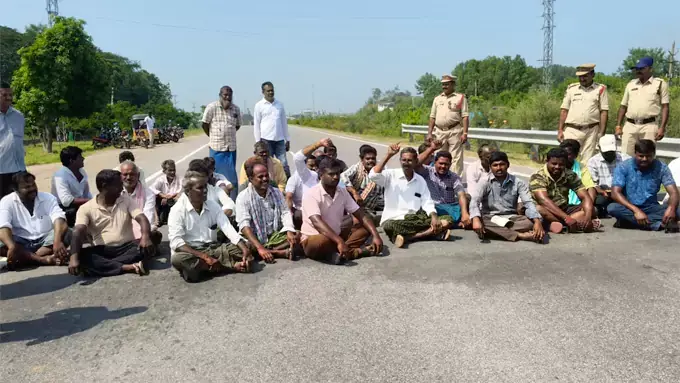
Farmers stage dharna on Khammam-Kodad national highway
Farmers staged a dharna on the Khammam-Kodad national highway near Shantinagar in Ananthagiri mandal, demanding the immediate release of water to the Kothagudem major canal. They said crops were drying up because canal water had not reached their fields and because of power cuts, and that they were facing severe difficulties. Police reached the spot and persuaded the farmers, who then called off the protest.
Source
Kodad — స్థానికం · read the original report ↗
Desk check · compared with the source
What the desk checked (4)
- Farmers staged a dharna on the Khammam-Kodad national highway near Shantinagar in Ananthagiri mandal — Reported directly by the publisher's district team; no independent attribution given in the source.
- Farmers demanded immediate release of water to the Kothagudem major canal — Attributed to the protesting farmers in the source.
- Crops are drying up due to power cuts and lack of canal water — Farmers' claim as stated in the source; no official or departmental confirmation provided.
- Police reached the spot and persuaded the farmers, who then called off the protest — Stated in the source without naming any police official.
Analysts’ view opinion
This looks like a small local protest, but the economics underneath it are straightforward: when canal water and power fail at a critical crop stage, the farmer's entire season's investment is at risk. Seed, fertiliser and land-preparation costs are already sunk, and a withered crop does not return them — which is why blocking a national highway, the cheapest way to force official attention, becomes the rational option. The story says the protest was called off after police persuasion, but it does not record any commitment on water release, meaning the underlying economic problem remains unresolved.
- Interrupted irrigation and power hits farmers as a sunk-cost loss: the spending is already done, and a dried-up crop cannot recover it.
- When canal supply is delayed, especially in tail-end command areas, farmers fall back on borewells or diesel pumps — and power cuts make that fallback costlier still.
- The loss does not stop at the farm household: farm labour workdays, local trade and loan-repayment capacity all weaken alongside it.
- A highway sit-in imposes a temporary cost on freight and passenger movement, effectively transferring one sector's distress onto others.
- Calling off the agitation is not the same as fixing it; without a clear water-release and power-supply schedule, repeat protests are a realistic possibility.
What to watch — Watch whether a formal water-release order for the Kothagudem major or clarity on agricultural feeder supply hours follows — or whether the same stretch sees fresh agitation.
The story does not establish how many acres or which crops are affected, the scale of the loss, why the canal is dry, or what assurance, if any, officials gave.
Deep dive
Research brief · 8 facts · 3 dates · exam-readyThe brief
Context
Farmers in Ananthagiri mandal of the Kodad area (Suryapet district region, Telangana) depend on canal supplies from the Kothagudem major canal for their standing crops. On 9 September 2026, a group of them blocked the Khammam-Kodad national highway near Shantinagar, saying canal water had not reached their fields and power cuts were compounding the problem. The protest was a demand for immediate release of water into the Kothagudem major canal. Police reached the spot and persuaded the protesters, who then withdrew the agitation.
Key facts
- Farmers staged a dharna on the Khammam-Kodad national highway near Shantinagar in Ananthagiri mandal, as reported on 9 September 2026 (published 10:46 IST).
- Their central demand was the immediate release of water to the Kothagudem major canal.
- Farmers said their crops were drying up because of power cuts.
- They said water was not flowing in the canal and that, along with power cuts, this was causing them severe difficulties.
- Police reached the protest site and persuaded the farmers, after which the agitation was called off.
- The report is filed from Kodad Rural and carried under Nalgonda news by the Telangana District Team.
- No arrests, injuries, official assurance or traffic-diversion details are stated in the source.
- Separately in the same district cluster, a review on 24 May 2025 had promised completion of the Rs 100 crore Ayitipamula lift irrigation scheme by December 2025.
Timeline
- 24 May 2025At a review on the Ayitipamula lift irrigation scheme, state major irrigation minister Uttam Kumar Reddy said the Rs 100 crore works would be completed by December 2025 to serve thousands of acres in two constituencies (from a related report).
- 9 September 2026Farmers block the Khammam-Kodad national highway near Shantinagar, Ananthagiri mandal, demanding immediate water release to the Kothagudem major canal.
- 9 September 2026 (same day)Police reach the spot, persuade the farmers, and the dharna is called off.
Who has a stake
- Farmers of Ananthagiri mandal / Shantinagar area — Standing crops drying up for want of canal water and reliable power; livelihood and season's investment at risk.
- Irrigation authorities managing the Kothagudem major canal — Responsible for releasing and scheduling water to the canal's command area.
- Electricity utility / power supply authorities — Power cuts blamed by farmers for pump sets failing to save crops.
- Police — Maintaining order and clearing a national highway; they persuaded farmers to end the blockade.
- Road users on the Khammam-Kodad national highway — Traffic movement disrupted while the dharna continued.
Why it matters
Highway dharnas over canal releases show how thin the margin is between a standing crop and a failed one when irrigation schedules and power supply slip even briefly. For tail-end farmers in canal commands, the last mile of water delivery, not the size of the project, decides the season's outcome. The episode also illustrates how local agrarian distress gets expressed through road blockades, forcing an immediate administrative or police response rather than a systemic fix.
UPSC angle
Prelims pointers
- Kothagudem major canal: the distribution channel whose water release was demanded by farmers at Shantinagar, Ananthagiri mandal.
- The dharna was held on the Khammam-Kodad national highway; reported 9 September 2026.
- Ananthagiri mandal and Kodad fall in the erstwhile Nalgonda district region of Telangana.
- Farmers cited two causes of crop damage: no canal water and power cuts.
- Related report: Ayitipamula lift irrigation scheme costing Rs 100 crore, reviewed by irrigation minister Uttam Kumar Reddy on 24 May 2025.
- Related report: state agriculture minister named in the source is Tummala Nageswara Rao.
Mains framing
The Shantinagar dharna is a small but representative case of irrigation-delivery failure in India's canal commands: the grievance is not the absence of a project but the non-arrival of water at the field in the window when the crop needs it, aggravated by unreliable power for pump-based supplementary irrigation. Causes visible in the source are delayed or inadequate release into the Kothagudem major canal and power cuts; the implication is direct crop loss and the resort to highway blockades as the only quick lever farmers hold, with police persuasion ending the protest without any stated assurance on water. A credible way forward, consistent only with what the source supports, lies in transparent and publicised canal release schedules (warabandi-type rotation) communicated to farmers in advance, coordination between the irrigation and power utilities so that release schedules and farm-feeder supply hours align, timely completion of pending lift irrigation works such as the Rs 100 crore Ayitipamula scheme that was to be finished by December 2025, and a local grievance-redress channel so that distress is registered before it reaches the national highway.
Key terms
- Dharna
- A sit-in protest; here farmers occupied a national highway to press for canal water release.
- Major canal
- A main distribution canal of an irrigation project that feeds smaller distributaries and field channels, such as the Kothagudem major canal.
- Mandal
- A sub-district administrative unit in Telangana; the protest site Shantinagar lies in Ananthagiri mandal.
- Ayakattu (command area)
- The cultivable area designed to receive water from a canal or lift scheme; the Ayitipamula scheme was meant to serve thousands of acres.
- Lift irrigation scheme
- A project that pumps water to higher land where gravity flow cannot reach, e.g. the Rs 100 crore Ayitipamula scheme.
Practice questions
- Why do tail-end farmers in canal command areas repeatedly resort to road blockades, and what institutional mechanisms could resolve water-release grievances earlier?
- Examine the linkage between assured power supply to agriculture and effective irrigation delivery, using the Khammam-Kodad highway protest as an illustration.
- Delays in completing lift irrigation schemes shift the burden onto existing canals. Discuss with reference to the Kothagudem major canal and the Ayitipamula lift irrigation scheme.
Grounded only in the source report — figures and dates are the source's, not inferred.