
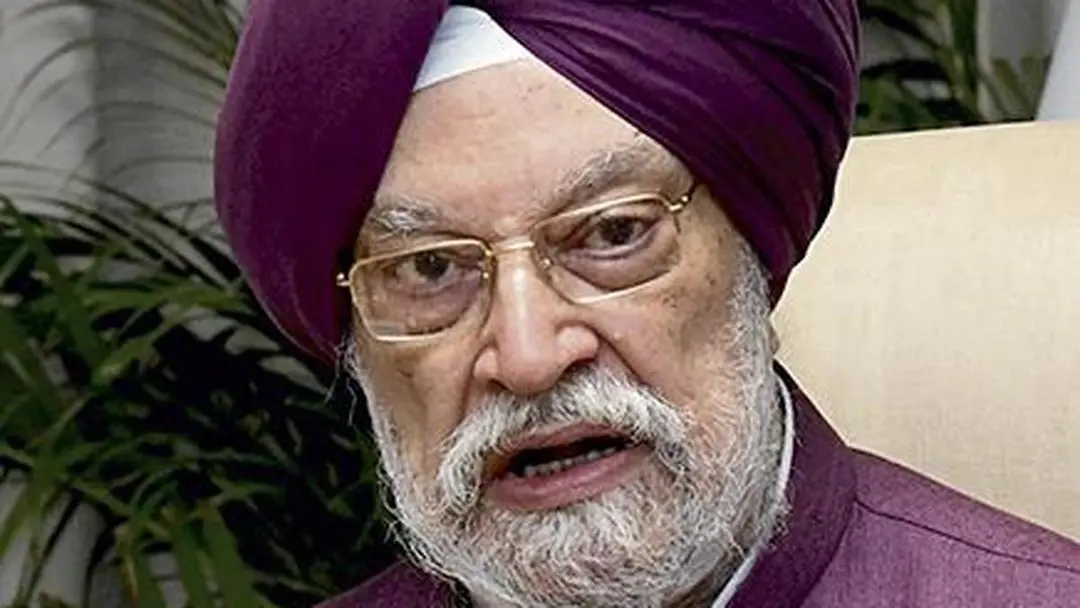
West Asia crisis not over, could worsen, says Hardeep Puri
Union Petroleum and Natural Gas Minister Hardeep Singh Puri said the West Asia crisis is not over and has the potential to exacerbate, speaking at the Public Affairs Forum of India's annual conclave on Thursday. He said global crude availability remains higher than demand, with about 102 million barrels per day available in the market against India's estimated requirement of 94-95 mb/d. Puri ruled out restricting exports, said foreign investment is not needed for refinery expansion though overseas interest exists, and put refinery construction cost at ₹78,000-80,000 crore.
Source
Petroleum — Hardeep Singh Puri · read the original report ↗
Desk check · compared with the source
What the desk checked (5)
- West Asia crisis is not over and could exacerbate — Directly attributed to Oil Minister Hardeep Singh Puri with quote in source.
- About 102 million barrels per day of crude is available globally — Figure appears in source, attributed to Puri; no independent data cited.
- India's domestic requirement estimated at 94-95 mb/d — Figure as stated in source and attributed to Puri; internally odd relative to global supply, editor may verify wording.
- Cost of building a refinery ranges between ₹78,000-80,000 crore — Figure appears in source, attributed to the minister.
- India does not need FDI for refinery expansion but overseas interest exists — Attributed to Puri responding to a query, supported by direct quotes.
Analysts’ view opinion
There are two layers to the minister's message: geopolitical risk has not receded, but for now global supply is running ahead of demand. Economically that is a cushion for India — when crude is abundant, price pressure eases and the import bill, inflation and current account are easier to manage. But the cushion is entirely contingent on geopolitics; if the crisis deepens, that advantage can evaporate quickly.
- When supply exceeds demand, pricing power shifts to the buyer — an advantage for a large importer like India in sourcing and negotiation.
- Softer crude feeds through to fuel, freight and fertiliser costs, easing both inflation and the subsidy burden; if prices rise instead, the cost lands on consumers or the exchequer.
- Ruling out export curbs gives refiners and export earnings policy clarity — uncertainty on that front tends to raise the risk premium investors demand.
- A single refinery costing ₹78,000-80,000 crore makes this a long-horizon, capital-heavy decision; even if funded domestically, that capital carries an opportunity cost.
- The stance of "we don't need FDI, but interest exists" signals that the real negotiation is over downstream market access rather than money, since investors want a slice of the growing domestic market.
What to watch — Watch West Asian developments alongside crude prices, the rupee, and the terms on which any foreign participation in refinery expansion is eventually settled.
The story does not establish any price forecast, any quantified impact on the import bill, or details of a specific refinery project or investor — these are the minister's assessments and remarks.
Deep dive
Research brief · 8 facts · 2 dates · exam-readyThe brief
Context
India imports the bulk of its crude oil, so instability in West Asia — a key supply region and shipping route — directly affects its import bill, fuel prices and refining plans. At the Public Affairs Forum of India's annual conclave, Union Petroleum and Natural Gas Minister Hardeep Singh Puri said the West Asia crisis is not over and could worsen, while pointing to a "silver lining" of abundant crude in the global market. He also addressed whether India needs foreign investment for refinery expansion and whether exports would be curbed. The remarks were published on September 24, 2026.
Key facts
- Hardeep Singh Puri, Union Minister for Petroleum and Natural Gas, said the West Asia crisis "is certainly not over" and "has the potential of exacerbating".
- He spoke at the Public Affairs Forum of India's annual conclave on Thursday; the report was published September 24, 2026.
- Global crude availability is around 102 million barrels per day (mb/d), per Puri.
- India's domestic requirement is estimated at 94-95 mb/d, as stated by the Minister.
- Puri ruled out restricting exports amid tightened market conditions.
- He said India does not need foreign investment to drive refinery expansion, but overseas investors have shown interest: "You do not need it but yes they want to come in."
- Puri said investors seek "a slice of your growing downstream market" before committing capital.
- The cost of building a refinery ranges between ₹78,000-80,000 crore, according to Puri.
Timeline
- Thursday (as reported)Puri speaks at the Public Affairs Forum of India's annual conclave, saying the West Asia crisis is ongoing and could worsen.
- September 24, 2026, 10:09 pm ISTReport of the Minister's remarks published.
Who has a stake
- Ministry of Petroleum and Natural Gas / Hardeep Singh Puri — Must secure crude supply and manage price and export policy amid an unresolved West Asia crisis.
- Indian refiners and the downstream sector — Refinery expansion plans, with each refinery costing ₹78,000-80,000 crore, and access to a growing domestic market.
- Foreign/overseas investors — Want entry into India's downstream market, though the Minister says FDI is not required for refining expansion.
- Indian consumers — Fuel prices depend on whether crude prices stay controlled; Puri hopes peace will push oil prices lower.
- Public Affairs Forum of India — Hosted the annual conclave where the policy signals were delivered.
Why it matters
Crude oil is India's largest import-linked vulnerability, and a worsening West Asia crisis could tighten supplies and raise prices at a time when the Minister says availability (about 102 mb/d) still exceeds demand (94-95 mb/d). The explicit refusal to restrict exports and the statement that refining expansion needs no foreign capital are policy signals for industry and investors. With each refinery costing ₹78,000-80,000 crore, how that expansion is financed shapes India's energy security for years.
UPSC angle
Prelims pointers
- Hardeep Singh Puri is Union Minister for Petroleum and Natural Gas (as per the source).
- Crude availability cited: about 102 mb/d globally against India's stated requirement of 94-95 mb/d.
- Cost of building a refinery in India: ₹78,000-80,000 crore, per the Minister.
- Public Affairs Forum of India (PAFI) held its annual conclave where these remarks were made.
- Government ruled out restricting exports despite tightened market conditions.
- 'Downstream' refers to refining and marketing segments of the oil and gas value chain.
Mains framing
India's energy policy is being shaped by a twin reality: geopolitical risk in West Asia that the Oil Minister says is not over and could worsen, and a global crude market where availability (around 102 mb/d) still exceeds India's stated requirement of 94-95 mb/d. This surplus gives New Delhi bargaining room — hence the decision not to restrict exports even under tightened conditions — but it is contingent on the conflict not escalating, since supply disruption or a risk premium on shipping routes would transmit quickly to import costs and domestic fuel prices. On the supply-side build-out, the Minister's position that India does not need foreign investment for refinery expansion, even as overseas investors seek "a slice of your growing downstream market", frames refining capacity as a sovereign and commercially attractive asset rather than a capital-scarce one; but with a single refinery costing ₹78,000-80,000 crore, financing, land and execution capacity remain real constraints. The way forward, as suggested by the Minister's own hope that "peace will come and the price of oil should be lower", combines diversified sourcing, sustained refining expansion and careful terms for any foreign entry into the downstream market.
Key terms
- mb/d (million barrels per day)
- Standard unit for measuring crude oil supply and demand; 102 mb/d available globally versus India's stated 94-95 mb/d requirement.
- Downstream sector
- The refining and marketing end of the oil and gas chain, which the Minister says foreign investors want a share of.
- Public Affairs Forum of India (PAFI)
- The body whose annual conclave hosted the Minister's remarks.
- Export restriction
- Curbing outbound sales of petroleum products to protect domestic supply — an option Puri explicitly ruled out.
- West Asia crisis
- The ongoing instability in the region, described by the Minister as not over and capable of getting more serious.
Practice questions
- How does surplus global crude availability insulate India from West Asian geopolitical risk, and where do the limits of that insulation lie?
- Critically examine the claim that India does not need foreign direct investment for refinery expansion, given the ₹78,000-80,000 crore cost of building a refinery.
- Should India restrict petroleum product exports during periods of tightened global supply? Discuss with reference to the Oil Minister's stated position.
Grounded only in the source report — figures and dates are the source's, not inferred.