
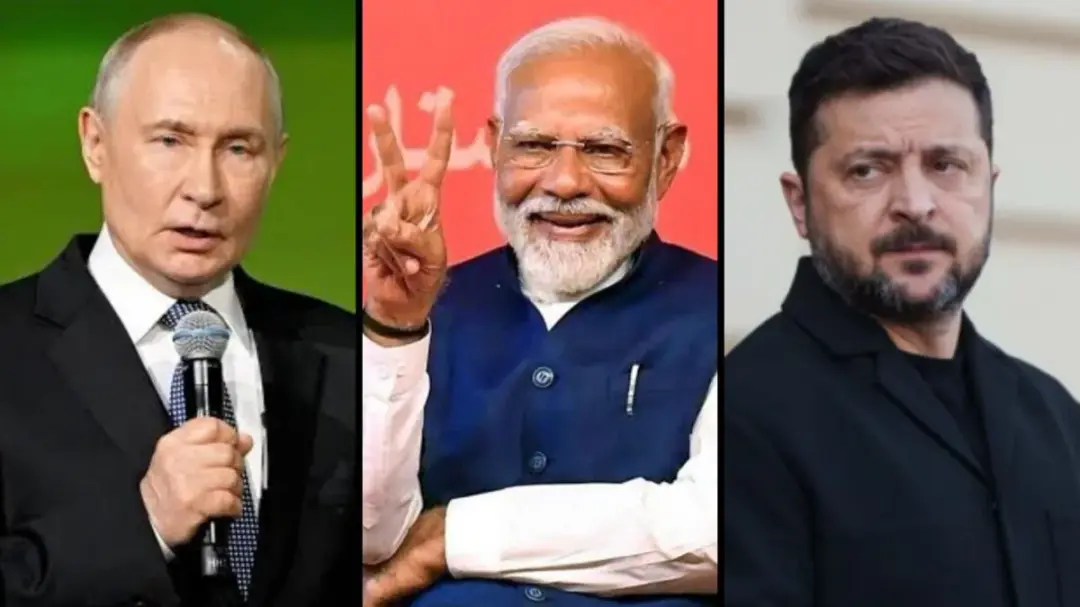
India proposes three-part Russia-Ukraine truce plan, sources say
India has proposed a three-part truce plan to reduce the immediate risks of the Russia-Ukraine war, people familiar with the proposal told News18. It calls for halting attacks on energy facilities and other critical infrastructure, ensuring grain and energy keep moving through Black Sea ports, and ending strikes on commercial shipping in the Black Sea. The proposal was conveyed during External Affairs Minister S Jaishankar's September 3 visit to Kyiv, his first stand-alone trip to Ukraine as foreign minister.
Source
News18 — India · read the original report ↗
Desk check · some claims need care
What the desk checked (4)
- India proposed a three-part truce plan covering energy infrastructure, commodity flows and commercial shipping. — Attributed to unnamed people familiar with the proposal, speaking to News18; no official statement cited.
- The proposal was conveyed during EAM S Jaishankar's September 3 visit to Kyiv. — Date and visit appear in source as stated fact, without named attribution.
- Jaishankar's Kyiv trip was his first stand-alone visit to Ukraine as India's foreign minister. — Stated in source; no source given, internally consistent.
- Egyptian and Turkish proposals focused on grain flows while the US proposal centred on an 'energy ceasefire'. — Comparative claim stated by the publication without attribution; internally consistent with the article's argument.
Analysts’ view opinion
India's three-part truce idea is as much domestic political positioning as it is diplomacy. By bundling energy infrastructure, grain and fuel flows and commercial shipping into one framework, Delhi stakes a claim to the role of practical problem-solver without abandoning its studied refusal to pick a side — a stance that has served the government well at home. The real test is not whether the plan is clever but whether either Moscow or Kyiv treats it as a serious negotiating text, and the story does not tell us that.
- Jaishankar's first stand-alone Kyiv visit as foreign minister carries symbolic weight, signalling that India's outreach is not purely Moscow-facing.
- Framing the proposal around shipping, grain and energy lets Delhi present strategic autonomy as a service to the global South rather than fence-sitting.
- If the plan gains traction, the political gain accrues largely to the Prime Minister's image as a global interlocutor, a theme the ruling party has used domestically before.
- Opposition parties could question the substance behind the headline, asking whether India has any real leverage to enforce such a truce.
- Because it is sourced to "people familiar" rather than an official announcement, the government retains deniability if the proposal goes nowhere.
What to watch — Watch for any formal confirmation from Delhi, Kyiv or Moscow, and for whether Washington or European capitals publicly acknowledge India's framework — that is the clearest signal of whether this becomes diplomacy or stays positioning.
The story does not establish how Russia, Ukraine or any third party responded, whether the proposal was formally tabled anywhere, or that India has any mechanism to enforce it.
Deep dive
Research brief · 8 facts · 2 dates · exam-readyThe brief
Context
India has put forward a three-part truce proposal intended to lower the immediate risks of the Russia-Ukraine war rather than settle its political causes. According to people familiar with the proposal who spoke to News18, it seeks a halt to attacks on energy and other critical infrastructure, continued movement of grain and energy through Black Sea ports, and an end to strikes on commercial shipping in the Black Sea. The proposal was conveyed during External Affairs Minister S Jaishankar's September 3 visit to Kyiv, his first stand-alone trip to Ukraine as India's foreign minister. India has consistently held that dialogue and diplomacy are central to resolving the conflict, and the plan reflects that approach by focusing on limited, practical measures.
Key facts
- India's proposal has three elements: stopping attacks on energy and other critical infrastructure, keeping grain and energy flowing through Black Sea ports, and ending strikes on commercial shipping in the Black Sea.
- The proposal was conveyed during EAM S Jaishankar's September 3 visit to Kyiv.
- The Kyiv trip was Jaishankar's first stand-alone visit to Ukraine as India's foreign minister.
- Earlier Egyptian and Turkish proposals focused largely on unimpeded grain flows by suspending attacks on shipping.
- The US proposal centred on an 'energy ceasefire'.
- India's formulation is broader than earlier initiatives as it combines energy infrastructure, commodity flows and commercial shipping in one framework.
- The third element goes beyond grain movement alone, seeking a broader protection framework for commercial vessels in the Black Sea.
- The report notes that in a separate incident after Ukraine hit a tanker off the Russian coast, all 23 Indian crew members were rescued.
Timeline
- September 3EAM S Jaishankar visits Kyiv — his first stand-alone trip to Ukraine as foreign minister — and conveys India's three-part truce proposal.
- October 7, 2026News18 report on the proposal first published, citing people familiar with it.
Who has a stake
- India / Ministry of External Affairs — Seeks to act on its stated position that dialogue and diplomacy can resolve the conflict, without choosing sides, while keeping vital trade routes functioning.
- Ukraine (Kyiv) — Recipient of the proposal; stands to gain protection for energy installations and critical infrastructure crucial to civilian life.
- Russia — Any halt to strikes on infrastructure and Black Sea shipping would require its participation; also affected by attacks on its coast, per the report.
- Global grain and energy importers — Depend on uninterrupted grain and energy shipments through Black Sea ports.
- Commercial shipping and seafarers, including Indian crew — Safety of commercial vessels in the Black Sea; 23 Indian crew were rescued in one tanker incident cited in the report.
- Egypt, Turkiye and the United States — Authors of earlier narrower proposals — grain-flow protection and an energy ceasefire respectively — now folded into a wider framework.
Why it matters
The proposal marks India stepping from general appeals for dialogue into a concrete, if limited, de-escalation framework at a time when a broader political settlement remains difficult. By bundling energy infrastructure, essential commodity flows and commercial shipping into a single plan, it targets precisely the areas where the war's consequences spill into global supply chains and the safety of seafarers, including Indians.
UPSC angle
Prelims pointers
- India's three-part truce plan: (1) no attacks on energy/critical infrastructure, (2) grain and energy flows via Black Sea ports, (3) no strikes on commercial shipping in the Black Sea.
- Proposal conveyed during EAM S Jaishankar's September 3 visit to Kyiv — his first stand-alone visit to Ukraine as foreign minister.
- Egyptian and Turkish proposals focused on unimpeded grain flows; the US proposal centred on an 'energy ceasefire'.
- India's stated position: dialogue and diplomacy are central to resolving the Russia-Ukraine conflict; no side-taking.
- The Black Sea is the key maritime route for grain and energy shipments affected by the conflict.
- In an incident cited in the report, all 23 Indian crew members were rescued after Ukraine struck a tanker off the Russian coast.
Mains framing
India's three-part truce proposal illustrates a diplomacy of incrementalism: where a comprehensive political settlement of the Russia-Ukraine war remains out of reach, New Delhi has sought agreement on narrow, functional areas where a cessation of hostilities would have immediate humanitarian and economic effect — energy and critical infrastructure, grain and energy movement through Black Sea ports, and the safety of commercial vessels. Its distinctiveness lies in aggregation: earlier Egyptian and Turkish initiatives addressed grain flows by suspending attacks on shipping, while the US proposal centred on an energy ceasefire; India combines these strands and adds commercial shipping and wider infrastructure. The approach is consistent with India's long-held insistence that dialogue and diplomacy, not side-taking, offer the path to resolution, and it serves India's own exposure as a major energy and commodity importer with large numbers of seafarers on affected routes. The limits are equally clear: a truce confined to infrastructure and shipping depends on the consent and compliance of both belligerents and does nothing to address the war's underlying political drivers. The way forward suggested by the source is therefore partial de-escalation as confidence-building — protecting civilian installations and trade routes to create space for wider de-escalation while a broader settlement is negotiated.
Key terms
- Truce / ceasefire
- A halt to hostilities; here a partial one limited to specified targets rather than a full end to the war.
- Energy ceasefire
- A limited truce under which strikes on energy facilities are suspended; the focus of the earlier US proposal.
- Black Sea ports
- Ports through which grain and energy shipments move; keeping these flows open is the second element of India's plan.
- Critical infrastructure
- Installations crucial to civilian life and economic activity, such as energy facilities, which India wants shielded from attack.
- External Affairs Minister (EAM)
- India's foreign minister; S Jaishankar conveyed the proposal in Kyiv on September 3.
- Commercial shipping
- Civilian merchant vessels; India seeks a broader protection framework for them in the Black Sea, beyond grain carriers alone.
Practice questions
- Examine how India's three-part Russia-Ukraine truce proposal differs from earlier Egyptian, Turkish and US ceasefire initiatives, and what it reveals about India's approach to the conflict.
- "Partial truces on infrastructure and shipping can build confidence but cannot substitute for a political settlement." Discuss in the context of India's proposal conveyed in Kyiv.
- How do disruptions to Black Sea grain and energy flows affect India's economic and maritime interests, including the safety of Indian seafarers?
Grounded only in the source report — figures and dates are the source's, not inferred.