
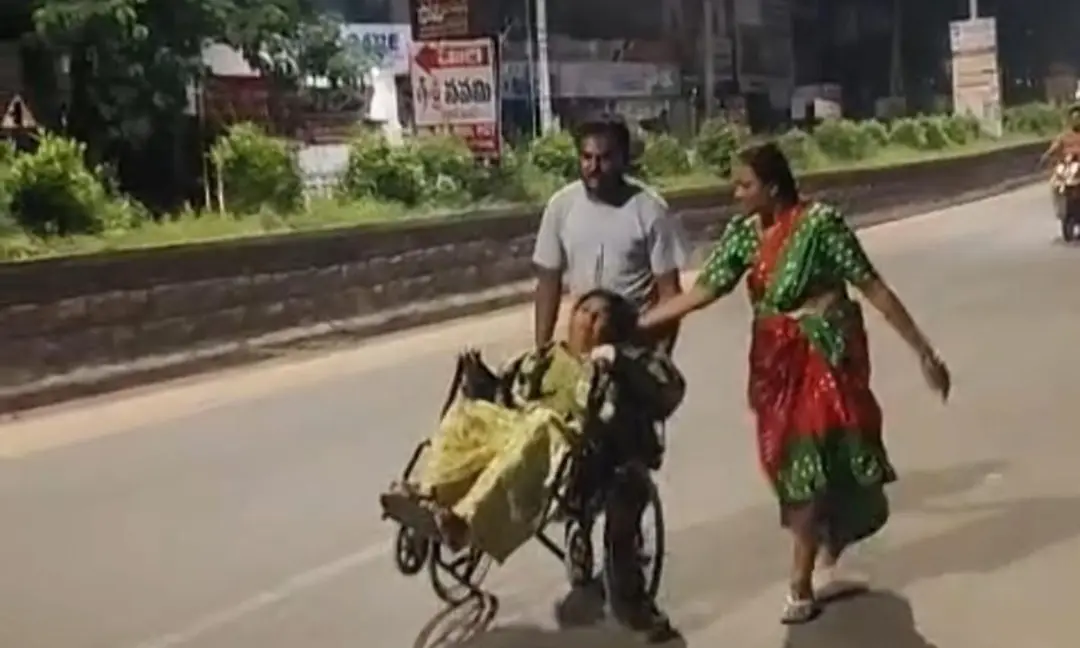
Son wheels ill mother to MLA's house over denied treatment
Bhukya Rajkumar of Pulimadugu village alleged that Mancherial district government hospital denied treatment to his mother, Bhukya Bujji (55), a kidney patient who fell seriously ill on Tuesday night. He said staff ignored them past midnight, refused a bed and assaulted him. He then wheeled her over a kilometre to MLA Premsagar Rao's residence. The MLA was away; informed of the matter, hospital RMO Sridhar reached the house, promised treatment and took them back to the hospital.
Source
Mancherial — స్థానికం · read the original report ↗
Desk check · some claims need care
What the desk checked (4)
- Bhukya Bujji (55) of Pulimadugu village suffers from a kidney ailment and fell seriously ill on Tuesday night. — Name, age, village and timing appear in the source; attributed to the family's account.
- Hospital staff at Mancherial district government hospital ignored the patient, denied a bed and assaulted her son. — Attributed to son Bhukya Rajkumar's allegation; no hospital response or independent confirmation in source.
- The son wheeled his mother over a kilometre to MLA Premsagar Rao's residence at night. — Distance and destination stated in source; MLA was not at home, per source.
- Hospital RMO Sridhar came to the MLA's residence, promised treatment and took the pair back to the hospital. — Named official's action reported in source; no direct quote or official statement provided.
Analysts’ view opinion
This is not just one family's distress — it exposes a design gap in how night-time emergency care is organised in public hospitals. By the family's account no bed or treatment was forthcoming; yet once they reached the MLA's residence, the hospital's RMO arrived in person and promised care. That suggests the capacity existed but moved only when political pressure entered the picture — which is the real governance problem here.
- Three things need establishing: night-shift doctor and nurse strength, whether a triage protocol was followed, and who is accountable for bed allocation after midnight.
- Kidney patients need a clear district-level dialysis and nephrology referral pathway, otherwise they end up repeatedly dependent on the emergency counter.
- A functioning grievance mechanism would have spared a family from pushing a wheelchair over a kilometre to an MLA's house; care arriving only via elected-representative intervention is itself a systemic failure signal.
- The allegation of assault by staff is serious, and equally real are the workload and safety pressures on public hospital staff — only a neutral inquiry can fairly test both versions.
- Past incidents of this kind have typically produced quick transfers and show-cause memos, but rarely structural fixes to duty rosters or bed-management systems.
What to watch — Watch whether the hospital or district health administration orders a formal inquiry and whether any change follows in night duty rosters and bed-allocation procedure.
The story does not carry the hospital's side, the patient's current clinical status, or any official finding on the assault allegation — so far these are the family's claims alone.
Deep dive
Research brief · 8 facts · 4 dates · exam-readyThe brief
Context
A family from Pulimadugu village in Telangana's Mancherial district has alleged that the district headquarters government hospital refused emergency care to a 55-year-old kidney patient late at night. Unable to get a bed, her son pushed her in a wheelchair for over a kilometre at night to the residence of local MLA Premsagar Rao to seek help. The episode, which ended with the hospital's Resident Medical Officer coming to the MLA's house and escorting the patient back, has triggered debate over the availability of night-time emergency treatment in government hospitals.
Key facts
- Bhukya Bujji, 55, of Pulimadugu village, suffers from a kidney ailment and fell seriously ill on Tuesday night.
- Her son Bhukya Rajkumar took her to the Mancherial district government hospital, the district headquarters facility.
- Rajkumar alleged hospital staff ignored them around midnight and did not provide treatment despite his mother's severe distress.
- He alleged that his request for a bed went unanswered and that hospital staff assaulted him.
- He then wheeled his mother in the same wheelchair over one kilometre at night to MLA Premsagar Rao's residence.
- The MLA was not at home; his staff spoke to the family, promised to inform him and alerted the government hospital staff.
- Government hospital RMO Sridhar reached the MLA's residence, spoke to the family, promised proper treatment and took the mother and son back to the hospital.
- The family's allegations of denial of emergency care at the government hospital have become a subject of public discussion.
Timeline
- Tuesday nightBhukya Bujji, a kidney patient, falls seriously ill; her son takes her to Mancherial district government hospital.
- Around midnightFamily alleges staff ignored them, refused a bed and assaulted the son.
- Later that nightSon wheels his mother over a kilometre to MLA Premsagar Rao's residence; MLA is away, staff speak to the family.
- After being informedHospital RMO Sridhar reaches the MLA's house, assures treatment and takes the patient back to the hospital.
Who has a stake
- Bhukya Bujji (55), kidney patient — Needed urgent night-time treatment; alleges she was left without a bed or care.
- Bhukya Rajkumar, her son — Alleges he was assaulted by hospital staff and had to wheel his mother over a kilometre for help.
- Mancherial district government hospital and its staff — Face allegations of negligence, refusal of a bed and assault during emergency hours.
- RMO Sridhar — Responded to the complaint, assured treatment and brought the patient back to the hospital.
- MLA Premsagar Rao and his office staff — Approached as the last resort by the family; his staff relayed the complaint to the hospital.
Why it matters
A district headquarters government hospital is the referral backbone for poor and rural patients, and a night-time denial of a bed to a kidney patient points to gaps in emergency readiness. That a family felt compelled to seek an MLA's intervention to get admitted suggests grievance mechanisms inside the hospital were either absent or ineffective. The added allegation of assault on an attendant raises questions of accountability and patient dignity in public healthcare.
UPSC angle
Prelims pointers
- Incident location: Mancherial district government hospital, Mancherial district headquarters, Telangana.
- Patient: Bhukya Bujji, 55, of Pulimadugu village, a kidney patient; son: Bhukya Rajkumar.
- RMO (Resident Medical Officer) Sridhar responded to the complaint at the MLA's residence.
- Local MLA named in the source: Premsagar Rao; the family travelled over 1 km by wheelchair to his house.
- Allegations: denial of treatment past midnight, refusal of a bed, and assault on the patient's son.
Mains framing
The Mancherial episode illustrates how emergency care in district-level public hospitals can fail at the point of first contact, especially at night, when staffing and triage are thinnest and patients from villages have no alternative. The family's account — being ignored past midnight, denied a bed, and allegedly assaulted — points to three interlinked deficits: capacity (beds and duty staff for a critically ill kidney patient), accountability (no accessible internal grievance redress, forcing recourse to an elected representative), and behavioural or attitudinal barriers that erode patient dignity. That a Resident Medical Officer acted promptly only after political intervention shows responsiveness is triggered by pressure rather than protocol. The way forward, as suggested by the facts in the source, lies in verifiable night-duty rosters and functioning emergency triage at district hospitals, a visible on-site complaint mechanism so patients need not approach an MLA's residence, an inquiry into the specific allegation of assault on an attendant, and clarity on referral pathways for chronic patients such as those needing dialysis. Since the source records only allegations and the hospital's assurance of treatment, any conclusion on culpability must await a formal inquiry.
Key terms
- RMO (Resident Medical Officer)
- The resident doctor-administrator responsible for day-to-day medical duties in a hospital; here, RMO Sridhar responded to the family.
- District government hospital
- The main public hospital at a district headquarters, serving as a referral centre for rural patients; here, Mancherial's facility.
- Kidney ailment (kidney problem)
- The chronic condition the 55-year-old patient was suffering from when she fell seriously ill on Tuesday night.
- MLA
- Member of the Legislative Assembly, the elected state representative; the family sought MLA Premsagar Rao's help after being turned away.
Practice questions
- Emergency care at district hospitals often fails at night. Discuss the institutional gaps revealed by the Mancherial incident and suggest accountability measures.
- Why do patients in India frequently turn to elected representatives instead of hospital grievance mechanisms? Examine with reference to public health administration.
- Examine the role of the Resident Medical Officer in ensuring emergency treatment and patient dignity in a district government hospital.
Grounded only in the source report — figures and dates are the source's, not inferred.