
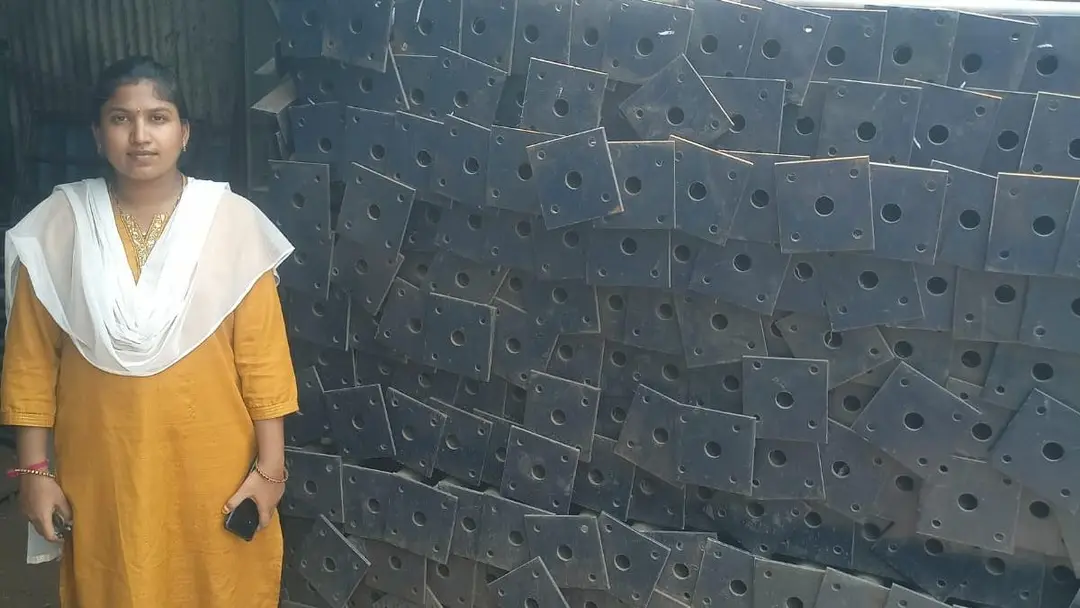
CSE graduate runs centring units with State support in Wanaparthy
Peddhabudi Vanaja, a 2019-batch B.Tech (CSE) graduate from Bandapalli village in Panagal mandal, Wanaparthy district, has set up centring units earning nearly ₹1 lakh a month with support from SERP in collaboration with the National Academy of Construction. She said she now employs at least six people. She secured a ₹20-lakh PMEGP loan. SERP CEO Divya Devarajan said 154 of 772 trained women have established units.
Source
Wanaparthy — jobs · read the original report ↗
Desk check · compared with the source
What the desk checked (5)
- Peddhabudi Vanaja, a 2019-batch B.Tech CSE graduate from Bandapalli village, Panagal mandal, runs centring units earning nearly ₹1 lakh a month and employing at least six people. — Figures appear in source; monthly earning stated by the report and employment figure quoted by Vanaja herself.
- Of 772 women trained with the National Academy of Construction, 154 have set up centring units. — Attributed to SERP CEO Divya Devarajan.
- Vanaja secured a ₹20-lakh loan under PMEGP; 16 more trained women have applied for PMEGP support. — Loan figure stated in source; applicant number attributed to Devarajan.
- Over 3.5 lakh houses are proposed under the Indiramma Housing Scheme in 2025-26, raising demand for construction materials. — Attributed to Minister Danasari Anasuya (Seethakka) as a projection, not verified.
- Each centring unit involves an investment of about ₹4 lakh as baseline support. — Figure appears in source without specific attribution.
Analysts’ view opinion
This is less a personal success story than a supply-chain experiment: linking state-created housing demand to rural women's micro-enterprises. With over 3.5 lakh houses proposed under the Indiramma scheme in 2025-26, demand for centring, cement bricks and related materials is naturally set to rise, and routing part of it to village-level units keeps that value inside the district. The headline numbers — about ₹4 lakh investment per unit against nearly ₹1 lakh a month — look attractive, but the story does not clarify whether that is gross turnover or net profit.
- The model's strength is directness: it plugs micro-suppliers into demand the government itself is creating, which is the shortest route from public spending to local jobs.
- At roughly ₹4 lakh of investment supporting six jobs in one case, the capital cost per job looks low compared with many rural employment interventions.
- Only 154 of 772 trained women have set up units, suggesting the real bottleneck is not training but credit access, collateral and market linkage.
- A ₹20-lakh PMEGP loan, DPRs and bank linkages mean public money carries much of the risk; the gains accrue to owners, their workers, and local buyers who get materials closer to home.
- The key vulnerability is concentration: if demand rests largely on one government housing programme, any slowdown in construction could squeeze revenues and loan repayments.
What to watch — Watch how quickly the 16 further PMEGP applications convert into sanctioned bank loans, and how fast Indiramma houses actually get built — together those two will decide whether this scales.
The story does not establish whether the ₹1 lakh a month is gross or net, whether the six jobs are full-time and durable, or how repayment is tracking — and one case cannot prove the programme's overall viability.
Deep dive
Research brief · 8 facts · 5 dates · exam-readyThe brief
Context
Telangana's Society for Elimination of Rural Poverty (SERP), under the Panchayat Raj and Rural Development department, is pushing rural women into non-conventional construction-related enterprises through its non-farm livelihood initiative, training them in collaboration with the National Academy of Construction (NAC). The story profiles Peddhabudi Vanaja, a 2019-batch B.Tech (CSE) graduate from Bandapalli village in Panagal mandal, Wanaparthy district, who set up centring units earning nearly ₹1 lakh a month with SERP support and a ₹20-lakh PMEGP loan. The push is timed to the expected surge in demand for construction materials from the State's Indiramma Housing Scheme.
Key facts
- Peddhabudi Vanaja, a 2019-batch B.Tech (CSE) graduate from Bandapalli village, Panagal mandal, Wanaparthy district, runs centring units earning nearly ₹1 lakh a month.
- Vanaja says she is able to create employment for at least six others.
- She secured a ₹20-lakh loan under the Prime Minister's Employment Generation Programme (PMEGP) after training.
- SERP CEO Divya Devarajan: of 772 women trained in collaboration with the NAC, 154 have already established centring units.
- 16 more trained women have applied for support under the PMEGP.
- Each centring unit involves an investment of about ₹4 lakh, the baseline support extended to trained members.
- Minister Danasari Anasuya (Seethakka) said over 3.5 lakh houses are proposed under the Indiramma Housing Scheme during 2025-26.
- SERP's non-farm livelihood training covers centring units, cement brick manufacturing and shear wall construction.
Timeline
- 2019Vanaja completes her B.Tech in Computer Science Engineering.
- Not dated in the sourceVanaja undergoes specialised training under SERP's non-farm livelihood initiative with the NAC.
- After training (date not stated)She secures a ₹20-lakh PMEGP loan and establishes her centring units.
- 2025-26Over 3.5 lakh houses proposed for construction under the Indiramma Housing Scheme.
- April 07, 2026Report published, noting 154 of 772 trained women have set up centring units.
Who has a stake
- Peddhabudi Vanaja, entrepreneur — Earns nearly ₹1 lakh a month from centring units and employs at least six people; carries a ₹20-lakh PMEGP loan.
- Society for Elimination of Rural Poverty (SERP) — Runs the non-farm livelihood initiative; prepares DPRs and pushes bank linkages for trained women.
- National Academy of Construction (NAC) — Training partner for the 772 women trained in construction-related enterprises.
- Trained rural women (772 trained, 154 with units, 16 PMEGP applicants) — Access to credit, bank linkage and a place in the construction supply chain.
- Panchayat Raj and Rural Development Ministry, Telangana (Minister Seethakka) — Links women's enterprises to demand from the Indiramma Housing Scheme.
- Banks and district administrations — Expected to act on DPRs forwarded by SERP and extend financial assistance.
- Local workers in Wanaparthy district — Wage employment generated by the new units.
Why it matters
It shows a route out of the degree-to-jobless trap: an engineering graduate building a construction-input business in her own village rather than migrating for a white-collar job. It also illustrates how a large public housing programme can be used deliberately to create demand for women-run micro-enterprises, with state training, DPRs and PMEGP credit as the connecting links.
UPSC angle
Prelims pointers
- SERP (Society for Elimination of Rural Poverty) — Telangana rural livelihoods body; CEO Divya Devarajan.
- PMEGP — Prime Minister's Employment Generation Programme; Vanaja's loan was ₹20 lakh.
- National Academy of Construction (NAC) — SERP's training collaborator for construction-related enterprises.
- Indiramma Housing Scheme — over 3.5 lakh houses proposed in Telangana in 2025-26.
- 772 women trained; 154 have set up centring units; 16 more have applied under PMEGP.
- Baseline investment per centring unit: about ₹4 lakh.
Mains framing
Rural non-farm diversification in India is often confined to 'feminised' trades such as tailoring or food processing; SERP's initiative deliberately routes women into non-conventional construction enterprises — centring units, cement brick manufacturing and shear wall construction — where margins and demand are larger. The design has three working parts: skilling with a specialist institution (NAC), a demand anchor in public housing (over 3.5 lakh Indiramma houses in 2025-26), and credit through PMEGP, backed by state-prepared DPRs to ease bank linkage. Yet the conversion ratio is instructive: only 154 of 772 trained women have established units and 16 more have applied for PMEGP, suggesting credit access, the roughly ₹4-lakh baseline investment, and market entry remain bottlenecks rather than training itself. The Vanaja case also points to underemployment among technical graduates: a 2019 CSE degree holder found viable income in local construction inputs. The way forward implied by the source lies in faster bank linkages on the DPRs already forwarded to districts, sustained procurement demand from government housing, and scaling the baseline support so that more trainees convert into enterprise owners and local employers.
Key terms
- Centring unit
- Enterprise supplying shuttering/centring material and services used to support concrete work during building construction.
- SERP
- Society for Elimination of Rural Poverty, the Telangana agency running rural livelihood programmes, including non-farm initiatives.
- PMEGP
- Prime Minister's Employment Generation Programme, a credit-linked scheme for setting up micro-enterprises; source cites a ₹20-lakh loan.
- Detailed Project Report (DPR)
- Project appraisal document prepared by SERP and sent to districts to help trained women obtain bank loans.
- Indiramma Housing Scheme
- Telangana housing programme; over 3.5 lakh houses proposed for construction in 2025-26.
- Shear wall construction
- A construction technique, among the non-conventional trades in which SERP trains women.
Practice questions
- Public housing programmes can be used as demand anchors for women-led micro-enterprises. Examine with reference to Telangana's SERP–NAC construction livelihoods initiative.
- Only 154 of 772 trained women have set up units. What does this gap reveal about the skilling-to-enterprise pipeline in rural India, and how can credit and market linkages be strengthened?
- Discuss the significance of moving rural women into non-conventional trades such as centring, cement brick manufacturing and shear wall construction for women's economic empowerment.
Grounded only in the source report — figures and dates are the source's, not inferred.