
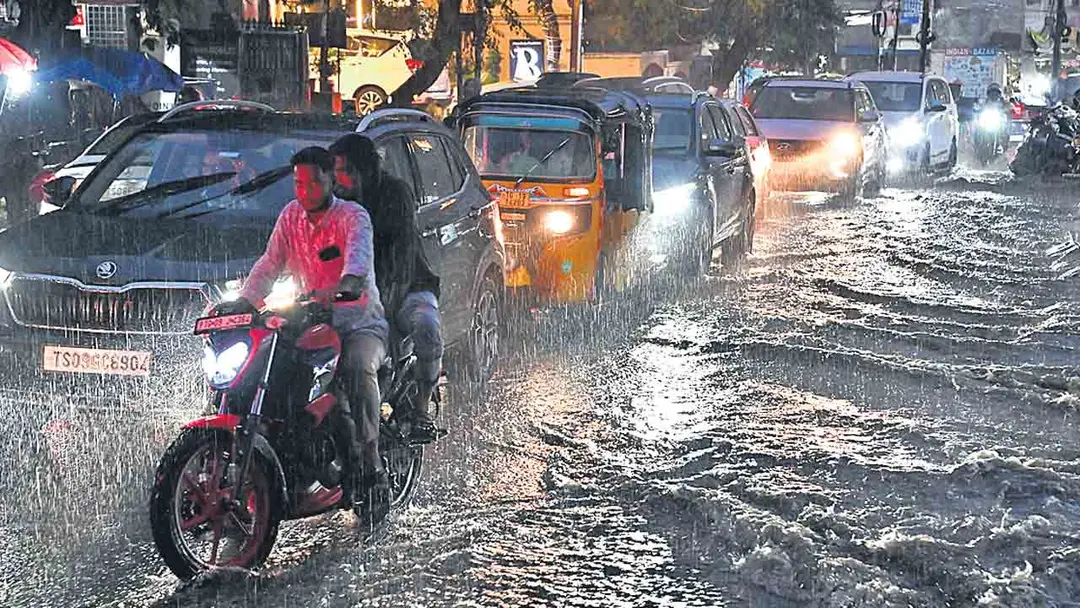
Heavy rain floods Hyderabad roads, brings traffic to halt
Heavy rain accompanied by thunder and lightning lashed Hyderabad on Tuesday evening, waterlogging roads and halting traffic. Rain was recorded at Assembly, Tank Bund, Musheerabad, Punjagutta, Banjara Hills, Gachibowli and Kukatpally among other areas. Himayatnagar received 3.2 cm, Kukatpally 2.8 cm, and Musheerabad and Abdullapurmet 2.5 cm each. Overflowing nalas left motorists stranded for hours. Weather department officials said rain is likely for two more days due to a storm formed in the Bay of Bengal.
Source
Namasthe Telangana · read the original report ↗
Desk check · some claims need care
What the desk checked (5)
- Heavy rain with thunder and lightning hit Hyderabad on Tuesday evening, waterlogging roads and halting traffic. — Core report by the newspaper's city bureau (Namasthe Telangana), dated September 22; consistent within the source.
- Rainfall recorded: Himayatnagar 3.2 cm, Kukatpally 2.8 cm, Musheerabad 2.5 cm, Abdullapurmet 2.5 cm, Balanagar 2.3 cm, Khairatabad 2.2 cm, Amberpet 2.1 cm. — Figures appear in the source as a list; no measuring agency named.
- Weather department officials said heavy rain is likely for two more days due to a storm formed in the Bay of Bengal, and warned of a low-pressure effect on the city. — Attributed to weather department officials; no individual named.
- GHMC and traffic police failed to take precautionary measures; staff were not available at junctions. — Unattributed critical claim presented as observation; no official response included.
- Nalas overflowed onto roads and vehicles were stuck in traffic for hours. — Reported observation in source; no independent data or official confirmation given.
Analysts’ view opinion
A single evening's downpour flooding Hyderabad's roads is not just a weather story — it is a test of urban governance, and therefore political. Because the report states that the GHMC and traffic police failed on pre-emptive measures, accountability naturally travels upward to the state government that owns city administration. That the inundated stretches include showcase locations — the Assembly area, Tank Bund, Banjara Hills, Gachibowli — makes it politically awkward, since these are exactly where middle-class voters, IT employees and news cameras concentrate.
- Opposition parties are likely to revive the "where did the nala and stormwater drain money go" line of attack, which recurs each monsoon.
- Traffic gridlock in IT-corridor pockets like Gachibowli and Kukatpally touches the city's investment-brand image, a sensitive point for any government marketing Hyderabad.
- The alleged coordination failure between the municipal machinery and traffic police typically triggers a visible political response — review meetings, officer reshuffles, emergency directives.
- With rain forecast for another two days, the speed of the government's response and the visibility of field staff will largely decide how heavy a political cost this carries.
- Because civic infrastructure failures repeat every season, expect a "legacy of the previous government" argument to be deployed from both directions.
What to watch — Watch whether ministers or top officials make visible on-ground inspections in the next 48 hours, and whether opposition leaders convert waterlogged spots into protest and photo-op sites.
The story records no political statements or reactions from any party or from the government, and establishes nothing about drainage budgets, pending works or the scale of damage — the reading above is analysis of possible political consequences, not reported fact.
Deep dive
Research brief · 8 facts · 4 dates · exam-readyThe brief
Context
Heavy rain with thunder and lightning lashed Hyderabad on Tuesday evening, after a hot and humid day, flooding roads across the city and bringing traffic to a standstill. Nalas (storm-water drains) overflowed, turning waterlogging points into what the report describes as lakes, and motorists were stuck for hours. Weather department officials attributed the spell to a storm/low-pressure system formed over the Bay of Bengal and warned of more heavy rain for two more days. The report faults the GHMC and traffic police for failing to take precautionary measures and for absent staff at junctions.
Key facts
- Heavy rain with thunder and lightning hit Hyderabad on Tuesday evening (report datelined September 22, City Bureau).
- Rainfall recorded: Himayatnagar 3.2 cm, Kukatpally 2.8 cm, Musheerabad 2.5 cm, Abdullapurmet 2.5 cm.
- Further readings: Balanagar 2.3 cm, Khairatabad 2.2 cm, Amberpet 2.1 cm.
- Areas that received heavy rain included Assembly, Saifabad, Liberty, Tank Bund, Musheerabad, Chikkadpally, Malakpet, Punjagutta, Banjara Hills, Gachibowli, Kukatpally and Borabanda.
- Weather department officials said heavy rain is likely in the city for two more days due to a storm formed in the Bay of Bengal, and warned of a low-pressure system (vayugundam) effect.
- Overflowing nalas on roads left motorists unable to cross those stretches; vehicles were stuck in traffic for hours.
- The report says staff were not available at junctions and traffic points, and that GHMC and traffic police negligence was clearly visible with advance measures failing.
- A traffic jam caused by the rain was reported in the Hyderabad Public School area; waterlogging was also noted in Banjara Hills and Krishnanagar.
Timeline
- Tuesday morningScorching sun and humid conditions in Hyderabad, with residents facing sultry weather.
- Tuesday eveningSky suddenly turned overcast; heavy rain with thunder and lightning lashed the city, flooding roads and halting traffic as office-goers were heading home.
- September 22 (report dateline)City Bureau report records rainfall figures area-wise and criticises GHMC and traffic police for lack of preparedness.
- Next two days (as per officials)Heavy rain forecast to continue in the city due to the Bay of Bengal storm and low-pressure effect.
Who has a stake
- Motorists and office-goers — Stranded for hours in traffic, unable to cross flooded stretches and overflowing nalas on the way home in the evening.
- GHMC (Greater Hyderabad Municipal Corporation) — Blamed in the report for negligence and failure to take advance measures against waterlogging and nala overflow.
- Traffic police — Faulted for absence of staff at junctions and traffic points, leaving vehicles stuck for hours.
- Weather department officials — Issued the forecast and warning of two more days of heavy rain due to the Bay of Bengal storm and low-pressure system.
- Residents of low-lying and waterlogging-prone localities (Himayatnagar, Kukatpally, Musheerabad, Banjara Hills, Krishnanagar) — Face flooded roads and disruption; highest rainfall recorded in these areas.
Why it matters
A single evening's downpour was enough to submerge arterial roads in Hyderabad and paralyse traffic, showing how thin the city's storm-water and traffic-management margin is. With officials forecasting two more days of heavy rain from a Bay of Bengal system, the failure of advance measures and the absence of staff at waterlogging points turn a routine monsoon spell into a mobility and safety problem for lakhs of commuters.
UPSC angle
Prelims pointers
- Highest rainfall recorded in the spell: Himayatnagar 3.2 cm, followed by Kukatpally 2.8 cm.
- Musheerabad and Abdullapurmet each recorded 2.5 cm; Balanagar 2.3 cm, Khairatabad 2.2 cm, Amberpet 2.1 cm.
- Cause cited by weather department: a storm formed in the Bay of Bengal, with a low-pressure (vayugundam) effect on the city.
- GHMC is the civic body responsible for Hyderabad's storm-water drains and nalas named in the report.
- Nala overflow and waterlogging points were the main reason motorists could not cross flooded roads.
Mains framing
Hyderabad's Tuesday evening downpour illustrates the classic urban flooding equation: intense, short-duration convective rainfall triggered by a Bay of Bengal system falling on a city whose storm-water drains (nalas) overflow rather than carry the load. Rainfall of 2-3.2 cm in localities such as Himayatnagar, Kukatpally, Musheerabad and Khairatabad was sufficient to turn waterlogging points into sheets of water, immobilise traffic at peak office-exit hour, and strand motorists for hours. The report locates the failure not in the rainfall volume but in governance: GHMC's inability to take precautionary measures and the absence of traffic personnel at junctions and known waterlogging spots. The implications are recurring economic loss from lost commuter hours, risk to life near overflowing drains, and erosion of public trust in civic warning systems. A way forward suggested by the facts in the report is pre-positioning of GHMC and traffic staff at identified waterlogging points ahead of forecast spells, acting on the weather department's advance warning of a further two days of rain, and de-silting and desilting-linked maintenance of nalas so that a single day's rain does not halt the city.
Key terms
- Nala
- Storm-water drain or channel carrying rainwater through the city; overflowing nalas on roads blocked motorists in this spell.
- GHMC
- Greater Hyderabad Municipal Corporation, the civic body faulted in the report for failing to take advance measures.
- Waterlogging point
- A known low-lying spot where rainwater accumulates; the report says these looked like lakes and were impassable.
- Vayugundam (low-pressure system)
- A low-pressure area whose effect on the city the weather department warned about, linked to the Bay of Bengal storm.
- Bay of Bengal storm
- The system cited by weather officials as the reason heavy rain is likely to continue for two more days.
Practice questions
- Why do short, intense rainfall spells cause disproportionate flooding in Indian metros like Hyderabad? Discuss with reference to storm-water drainage and civic preparedness.
- Examine the role of municipal bodies and traffic police in translating weather warnings into on-ground action during urban flooding events.
- Bay of Bengal low-pressure systems drive much of peninsular India's monsoon rainfall. Discuss their implications for urban flood management in Telangana's cities.
Grounded only in the source report — figures and dates are the source's, not inferred.