
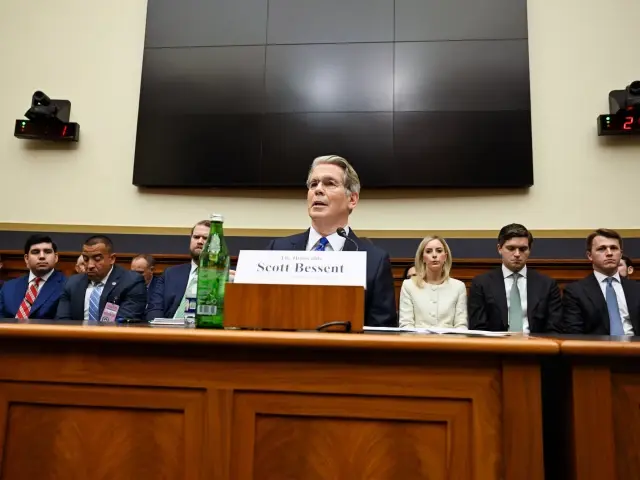
US ending, not managing, Iranian threat, says Treasury chief Bessent
The United States is no longer seeking to contain Iran's threat but to end it, Treasury Secretary Scott Bessent told the House Financial Services Committee on Tuesday, describing the campaign against Tehran as the greatest economic isolation effort in history. Separately, the Saudi-led coalition said 13 civilians were injured in Houthi missile and drone attacks on Khamis Mushait, Abha and Taif, damaging seven homes and two vehicles. Saudi Arabia cancelled late-September crude cargoes to Europe after a pipeline attack.
Source
The Express Tribune (Pakistan) · read the original report ↗
Desk check · some claims need care
What the desk checked (5)
- US Treasury Secretary Scott Bessent said America is no longer managing the Iranian threat but ending it. — Directly quoted from his testimony to the House Financial Services Committee; attributed.
- Thirteen civilians were injured in Houthi missile and drone attacks on Khamis Mushait, Abha and Taif; seven homes and two vehicles damaged. — Attributed to Saudi-led coalition spokesman Turki al-Malki; single-side source, not independently confirmed in text.
- Saudi Arabia cancelled late-September crude cargoes to Europe and suspended Yanbu oil loadings after the East-West pipeline attack. — Attributed to three sources and shipping industry sources cited by Reuters; Saudi Aramco declined to comment.
- Tanker El Gaia was hit by sea mines in the Strait of Hormuz, per IRGC. — Disputed in source: US Central Command says the vessel was struck by an Iranian missile last month; IMO says it was damaged Saturday without stating cause.
- A prolonged Saudi pipeline shutdown could cut as much as 4% of global oil supply. — Attributed to unnamed traders; estimate, not an official figure.
Analysts’ view opinion
Bessent's language marks a doctrinal shift — moving from "containing" Iran to "ending" the threat effectively reframes financial pressure as a war aim rather than a holding measure. Yet the rest of the story shows how costly that ambition is proving: with Hormuz already closed, the Yanbu workaround has now been hit too, and Riyadh has cancelled late-September crude cargoes to Europe. The pressure campaign is aimed at Tehran, but a large share of its immediate economic burden is landing on US partners and global energy markets.
- The story does not clarify whether "ending the threat" means regime change or the degradation of capabilities — and that ambiguity itself narrows the space for diplomacy.
- Houthi control of the Red Sea coast plus the East-West pipeline attack put both of Saudi Arabia's export routes, Hormuz and the Red Sea, in question simultaneously.
- Missile and drone strikes injuring 13 in Abha, Khamis Mushait and Taif show the conflict has moved beyond shipping lanes into Saudi inland cities.
- Turkiye and Qatar are publicly pressing for de-escalation, while Iran's foreign minister heading to Beijing and China's call for a political solution suggest Tehran is working to blunt its economic isolation.
- The Pentagon inspector general's reported munitions shortfalls, alongside Iran's passive-defence directive covering three war scenarios, point to both sides bracing for a prolonged contest.
What to watch — Watch the UN Security Council session on Bab al-Mandab and whether Yanbu loadings resume — these will be the first indicators of whether economic pressure bites Tehran or further destabilises global energy supply.
The story does not spell out what concrete measures or timeline "ending the threat" entails, how long the pipeline will stay down, or whether claims that Iran directed the Houthi operations have been independently verified.
Deep dive
Research brief · 8 facts · 8 dates · exam-readyThe brief
Context
The source describes an ongoing US-Iran war that began on February 28, 2026, in which the Strait of Hormuz has been closed since spring and Iran-aligned Houthis in Yemen have seized Yemen's Red Sea coast. Testifying to the US House Financial Services Committee on September 15, 2026, Treasury Secretary Scott Bessent said Washington is no longer "managing" but "ending" the Iranian threat through what he called the greatest economic isolation campaign in history. Simultaneously, Houthi missile and drone attacks have hit Saudi cities and oil infrastructure, forcing Saudi Arabia to shut its East-West pipeline, suspend loadings at Yanbu and cancel late-September crude cargoes to Europe. Qatar, Turkiye, China and France are pressing for diplomacy, with the UN Security Council meeting on the Bab al-Mandab Strait.
Key facts
- US Treasury Secretary Scott Bessent told a House Financial Services Committee hearing on September 15, 2026: "America is no longer managing the Iranian threat. We are ending it."</string>
- Saudi Arabia informed European customers on Tuesday that late-September crude cargoes are cancelled after the East-West pipeline shut down following Houthi attacks; Yanbu had 5-7 days of crude stocks left.
- The Saudi-led coalition said 13 civilians suffered minor to moderate injuries in Houthi missile and drone attacks on Khamis Mushait, Abha and Taif; seven homes and two vehicles were damaged.
- Commodity vessel transits at the Strait of Hormuz fell to four on Monday from 10 the previous day; before the war began on February 28 it handled about 125 large commercial vessels a day, some 20% of world daily crude and LNG supply.
- Bab el-Mandeb transits fell to 21 commodity vessels on Monday from 28 a day earlier.
- Yemen's National Resistance Forces said the Houthis mobilised over 76,000 personnel, and that between August 9 and September 9 there were 130 ballistic missiles, 145 suicide drones and 15 explosive-laden boats launched against a 170-km front.
- The Pentagon inspector general's first report found munitions used in the four-month US war with Iran caused "strategic inventory shortfalls" and exposed defence industrial base bottlenecks.
- Oman's Maritime Security Centre said the Panama-flagged tanker 'EL GAIA' was attacked about 103 nautical miles northeast of Musandam; 23 crew were evacuated and two remain missing.
Timeline
- February 28, 2026The US war with Iran begins; Saudi Aramco subsequently increases use of the Yanbu terminal.
- Spring 2026Strait of Hormuz closed, pushing European buyers to take Saudi crude via the Red Sea port of Yanbu.
- June 2026US-backed framework agreement provides for Israeli withdrawal from south Lebanon in parallel with Lebanese army deployment in "pilot zones", conditional on Hezbollah disarming.
- August 9 - September 9, 2026130 ballistic missiles, 145 suicide drones and 15 explosive-laden boats launched in west coast battles, per Yemeni government-aligned forces.
- Week of September 7-13, 2026Houthi attack shuts Saudi Arabia's East-West pipeline; Yanbu reported to have 5-7 days of crude export stocks left.
- Monday, September 14, 2026Houthi strikes injure 13 civilians in Khamis Mushait, Abha and Taif; Houthi spokesman says Saudi jets carried out 54 strikes in five Yemeni provinces; Gulf Arab states postpone Hormuz talks with Iran.
- Tuesday, September 15, 2026Bessent testifies; Yanbu loadings suspended and late-September cargoes cancelled; IRGC downs MQ-1 drones; UNSC to meet on Bab al-Mandab at France's request.
- September 16, 2026Iranian Foreign Minister Abbas Araghchi to visit China and meet Foreign Minister Wang Yi.
Who has a stake
- United States / Treasury Secretary Scott Bessent — Running what he calls the greatest economic isolation campaign in history against Iran and its allies; facing munitions shortfalls flagged by the Pentagon inspector general.
- Iran / IRGC and Armed Forces General Staff — Fighting a four-month war, blocking Hormuz, downing US MQ-1 drones, and issuing a 10-article passive defence directive for three scenarios: end of war, ceasefire, full-scale war.
- Saudi Arabia and Saudi Aramco — Crude exports disrupted: East-West pipeline shut, Yanbu loadings suspended, late-September European cargoes cancelled, cities under missile and drone attack.
- Yemen's Houthis and Yemeni government-aligned forces — Houthis control the Red Sea coast and strike Saudi targets; government forces defend a 170-km front and Bab al-Mandab against a claimed 76,000-strong mobilisation.
- Qatar and Turkiye — Pushing diplomacy; Qatar warns a Bab al-Mandab closure would be "catastrophic"; Turkiye's Hakan Fidan seeks restored freedom of passage through Hormuz.
- China and France — China urges political and diplomatic solutions and hosts Araghchi; France has called the UN Security Council meeting on Bab al-Mandab.
- Lebanon, Israel and Hezbollah — Implementation of the June framework: Lebanese army takes over "pilot zones" while Israeli troops hold a roughly 10-km-deep "security zone"; Hezbollah disarmament is a condition.
- Global shipping and energy consumers — Hormuz normally carries about 20% of world daily crude and LNG; traffic has collapsed and tankers face mines and attacks.
Why it matters
Two of the world's most important energy chokepoints, the Strait of Hormuz and Bab al-Mandab, are simultaneously disrupted, with Hormuz alone normally accounting for about 20% of daily global crude and LNG supply. A declared US objective of "ending" rather than managing the Iranian threat, combined with cancelled Saudi cargoes and attacks on tankers, points to a prolonged shock to global energy prices, shipping insurance and supply chains. For an import-dependent economy like India, the closure of these routes and the widening Yemen-Saudi exchange of fire carry direct energy security and diaspora implications.
UPSC angle
Prelims pointers
- Strait of Hormuz: before February 28, 2026 it handled about 125 large commercial vessels daily, roughly 20% of world crude and LNG supply; transits fell to four on Monday.
- Bab al-Mandab is the southern entrance to the Red Sea; Qatar warned its closure would be "catastrophic"; France convened a UN Security Council meeting on it.
- Saudi Arabia's East-West pipeline carries crude to the Red Sea port of Yanbu, home to the YASREF refinery, bypassing Hormuz.
- Bessent testified before the US House Financial Services Committee, a hearing nominally on the international financial system, IMF and World Bank reforms.
- Iran's Permanent Passive Defence Committee, chaired by Major General Ali Abdollahi, issued a 10-article directive for three scenarios: end of war, ceasefire, full-scale war.
- The June US-backed Lebanon-Israel framework links Israeli withdrawal from south Lebanon to Lebanese army deployment in "pilot zones" and Hezbollah disarmament.
Mains framing
The story captures how a state-level conflict has become a systemic energy and maritime security crisis. Washington's stated shift from containment to termination of the Iranian threat, articulated by Treasury Secretary Bessent as the \"greatest economic isolation campaign\" in history, indicates that sanctions and financial instruments are now primary war-fighting tools; yet the Pentagon inspector general's finding of \"strategic inventory shortfalls\" after four months of war shows the material limits of such a campaign. On the other side, Iran's asymmetric strategy - blocking Hormuz, mining shipping lanes, downing MQ-1 drones and enabling Houthi advances on Yemen's Red Sea coast and towards Bab al-Mandab - converts geography into leverage, forcing Saudi Arabia to shut the East-West pipeline, suspend Yanbu loadings and cancel European cargoes. The consequences fall on third parties: Gulf states postponing talks with Iran, Qatar and Turkiye pleading for de-escalation and freedom of passage, China urging political solutions while hosting Iran's foreign minister, and France taking Bab al-Mandab to the Security Council. The way forward suggested by the source is diplomatic: restoring pre-war passage through Hormuz, keeping Bab al-Mandab open, reviving stalled Gulf-Iran negotiations, and multilateral action through the UN Security Council, alongside credible measures to protect civilians and commercial shipping.
Key terms
- East-West pipeline
- Saudi crude pipeline to the Red Sea port of Yanbu, used to bypass Hormuz; shut after Houthi attacks, triggering cargo cancellations.
- Bab al-Mandab
- Strait at the southern entrance to the Red Sea; Qatar called its potential closure catastrophic for the world economy.
- Passive defence directive
- Iran's 10-article nationwide preparedness instruction covering end of war, ceasefire and full-scale war scenarios, issued via the Permanent Passive Defence Committee.
- IRGC (Islamic Revolutionary Guard Corps)
- Iranian force whose Aerospace Force said it shot down US MQ-1 Predator drones over the Strait of Hormuz.
- Pilot zones (Lebanon)
- Areas of south Lebanon handed to the Lebanese army under the June framework as Israel withdraws, conditional on Hezbollah disarming.
- Kpler data
- Shipping and commodity tracking data cited for falling vessel transits at Hormuz and Bab el-Mandeb; excludes ships with AIS transponders switched off.
Practice questions
- Examine how the simultaneous disruption of the Strait of Hormuz and Bab al-Mandab affects global energy security, and discuss the options available to import-dependent economies.
- "Economic isolation campaigns are now an instrument of war-fighting rather than deterrence." Critically evaluate this statement with reference to the US approach towards Iran as described in the story.
- Discuss the role of regional and extra-regional actors such as Qatar, Turkiye, China and the UN Security Council in de-escalating the ongoing US-Iran conflict and the Yemen-Saudi exchange of attacks.
Grounded only in the source report — figures and dates are the source's, not inferred.