
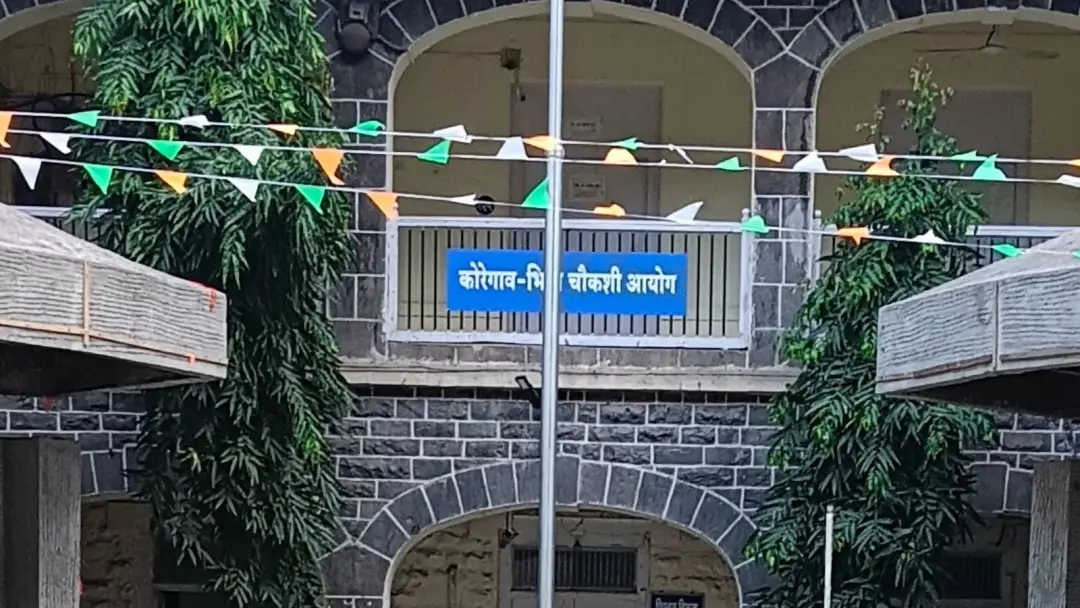
Koregaon Bhima inquiry panel ends evidence hearings after eight years
The commission set up by the Maharashtra government to probe the January 1, 2018 violence at Koregaon Bhima in Pune district has concluded hearings to record evidence, nearly eight and a half years after it was formed. It has received a 23rd extension, till October 31, 2026, to submit its final report, per a September 11 letter by Home Department Joint Secretary Rajendra Holkar. Commission lawyer Ashish Satpute said 58 witnesses, including Sharad Pawar and Prakash Ambedkar, were examined. One person died in the violence.
Source
Indian Express — Cities · read the original report ↗
Desk check · compared with the source
What the desk checked (5)
- The Koregaon Bhima Commission of Inquiry has concluded hearings to record evidence, nearly eight and a half years after being formed. — Attributed to Commission secretary V V Palnitkar and advocate Ashish Satpute in the source.
- The Commission got a 23rd extension till October 31, 2026, via a September 11 letter by Joint Secretary Rajendra Holkar. — Figures and names appear in the source, citing the Home Department letter; source also notes the previous extension ran to August 31, 2026.
- 58 witnesses were examined, including Sharad Pawar, Prakash Ambedkar, Rashmi Shukla and Saurabh Rao. — Attributed to advocate Ashish Satpute.
- One person died and several were injured in the January 1, 2018 violence at Koregaon Bhima and adjoining villages. — Stated in the source without a named official source.
- One party blamed Milind Ekbote and Sambhaji Bhide; the other alleged Elgaar Parishad organisers instigated the violence. — Presented in the source as rival allegations by parties before the Commission, not as established fact.
Analysts’ view opinion
The Koregaon Bhima Commission has finished recording evidence, but the fact that it took nearly eight and a half years and 23 extensions says a lot about how politically delicate this file is in Maharashtra. With one side pointing at Hindutva leaders and the other at the Elgaar Parishad organisers, and with figures like Sharad Pawar and Prakash Ambedkar deposing as witnesses, whichever way the final report leans will carry weight in the contest between Dalit-Ambedkarite politics and Hindutva mobilisation. That the inquiry outlived multiple political configurations also shows how delayed accountability can cool the political heat around an issue.
- Eight and a half years and 23 extensions give opponents an easy line about accountability being deferred, while the government can defend the pace as ensuring a full hearing for every party.
- Two clearly opposed camps appeared before the Commission — one blaming Hindutva leaders, the other the Elgaar Parishad organisers — so any tilt in the report hands one side a political win.
- The appearance of leaders like Sharad Pawar and Prakash Ambedkar as witnesses underlines that this is not merely a law-and-order inquiry but an issue tied to Dalit-Ambedkarite political identity.
- With the deadline now October 31, 2026, the report could land in a politically active window, sharpening reactions to whatever it concludes.
- A prolonged inquiry into violence in which one person died raises political questions about how victims' communities view the pace of justice.
What to watch — Watch whether the report is actually submitted by the new deadline and whether the government tables it in full — both will determine how loud the political reaction gets.
The story does not establish what the Commission has concluded or whom it holds responsible; it only confirms that evidence-recording is over.
Deep dive
Research brief · 8 facts · 7 dates · exam-readyThe brief
Context
On January 1, 2018, violence broke out at Koregaon Bhima and adjoining villages in Pune district while lakhs of Ambedkarites had gathered to mark the 200th anniversary of the battle of Koregaon Bhima; one person died and several were injured. The Maharashtra government set up a two-member Commission of Inquiry on February 9, 2018, headed by retired high court justice J N Patel, with former chief secretary Sumit Malik, to establish the "exact sequence" of events. Nearly eight and a half years later, the panel has concluded its hearings to record evidence and has received a 23rd extension, till October 31, 2026, to submit its final report. Before the Commission, one side blamed Hindutva leaders Milind Ekbote and Sambhaji Bhide, while the other pointed to organisers of the Elgaar Parishad held at Pune's Shaniwar Wada on December 31, 2017.
Key facts
- Violence at Koregaon Bhima and adjoining villages in Pune district on January 1, 2018 left one person dead and several injured.
- The two-member Commission of Inquiry was constituted on February 9, 2018, headed by retired high court justice J N Patel, with former chief secretary Sumit Malik as the other member.
- The Commission was initially given four months to report; it has now received its 23rd extension, till October 31, 2026 — the previous one ran till August 31, 2026.
- Home Department Joint Secretary Rajendra Holkar issued the extension letter on September 11.
- Commission lawyer advocate Ashish Satpute said 58 witnesses were examined.
- Witnesses included NCP(SP) chief Sharad Pawar, VBA president Prakash Ambedkar, then Pune city police commissioner Rashmi Shukla, then Pune rural SP Suvez Haque and then collector Saurabh Rao.
- The Commission received over 400 affidavits from police, government officials and civilians.
- The Commission could not function during the Covid-19 outbreak, one reason for the repeated extensions.
Timeline
- December 31, 2017Elgaar Parishad conclave held at Shaniwar Wada in Pune, alleged by one party before the Commission to have been planned by the banned CPI-Maoist.
- January 1, 2018Violence at Koregaon Bhima and nearby villages during the 200th anniversary commemoration of the battle; one person killed, several injured.
- February 9, 2018Maharashtra government constitutes the two-member Commission of Inquiry under retired justice J N Patel with Sumit Malik; initial tenure four months.
- After formationCommission invites affidavits from public and officials; receives over 400; begins hearings in Mumbai and Pune a few days every month.
- Covid-19 outbreak periodCommission could not function, contributing to repeated extensions.
- September 11Home Department Joint Secretary Rajendra Holkar issues letter granting the 23rd extension, till October 31, 2026.
- Friday (as reported)Commission secretary V V Palnitkar confirms hearings to record evidence are concluded and final report is being prepared.
Who has a stake
- Koregaon Bhima Commission of Inquiry (Justice J N Patel, Sumit Malik) — Must now finalise and submit its report on the causes and sequence of the 2018 violence by October 31, 2026.
- Maharashtra government / Home Department — Granted 23 extensions; will receive the report and its recommendations on preventing such incidents and better law-and-order management.
- Ambedkarite groups and Dalit Mahar community — Seek accountability for the violence; the community claims the disputed tomb-like structure at Vadhu Budruk is the samadhi of Govind Gopal Dhegoji Meghoji.
- Milind Ekbote and Sambhaji Bhide — Named by one party before the Commission as responsible for the violence.
- Elgaar Parishad organisers and activists (e.g., Harshali Potdar) — Accused by the other party of instigating the January 1 violence; Potdar deposed before the Commission.
- Senior politicians and officials who deposed — Sharad Pawar, Prakash Ambedkar, Rashmi Shukla, Suvez Haque, Saurabh Rao, Vishwas Patil — their testimony shapes findings on administrative and political responsibility.
- Villagers of Koregaon Bhima and Vadhu Budruk — Directly affected residents; Vadhu Budruk gram panchayat was represented by counsel who cross-examined witnesses.
Why it matters
A commission meant to report in four months has taken over eight and a half years and 23 extensions, raising questions about the pace and utility of statutory inquiries into communal and caste-related violence. Its findings will bear on contested narratives about who instigated the January 1, 2018 violence and on the Elgaar Parishad case, and on what the state must do to prevent recurrences at politically sensitive commemorations.
UPSC angle
Prelims pointers
- Koregaon Bhima violence: January 1, 2018, Pune district; one person died during the 200th anniversary commemoration of the battle.
- Commission of Inquiry constituted February 9, 2018: retired high court justice J N Patel (head) and ex-chief secretary Sumit Malik.
- 23rd extension granted till October 31, 2026; earlier deadline was August 31, 2026; original tenure was four months.
- 58 witnesses examined; over 400 affidavits received from police, officials and civilians.
- Elgaar Parishad was held at Shaniwar Wada, Pune, on December 31, 2017.
- Vadhu Budruk, over 3 km from Koregaon Bhima, houses Chhatrapati Sambhaji Maharaj's samadhi and a disputed tomb-like structure.
Mains framing
The Koregaon Bhima inquiry illustrates both the purpose and the pathology of commissions of inquiry in India. Set up within weeks of the January 1, 2018 violence to determine the "exact sequence" of events, the two-member panel under Justice J N Patel was given four months but needed 23 extensions over eight and a half years, delayed partly by the Covid-19 outbreak and partly by the sheer volume of material — over 400 affidavits, 58 witnesses ranging from Sharad Pawar and Prakash Ambedkar to the then police commissioner, rural SP and district collector, each cross-examined by counsel for competing parties. The proceedings also mirrored the polarised public contest: one side attributing the violence to Hindutva leaders Milind Ekbote and Sambhaji Bhide, the other to Elgaar Parishad organisers allegedly linked to the banned CPI-Maoist. The implications are twofold: prolonged inquiries dilute both deterrence and closure for victims, while findings arriving years later risk being overtaken by parallel criminal investigations and shifting politics. The way forward, as the Commission's own mandate suggests, lies in translating its recommendations on preventing such incidents and managing law and order at mass commemorations into enforceable administrative protocols, alongside stricter adherence to statutory timelines and transparent reasons for every extension.
Key terms
- Commission of Inquiry
- A panel appointed by government to investigate a defined matter of public importance and report findings; here, the Koregaon Bhima panel set up on February 9, 2018.
- Koregaon Bhima
- Village in Pune district where lakhs of Ambedkarites gathered on January 1, 2018 to commemorate the 200th anniversary of the battle; violence broke out that day.
- Elgaar Parishad
- Conclave held at Pune's Shaniwar Wada on December 31, 2017, alleged by one party before the Commission to have been planned by the banned CPI-Maoist.
- Vadhu Budruk
- Village over 3 km from Koregaon Bhima with Chhatrapati Sambhaji Maharaj's samadhi and a disputed tomb-like structure claimed by the Dalit Mahar community.
- VBA
- Vanchit Bahujan Aghadi, the party whose president Prakash Ambedkar deposed before the Commission.
- NCP(SP)
- The Nationalist Congress Party (Sharadchandra Pawar) faction, headed by Sharad Pawar, who was examined as a witness.
Practice questions
- Commissions of inquiry are meant to establish facts quickly but often take years. Examine this with reference to the Koregaon Bhima Commission's eight-and-a-half-year timeline and 23 extensions.
- Discuss how the administration should balance the right to assemble at caste and community commemorations with the prevention of communal violence, using the January 1, 2018 Koregaon Bhima events as a case study.
- What are the limitations of fact-finding commissions when parallel criminal investigations are underway on the same incident? Illustrate with the Koregaon Bhima and Elgaar Parishad cases.
Grounded only in the source report — figures and dates are the source's, not inferred.