
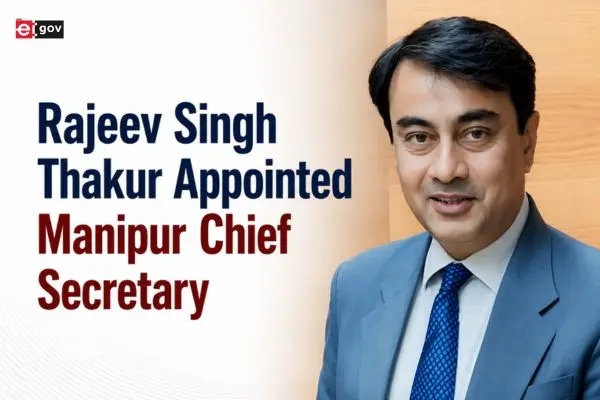
Rajeev Singh Thakur appointed Manipur Chief Secretary
The Centre has appointed Rajeev Singh Thakur, a 1995-batch IAS officer of the Rajasthan cadre, as the new Chief Secretary of Manipur. The Appointments Committee of the Cabinet cleared his inter-cadre deputation by relaxing applicable policy provisions. He will hold the post until his retirement on June 30, 2029. Thakur will also hold additional charge as Chief Vigilance Commissioner and Principal Resident Commissioner, Manipur Bhawan, New Delhi. He was earlier Adviser at NITI Aayog from February 2025.
Source
Manipur — CM & govt · read the original report ↗
Desk check · compared with the source
What the desk checked (5)
- The Centre approved the inter-cadre deputation of Rajeev Singh Thakur, a 1995-batch IAS officer of the Rajasthan cadre, to Manipur. — Attributed to the Centre in the source; no order number or official document cited.
- The Appointments Committee of the Cabinet cleared the deputation by relaxing applicable policy provisions. — Attributed to ACC in the source; wording of the relaxation not detailed.
- Thakur will continue as Chief Secretary until his retirement on June 30, 2029. — Date appears in source; internally consistent with a 1995-batch officer.
- He holds additional charge as Chief Vigilance Commissioner and Principal Resident Commissioner, Manipur Bhawan, New Delhi. — Stated in source without separate attribution.
- He was serving as Adviser at NITI Aayog from February 2025 before the Manipur posting. — Figure and date appear in source; no source given for the detail.
Analysts’ view opinion
Bringing in a Rajasthan-cadre officer as Manipur's Chief Secretary — and relaxing policy provisions to do it — is a clear signal that the Centre is tightening its grip on the state's administrative levers. Loading one officer with the Chief Secretary's post, the Chief Vigilance Commissioner's charge and the Principal Resident Commissioner role in Delhi concentrates three critical channels — administration, oversight and the Delhi interface — in a single pair of hands. A tenure running to June 2029 offers continuity, but it also opens space for political argument.
- The ACC's decision to relax policy provisions for an inter-cadre deputation suggests this was a deliberate pick rather than a routine posting.
- Combining Chief Secretary, vigilance and Delhi representation in one officer centralises decision-making to an unusual degree.
- Choosing an officer with Defence and Military Affairs experience is likely to be read politically as prioritising security-administration coordination.
- A long runway to 2029 aids administrative continuity, but may invite the 'outsider officer' criticism from sections of local politics.
- Because relief and rehabilitation are sensitive files, how different community and political groups receive this appointment will largely decide its political success.
What to watch — Watch how Manipur's political parties and civil society groups respond, and what the new Chief Secretary sets as his first administrative priorities.
The story does not establish the reasoning behind the appointment, who recommended it, or any reaction from any political quarter — it reports the official appointment only.
Deep dive
Research brief · 8 facts · 4 dates · exam-readyThe brief
Context
The Union government has approved the inter-cadre deputation of Rajeev Singh Thakur, a 1995-batch IAS officer of the Rajasthan cadre, to Manipur and appointed him the state's new Chief Secretary. The Appointments Committee of the Cabinet (ACC) cleared the move by relaxing applicable policy provisions, and he will hold the post until his retirement on June 30, 2029. Thakur, who was serving as Adviser at NITI Aayog since February 2025, will also hold additional charge as Chief Vigilance Commissioner and as Principal Resident Commissioner, Manipur Bhawan, New Delhi. The source notes the appointment comes as Manipur continues to focus on administrative coordination, governance, relief and rehabilitation.
Key facts
- Rajeev Singh Thakur, a 1995-batch IAS officer of the Rajasthan cadre, has been appointed Chief Secretary of Manipur.
- The Appointments Committee of the Cabinet (ACC) approved his inter-cadre deputation to Manipur by relaxing applicable policy provisions.
- He will continue as Chief Secretary until June 30, 2029, the date of his retirement from government service.
- He holds additional charge as Chief Vigilance Commissioner and as Principal Resident Commissioner, Manipur Bhawan, New Delhi.
- Before the Manipur posting he was Adviser at NITI Aayog, a post he took up in February 2025.
- In Rajasthan he served as District Collector of Banswara, Bhilwara, Alwar, Karauli and Sri Ganganagar.
- At the Centre he was Joint Secretary in the Ministry of Defence and the Department of Military Affairs, and later Additional Secretary in DPIIT.
- His earlier Central assignments covered the Ministry of Rural Development, Ministry of Road Transport and Highways, and Ministry of Railways.
Timeline
- 1995Thakur joins the IAS; allotted the Rajasthan cadre.
- February 2025Takes up the post of Adviser at NITI Aayog.
- Current (date not stated in the source)Centre approves his inter-cadre deputation to Manipur; appointed Chief Secretary with additional charge as Chief Vigilance Commissioner and Principal Resident Commissioner, Manipur Bhawan, New Delhi.
- June 30, 2029Scheduled retirement from government service; he is to continue as Chief Secretary until then.
Who has a stake
- Rajeev Singh Thakur — Takes over as Manipur Chief Secretary with additional charge as Chief Vigilance Commissioner and Principal Resident Commissioner, until June 30, 2029.
- Appointments Committee of the Cabinet (ACC) — The authority that cleared the inter-cadre deputation by relaxing applicable policy provisions.
- Government of Manipur — Gains a Chief Secretary expected to aid administrative coordination, governance, relief and rehabilitation efforts.
- Government of Rajasthan (parent cadre) — Loses a senior 1995-batch officer to inter-cadre deputation for several years.
- NITI Aayog — Vacancy created as its Adviser since February 2025 moves to Manipur.
- Manipur Bhawan, New Delhi — Its Principal Resident Commissioner charge now rests with the new Chief Secretary.
Why it matters
The Chief Secretary is the administrative head of a state government, and in Manipur the post carries added weight amid the state's focus on governance, relief and rehabilitation. The use of inter-cadre deputation with a relaxation of policy provisions shows the Centre's direct role in staffing key positions in the state. Concentrating the Chief Vigilance Commissioner and Principal Resident Commissioner charges in the same officer also centralises oversight and Centre-state liaison functions.
UPSC angle
Prelims pointers
- Appointments Committee of the Cabinet (ACC) approves senior IAS appointments, including inter-cadre deputations.
- Rajeev Singh Thakur: 1995-batch IAS, Rajasthan cadre, appointed Chief Secretary of Manipur until June 30, 2029.
- He holds additional charge as Chief Vigilance Commissioner and Principal Resident Commissioner, Manipur Bhawan, New Delhi.
- DPIIT (Department for Promotion of Industry and Internal Trade) is where he served as Additional Secretary.
- He was Adviser at NITI Aayog from February 2025 before the Manipur posting.
- Resident Commissioner heads a state's Bhawan in New Delhi, the state's liaison office with the Centre.
Mains framing
The appointment of a Rajasthan-cadre officer as Manipur's Chief Secretary through inter-cadre deputation, cleared by the ACC with a relaxation of policy provisions, illustrates how the Union government uses its powers over the All India Services to strengthen administration in states facing governance stress. Manipur's stated priorities of administrative coordination, relief and rehabilitation demand continuity and senior experience, which the source links to Thakur's more than three decades across district administration in Rajasthan (Banswara, Bhilwara, Alwar, Karauli, Sri Ganganagar), state-level work in rural development, livelihoods and food and civil supplies, and Central postings in Defence, the Department of Military Affairs, DPIIT, Rural Development, Road Transport and Highways and Railways. A fixed tenure until his retirement on June 30, 2029 offers administrative stability, while the clubbing of the Chief Vigilance Commissioner and Principal Resident Commissioner, Manipur Bhawan charges concentrates vigilance oversight and Centre-state liaison in one office. The way forward, on the evidence of the source, lies in using this continuity for coordinated relief and rehabilitation delivery; whether such relaxations should become routine, and how workload across three charges is managed, is not stated in the source.
Key terms
- Inter-cadre deputation
- Posting of an IAS officer from the allotted state cadre (here Rajasthan) to serve in another state (Manipur).
- Appointments Committee of the Cabinet (ACC)
- The Cabinet body that approves senior civil service appointments; it cleared this deputation by relaxing policy provisions.
- Chief Secretary
- The senior-most administrative officer and head of the state government's bureaucracy.
- Chief Vigilance Commissioner (state charge)
- Officer overseeing vigilance and anti-corruption matters; here held as additional charge by the Chief Secretary.
- Principal Resident Commissioner, Manipur Bhawan
- Head of the state's representative office in New Delhi handling liaison with the Central government.
- DPIIT
- Department for Promotion of Industry and Internal Trade, where Thakur served as Additional Secretary.
Practice questions
- Discuss the role of the Appointments Committee of the Cabinet in senior civil service appointments, and examine the implications of relaxing policy provisions for inter-cadre deputations.
- The Chief Secretary is the pivot of state administration. Analyse how tenure certainty and concentration of multiple charges affect administrative effectiveness in a state focused on relief and rehabilitation.
- Inter-cadre deputation of All India Services officers is used to meet specific state needs. Critically evaluate its impact on Centre-state administrative relations.
Grounded only in the source report — figures and dates are the source's, not inferred.