
RTI appeal on Ramagundam corporation: notices issued for hearing
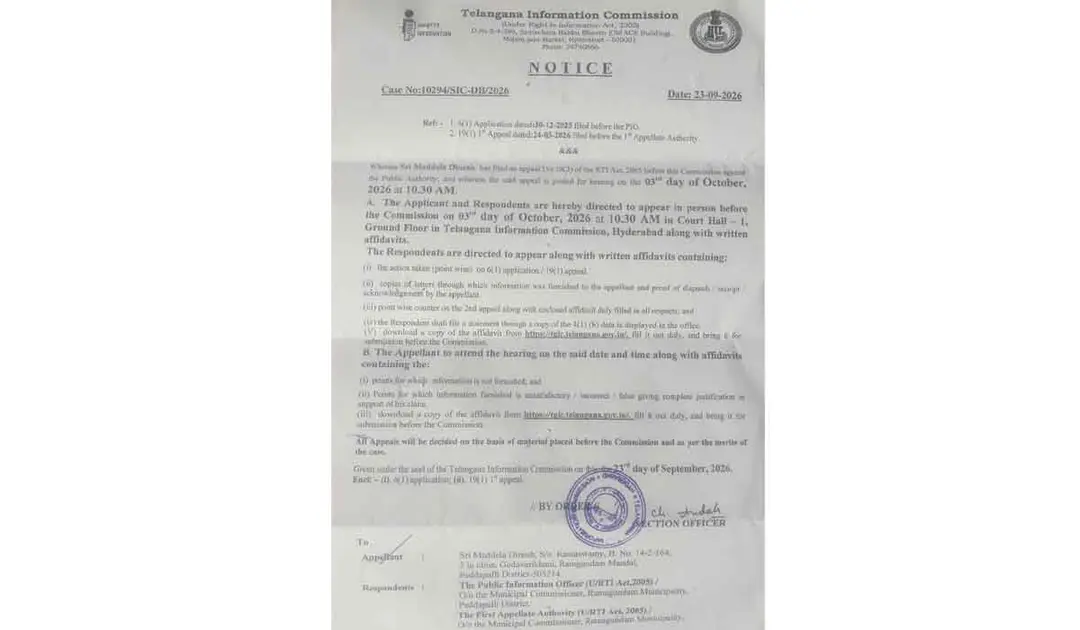
The Telangana Information Commission has issued notices to both parties on an appeal filed by social activist Maddela Dinesh under the RTI Act, 2005, seeking information relating to Ramagundam Municipal Corporation. Dinesh said the corporation's Public Information Officer has been made respondent in case no. 10234/SIC-DB/2026, and the hearing will be held in Hyderabad on October 3. He alleged corruption in the corporation and said he would submit evidence by affidavit.
Source
Ramagundam — స్థానికం · read the original report ↗
Desk check · some claims need care
What the desk checked (5)
- Telangana Information Commission issued notices to both parties on an RTI appeal filed by social activist Maddela Dinesh — Attributed to the applicant Maddela Dinesh; no commission document or official quoted in source.
- Case number 10234/SIC-DB/2026, with Ramagundam Municipal Corporation Public Information Officer as respondent — Figure and reference appear in source, sourced to the applicant's statement.
- Hearing to be held on October 3 before the Telangana Information Commission in Hyderabad — Date appears in source as stated by the applicant; not independently confirmed.
- Ramagundam Municipal Corporation commissioner and staff act as ruling-party leaders and serious corruption occurs in the corporation — Allegation by the applicant; no evidence cited and no response from the corporation in the source.
- The notice has become a subject of discussion among corporation officials — General assertion by the reporter with no source given.
Analysts’ view opinion
On the surface this is merely a notice on a routine RTI appeal. But in a coal town like Ramagundam, where the complaint is tied to an allegation that the civic machinery behaves like the ruling party's extension, transparency quickly becomes a local political weapon. A commission notice does not mean the allegations are established — only that a process has begun; yet the very fact that it is being discussed within official circles shows where the political value of such cases lies.
- The commission taking up an activist's appeal hands opposition and civil-society pressure on local governance a legally sanctioned platform.
- The claim that officials act as "ruling party leaders" — and it remains only a claim — echoes a familiar local grievance about the blurring line between administration and party machinery.
- The exposure for the ruling side is more reputational than electoral: releasing records invites scrutiny, withholding them invites accusations of concealment.
- Because the hearing is before the state commission in Hyderabad, a municipal dispute could gain visibility beyond the district.
- No party is named in the story, so the fairer frame is accountability versus local officialdom rather than a straight party-versus-party fight.
What to watch — Watch whether the corporation's public information officer produces the records at the October 3 hearing or seeks time — that will largely decide how far this grows politically.
The corruption allegations are the applicant's own assertions; the story neither substantiates them nor carries any response from the corporation or its officials.
Deep dive
Research brief · 8 facts · 4 dates · exam-readyThe brief
Context
Social activist Maddela Dinesh sought information about the Ramagundam Municipal Corporation in Telangana's Karimnagar region under the Right to Information Act, 2005. After his request was not satisfied at the corporation level, he filed an appeal before the Telangana Information Commission, the state's apex RTI appellate body. The Commission has now issued notices to both parties to appear for a hearing, with the corporation's Public Information Officer named as respondent. Dinesh has alleged serious corruption in the corporation and says he will place evidence before the Commission by affidavit.
Key facts
- The appeal was filed under the RTI Act, 2005, seeking information relating to Ramagundam Municipal Corporation.
- The Telangana Information Commission has issued notices to both parties directing them to attend the hearing.
- The case is registered as case no. 10234/SIC-DB/2026.
- The Public Information Officer (PIO) of Ramagundam Municipal Corporation has been made the respondent in the case.
- The hearing is scheduled for October 3 before the Telangana Information Commission in Hyderabad.
- The report is dated September 29, 2026, 07:13 PM IST, filed from 'Coal City' (Ramagundam), Karimnagar.
- Appellant Maddela Dinesh alleged that the Ramagundam Municipal Corporation Commissioner and other staff act as ruling-party leaders rather than as officials, and that severe corruption is taking place in the corporation.
- Dinesh said he will submit full details in the form of an affidavit as per the Commission's direction.
Timeline
- Before the notice (date not stated in the source)Maddela Dinesh files an RTI application and subsequently an appeal seeking information on Ramagundam Municipal Corporation.
- On or before September 29, 2026Telangana Information Commission issues notices to both parties in case no. 10234/SIC-DB/2026; the corporation's PIO is made respondent.
- September 29, 2026Dinesh publicly speaks about the notice, alleging corruption in the corporation; the notice becomes a talking point among corporation officials.
- October 3Hearing to be held before the Telangana Information Commission at Hyderabad.
Who has a stake
- Maddela Dinesh, social activist and appellant — Seeks disclosure of corporation records; says he will use the RTI right effectively and submit evidence with an affidavit.
- Public Information Officer, Ramagundam Municipal Corporation — Named respondent; must appear before the Commission and answer for the information sought.
- Ramagundam Municipal Corporation (Commissioner and staff) — Faces allegations of corruption and of officials behaving as ruling-party functionaries; the notice has become a talking point among officials.
- Telangana Information Commission — Statutory appellate authority that must hear both sides and decide on disclosure in case no. 10234/SIC-DB/2026.
- Residents of Ramagundam — Outcome determines public access to information on the functioning and spending of their municipal corporation.
Why it matters
The case shows how an ordinary citizen can use the RTI Act to force a municipal body to account for its records before an independent statutory commission. Urban local bodies handle civic works and public money, so transparency at the corporation level directly affects service delivery and checks on corruption. The hearing will test whether the appellate route under RTI delivers timely disclosure when a Public Information Officer is alleged to have withheld information.
UPSC angle
Prelims pointers
- Right to Information Act came into force in 2005; appeals from a public authority's PIO go up to the State Information Commission.
- Telangana Information Commission is the state-level RTI appellate body; it sits in Hyderabad.
- Case in the news: no. 10234/SIC-DB/2026, respondent being the PIO of Ramagundam Municipal Corporation.
- Ramagundam, in the Karimnagar region of Telangana, is referred to as 'Coal City'.
- Public Information Officer (PIO) is the designated official in every public authority responsible for supplying information under RTI.
Mains framing
The Ramagundam episode illustrates both the promise and the friction points of India's transparency regime. The RTI Act, 2005 created a citizen's enforceable right to information backed by an appellate structure culminating in State Information Commissions; yet appeals arise precisely because Public Information Officers in local bodies often do not furnish records at first instance, pushing citizens into a second round of litigation-like hearings, here at Hyderabad, far from Ramagundam. The activist's allegation that corporation officials function as ruling-party leaders points to the deeper problem of weak separation between political authority and municipal administration in urban local bodies that handle substantial civic funds. The way forward suggested by such cases lies in proactive disclosure of municipal records, prompt and reasoned PIO responses, faster disposal of second appeals and credible action where the Commission finds information was wrongly withheld — while equally requiring that allegations of corruption be tested on evidence, as the appellant proposes to do through affidavit, rather than settled by assertion.
Key terms
- RTI Act, 2005
- Law giving citizens the right to seek information from public authorities, with a graded appeal mechanism.
- Telangana Information Commission
- State statutory body that hears RTI appeals and complaints; sits in Hyderabad.
- Public Information Officer (PIO)
- Official designated by a public authority to receive RTI applications and provide the information sought.
- Respondent
- The party against whom an appeal is filed; here, the PIO of Ramagundam Municipal Corporation.
- Affidavit
- A sworn written statement submitted as evidence; the appellant says he will file details this way.
- Municipal Corporation
- Urban local body governing a city, headed administratively by a Commissioner.
Practice questions
- Discuss how the appellate mechanism under the RTI Act, 2005 strengthens accountability in urban local bodies, using the Ramagundam Municipal Corporation case as an illustration.
- What are the structural reasons why citizens are forced to approach State Information Commissions instead of receiving information from Public Information Officers at first instance? Suggest remedies.
- Transparency in municipal administration is weakened when officials are perceived as acting for political parties. Examine this statement with reference to the functioning of urban local bodies.
Grounded only in the source report — figures and dates are the source's, not inferred.