
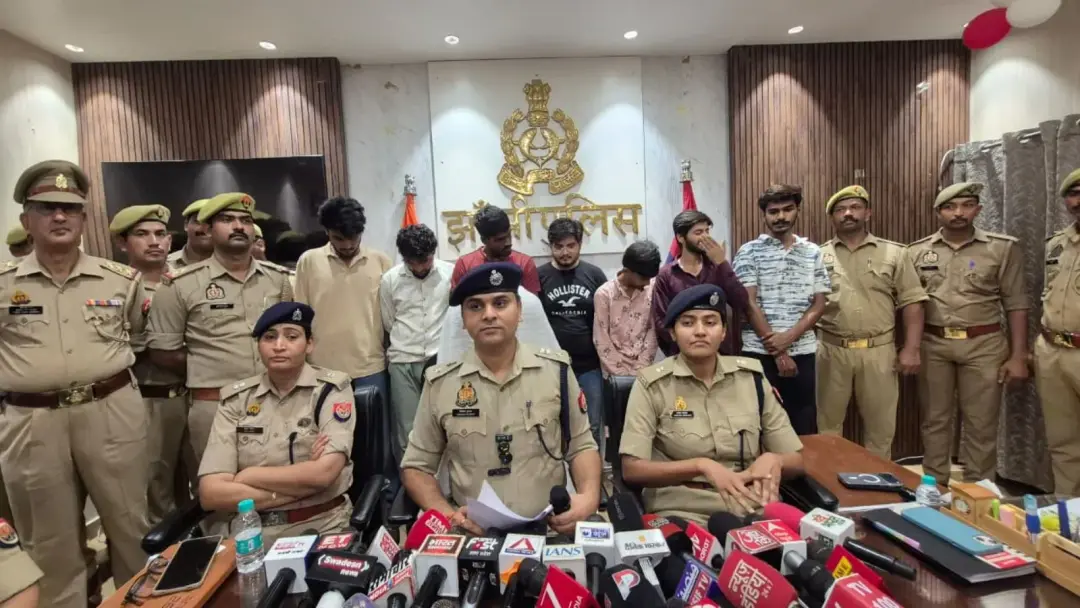
Bite marks turn Jhansi death into murder case; eight held
Police in Jhansi, Uttar Pradesh, initially treated the death of Parvez Ali, a 21-year-old law student found on a main road last Sunday, as accidental. After the postmortem report showed six human bite marks on his right thigh, a murder case was registered. An investigation led by five women officers led to the arrest of eight people, including a police constable, on Friday. Police said the accused, calling themselves 'Rashtra Bhakt', extorted money from those involved in crime.
Source
Indian Express — Cities · read the original report ↗
Desk check · some claims need care
What the desk checked (5)
- Six human bite marks on the right thigh of 21-year-old law student Parvez Ali turned a suspected accidental death into a murder probe. — Attributed to police and the postmortem report as described in the source.
- Eight people, including Prem Nagar police station constable Ashish Singh, were arrested on Friday. — Names and ages listed in source, attributed to police; no charge-sheet stage mentioned.
- The accused claimed to belong to a group called 'Rashtra Bhakt' but allegedly extorted money using video and audio evidence found by police. — Police claim; evidence not independently verifiable from the source.
- Investigation led by five women officers; footage from over 150 cameras examined; seven mobile phones and three cars recovered. — Figures and names appear in source, attributed to SSP Vikash Kumar.
- Dental samples of Vanshkar and Namdev sent for matching; white powder from victim's pocket sent for examination. — Stated as pending tests; results not available in source.
Analysts’ view opinion
The bite marks in the postmortem report are what turned this from a presumed accident into a murder investigation — a textbook illustration of how forensic findings can reshape the legal character of a case. Two distinct serious questions now sit side by side: the allegation that police authority was borrowed to illegally detain a man and extort money from him, and the separate question of what grade of homicide, if any, the resulting death attracts. The victim's alleged prior case and alleged drug involvement are legally irrelevant as justification — a person suspected of crime retains the same rights to life and liberty as anyone else.
- An FIR first registered against unknown persons, later recast as murder on the strength of the postmortem, shows how decisively the forensic report drove the direction of the investigation.
- Because the accused reportedly say they had no intention to kill and were trying to revive him, the distinction between intentional murder and culpable homicide not amounting to murder is likely to be the central contest at trial.
- The alleged involvement of a serving constable opens a second track beyond ordinary criminal charges — departmental proceedings and the question of abuse of official position.
- Dental sample matching, footage from more than 150 cameras, call records and an online transaction are all circumstantial strands; their manner of collection and chain of custody will have to hold up in court.
- No private group, whatever name it uses, has legal power to apprehend and hold a person for money; arrest and detention are permitted only through defined procedures with built-in safeguards.
What to watch — Watch for the arrest of the remaining suspects, the forensic result on the dental samples and the white powder, and above all which sections the chargesheet invokes — murder or a lesser homicide offence.
Everything here is at the stage of police allegation: guilt, the precise injury that caused death, and any match with the bite marks remain unproven in court, and the accused persons' own version is not set out in this story.
Deep dive
Research brief · 8 facts · 6 dates · exam-readyThe brief
Context
Parvez Ali, a 21-year-old final-year law student from Jhansi, Uttar Pradesh, was found injured on a main road in the Prem Nagar police station area last Sunday and later died in hospital. Police initially treated it as an accidental death, suspecting the heavily intoxicated victim had fallen and suffered a fatal head injury. A postmortem report showing six human bite marks on his right thigh, along with other injuries, prompted a murder case. An investigation led by five women officers resulted in the arrest of eight people on Friday, including a police constable, allegedly part of a self-styled vigilante group called 'Rashtra Bhakt' that extorted money from those involved in crime.
Key facts
- Postmortem revealed six human bite marks on the right thigh of victim Parvez Ali, 21, a final-year law student of Jhansi, along with other injury marks.
- Eight men, all residents of Jhansi, were arrested on Friday: Prayansh (30), Jai Srivastava alias Aman (24), Sahil Mishra (21), Bhupendra Vanshkar (23), Yash Shivhare alias Bittu (23), Arshil Khan (20), Shani Namdev (24) and constable Ashish Singh (30).
- Accused constable Ashish Singh is posted at Prem Nagar police station, the same station area where the body was found.
- Police recovered seven mobile phones and three cars allegedly used in the crime; a white powder suspected to be a drug was found in Parvez's pocket and sent for examination.
- Dental samples of accused Bhupendra Vanshkar and Shani Namdev were collected for matching with the bite marks on the victim's body.
- Investigators examined footage from more than 150 cameras and call records of several people to piece together the case.
- An online transaction of Rs 5,000 took place for viewing and obtaining a drug sample before the victim got into the accused's car.
- SSP Jhansi Vikash Kumar said police are looking for three more persons involved in the crime.
Timeline
- Around 9 pm, September 13Parvez Ali booked a Rapido and left home, telling his father Ahsan Ali he would return in an hour or two.
- Same night (day of incident)Accused Sahil called Parvez on the pretext of collecting a drug sample; Parvez reached the spot on a friend's bike and got into Sahil's car, with two other cars following.
- Inside the carParvez grew suspicious and resisted; the accused assaulted him. As he lost consciousness, Vanshkar and Namdev allegedly bit his thigh to revive him, then abandoned the body believing he was dead.
- Last SundayPolice, alerted about an injured person at Nagra Haat Maidan under Prem Nagar police station, sent him to hospital where he died; death treated as accidental.
- After postmortem reportSix bite marks led police to suspect foul play; a case was registered against unknown persons as the body was then unidentified.
- FridayEight people, including a police constable, arrested after an investigation led by a team of five women officers.
Who has a stake
- Parvez Ali and his family — The 21-year-old law student died; his father Ahsan Ali gave police the crucial account of his son leaving home by Rapido on September 13.
- Jhansi police / SSP Vikash Kumar — Credibility at stake after initially calling the death accidental; now leading the murder probe and hunt for three more accused.
- Five women officers (SPs Areeba Nomaan and Simran Singh, ASP Preeti Singh, COs Priya Singh and Asma Waqar) — Led the investigation that converted a suspected accident into a murder case with eight arrests.
- Constable Ashish Singh, Prem Nagar police station — Accused of aiding the illegal detention and extortion plan; case raises questions of police complicity.
- The self-styled 'Rashtra Bhakt' group — Claimed to curb crime by handing offenders to police, but video and audio evidence allegedly shows extortion of criminals.
- Forensic and medico-legal agencies — Postmortem findings, dental sample matching and examination of the seized white powder will determine the strength of the case.
Why it matters
A death first written off as an accident became a murder case only because a postmortem recorded six bite marks, showing how forensic and medico-legal detail can decide whether a crime is investigated at all. The alleged involvement of a serving constable in a vigilante group that extorted money from suspected offenders highlights the danger of self-appointed crime-fighters operating with police complicity.
UPSC angle
Prelims pointers
- Victim: Parvez Ali, 21, final-year law student of Jhansi, Uttar Pradesh; previously booked in a case in Jammu and Kashmir.
- Body found at Nagra Haat Maidan under Prem Nagar police station, Jhansi; SSP Jhansi is Vikash Kumar.
- Turning point in the probe: postmortem report showing six human bite marks on the victim's right thigh.
- Eight arrested including constable Ashish Singh of Prem Nagar police station; three more accused being sought.
- Seizures: seven mobile phones, three cars, and a white powder suspected to be a drug found in the victim's pocket.
- Probe led by five women officers: SPs Areeba Nomaan and Simran Singh, ASP Preeti Singh, COs Priya Singh and Asma Waqar.
Mains framing
The Jhansi case illustrates three intersecting problems in everyday policing: premature classification of suspicious deaths, extortion rackets built on the vulnerability of those already engaged in crime, and insider complicity within the force. Police had attributed Parvez Ali's death to a fall while heavily intoxicated, and only the postmortem's record of six bite marks and other injuries triggered a murder case against unknown persons, after which digital investigation — over 150 CCTV cameras, call records, and video and audio evidence — exposed a group styling itself 'Rashtra Bhakt' that allegedly threatened drug offenders with exposure to extract money, with a serving constable helping to illegally detain the victim. The case also shows why drug peddlers and similar offenders rarely report extortion: complaining means self-incrimination, which vigilante groups exploit. The way forward, on the facts available, lies in mandatory forensic rigour and careful reading of postmortem findings before any death is closed as accidental, corroboration through dental sample matching and chemical examination of the seized powder, accountability proceedings against the police personnel involved, and no tolerance for private groups performing 'crime control' functions that only the state may lawfully perform.
Key terms
- 'Rashtra Bhakt'
- Self-styled group the accused claimed to belong to, purportedly apprehending offenders and handing them to police, but allegedly extorting money from them instead.
- Postmortem report
- Medico-legal autopsy findings; here it recorded six human bite marks and other injuries, converting a suspected accident into a murder probe.
- Bite mark / dental sample matching
- Forensic odontology technique comparing suspects' dental impressions with bite marks on a body; samples of Vanshkar and Namdev were sent for matching.
- Senior Superintendent of Police (SSP)
- Senior district police head; in Jhansi, Vikash Kumar, who confirmed three more accused are being sought.
- Circle Officer (CO)
- Police officer in charge of a circle of police stations in Uttar Pradesh; Priya Singh and Asma Waqar were part of the probe team.
- Illegal detention
- Confining a person without lawful authority; the accused allegedly detained Ali with the constable's help to threaten him with jail and extort money.
Practice questions
- Suspicious deaths are often closed as accidental in the absence of forensic scrutiny. Examine, with reference to the Jhansi case, how medico-legal evidence shapes the course of a criminal investigation.
- Self-styled vigilante groups claiming to assist the police undermine the rule of law. Discuss, highlighting the risks when serving police personnel collude with such groups.
- How can digital evidence such as CCTV footage, call detail records and online payment trails strengthen criminal investigations? Illustrate with a recent example.
Grounded only in the source report — figures and dates are the source's, not inferred.