
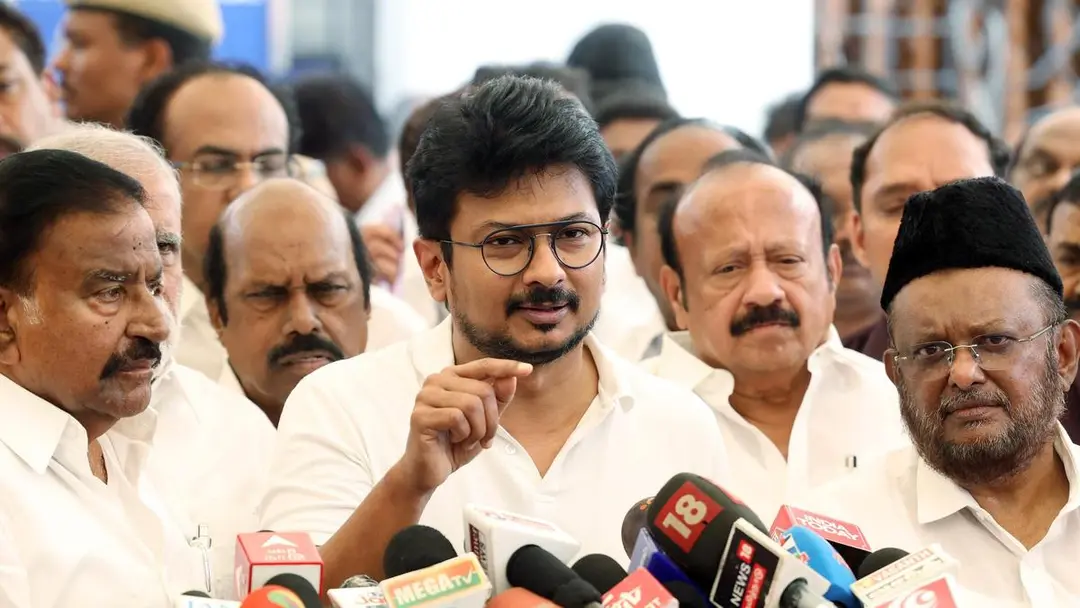
Udhayanidhi accuses TVK government of paralysing Union-State relations panel
Tamil Nadu Leader of the Opposition Udhayanidhi Stalin on Tuesday (September 15, 2026) condemned the TVK-led government for allegedly attempting to "paralyse" the functioning of the High Level Committee on Union-State Relations, headed by retired Supreme Court Judge Justice Kurian Joseph. The panel was constituted during the previous M.K. Stalin-led DMK government. In a post on X, the DMK youth wing head said the Committee faced difficulties due to a staff shortage, leaving researchers working on its second report on State autonomy unable to continue. He demanded uninterrupted functioning.
Source
The Hindu — National · read the original report ↗
Desk check · some claims need care
What the desk checked (5)
- Udhayanidhi Stalin accused the TVK-led government of attempting to 'paralyse' the High Level Committee on Union-State Relations — Attributed to his post on X on September 15, 2026; direct quotes appear in source.
- The Committee is headed by retired Supreme Court Judge Justice Kurian Joseph — Stated as fact in the source without further attribution.
- The Committee was constituted during the previous M.K. Stalin-led DMK government — Stated as background fact in the source; no document cited.
- The Committee faces difficulties due to a shortage of staff, leaving researchers unable to continue work on a second report on State autonomy — Based on unspecified 'reports' cited by Udhayanidhi; no independent source given.
- Udhayanidhi Stalin is Leader of the Opposition and heads the DMK youth wing — Stated in the source; no external verification possible here.
Analysts’ view opinion
This attack shows the DMK, now in opposition, moving to reclaim its most reliable political asset — the Dravidian plank of State rights and autonomy. By alleging that the Kurian Joseph committee set up under its own government is being "paralysed", Leader of the Opposition Udhayanidhi Stalin frames the new TVK government as timid before the Centre. Phrases like "dummy government" and the jab about "posting reels" are about political branding more than administrative critique. Notably, the story carries no government response, so for now this remains a one-sided charge.
- State autonomy is emotionally potent in Tamil Nadu politics, and the DMK wants to be seen as its authentic custodian.
- Because the committee was its own creation, any stalling gives the opposition a ready-made stick with which to beat the incumbent.
- Painting the new government as unwilling or unable to fight the Centre could become the DMK's central campaign narrative.
- Udhayanidhi, who also heads the party's youth wing, chose X for the attack — a deliberate pitch to younger, digital-first voters.
- Whether the staff shortage is routine administrative drift or deliberate neglect will determine how far this controversy travels.
What to watch — Watch whether the TVK government publicly commits staff and resources to the committee or lets it lapse — that choice will define its own positioning on State rights.
The story does not independently establish that the committee's work has stopped, why staff are short, or what the government's explanation is.
Deep dive
Research brief · 8 facts · 3 dates · exam-readyThe brief
Context
Tamil Nadu's Leader of the Opposition and DMK youth wing head Udhayanidhi Stalin has accused the ruling TVK-led State government of "paralysing" the High Level Committee on Union-State Relations, a panel headed by retired Supreme Court Judge Justice Kurian Joseph. The Committee was set up during the previous M.K. Stalin-led DMK government to examine Centre-State relations and State autonomy. According to Udhayanidhi, reports indicate the panel is unable to function due to a staff shortage, stalling work on its second report on State autonomy. The charge places the long-running debate on federalism and State rights at the centre of Tamil Nadu politics.
Key facts
- On Tuesday, September 15, 2026, LoP Udhayanidhi Stalin condemned the TVK-led Tamil Nadu government for allegedly attempting to "paralyse" the High Level Committee on Union-State Relations.
- The Committee is headed by retired Supreme Court Judge Justice Kurian Joseph.
- The Committee was constituted during the previous M.K. Stalin-led DMK government.
- Udhayanidhi made the allegation in a post on X; he heads the DMK youth wing.
- He said there were reports the Committee was facing difficulties in functioning due to a shortage of staff.
- He claimed researchers and research scholars working on the Committee's second report on State autonomy were unable to continue their work.
- He called the TVK-led government a "dummy government" that is "afraid to speak about or fight for State rights".
- He demanded that the Committee be allowed to function "without any interruption", saying "merely posting reels cannot establish State autonomy".
Timeline
- During the previous M.K. Stalin-led DMK government (date not stated in the source)High Level Committee on Union-State Relations constituted, headed by Justice Kurian Joseph (retd.).
- Tuesday, September 15, 2026Udhayanidhi Stalin posts on X condemning the TVK-led government for allegedly paralysing the Committee.
- September 16, 2026, 12:30 am ISTReport published.
Who has a stake
- Udhayanidhi Stalin, Leader of the Opposition in the Tamil Nadu Assembly — Leading the DMK's attack on the ruling TVK government over State rights and the functioning of the Committee.
- TVK-led Tamil Nadu government — Accused of paralysing the Committee and of being unwilling to fight for State rights; faces demand to restore staffing.
- High Level Committee on Union-State Relations — Its functioning is allegedly hampered by staff shortage, delaying its second report on State autonomy.
- Justice Kurian Joseph (retired Supreme Court Judge) — Heads the Committee whose work is said to be disrupted.
- Researchers and research scholars attached to the Committee — Reportedly unable to continue work on the second report on State autonomy.
- DMK — Committee was its initiative in government; its legacy on federalism and State autonomy is at issue.
Why it matters
The dispute turns a technical question of staffing into a live political test of how seriously Tamil Nadu's new government pursues State autonomy, a defining plank of the State's politics. If the High Level Committee on Union-State Relations cannot complete its second report, an institutional effort to document and argue the case for greater State powers within India's federal structure stalls.
UPSC angle
Prelims pointers
- High Level Committee on Union-State Relations (Tamil Nadu) is headed by retired Supreme Court Judge Justice Kurian Joseph.
- The Committee was constituted during the M.K. Stalin-led DMK government in Tamil Nadu.
- Udhayanidhi Stalin is Leader of the Opposition in the Tamil Nadu Assembly and heads the DMK youth wing.
- The Committee's second report is on State autonomy; its first report is implied but details are not stated in the source.
- The allegation of 'paralysing' the panel was made on September 15, 2026 via a post on X.
Mains framing
The controversy over the High Level Committee on Union-State Relations illustrates how federalism in India is contested not only between the Centre and States but also within State politics, where successive governments inherit and may abandon institutional mechanisms created by predecessors. The Committee, headed by Justice Kurian Joseph (retd.) and constituted under the previous DMK government, was intended to build an evidence base on State autonomy; the Opposition's charge is that a staff shortage under the TVK-led government has left researchers unable to complete its second report, amounting to deliberate paralysis. The immediate implication is discontinuity: expert panels depend on stable secretarial and research support, and interruptions can render their recommendations dated or incomplete. The wider implication is that State-rights advocacy risks becoming rhetorical rather than institutional, a point Udhayanidhi captures in his jibe that "merely posting reels cannot establish State autonomy". A way forward, on the source's own terms, is to ensure the Committee functions "without any interruption" by restoring staffing and research capacity so that its report can be completed and placed in the public domain. The source does not state the government's response, and no conclusion on the merits of the allegation can be drawn from it.
Key terms
- High Level Committee on Union-State Relations
- A Tamil Nadu government panel, headed by Justice Kurian Joseph (retd.), constituted under the previous DMK government to examine Centre-State relations.
- State autonomy
- Greater powers and self-governance for States within the Indian federal structure; the subject of the Committee's second report.
- Leader of the Opposition (LoP)
- The head of the largest opposition party in a legislature; here, Udhayanidhi Stalin in the Tamil Nadu Assembly.
- TVK
- The party leading the current Tamil Nadu government, as described in the source; further details not stated in the source.
- DMK
- Dravida Munnetra Kazhagam, the party of Udhayanidhi Stalin and of the previous M.K. Stalin-led State government.
Practice questions
- Expert committees on Centre-State relations depend on continuous institutional support to be effective. Discuss with reference to the controversy over Tamil Nadu's High Level Committee on Union-State Relations.
- Examine how State autonomy has functioned as both a constitutional demand and a political plank in Tamil Nadu politics, using the debate over the Justice Kurian Joseph committee.
- Should commissions and committees set up by one State government be insulated from discontinuation by its successor? Argue your case.
Grounded only in the source report — figures and dates are the source's, not inferred.