
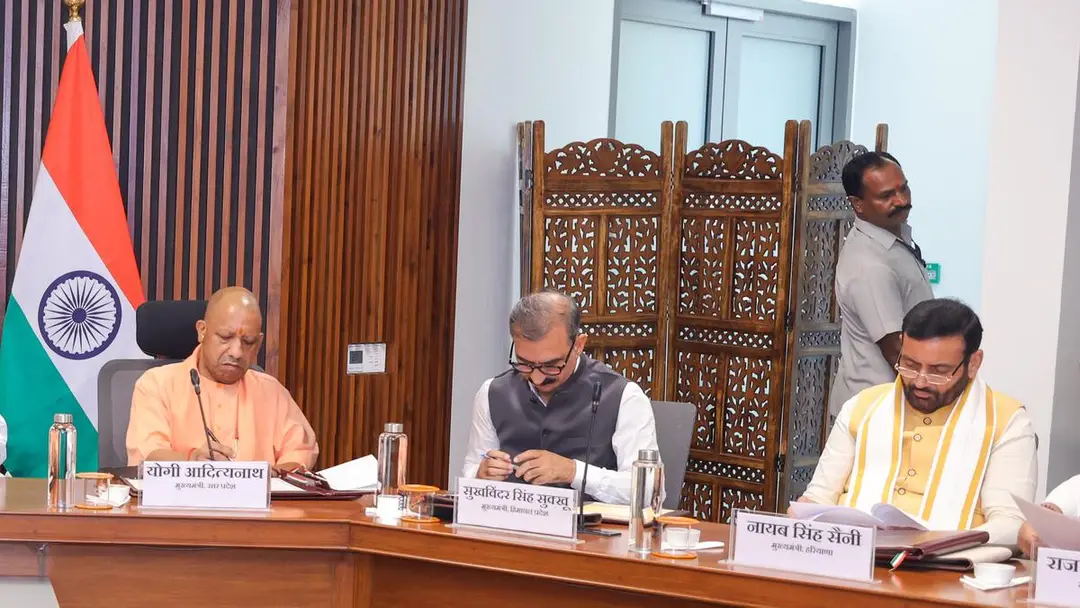
Five States, Delhi sign agreement for 422 MW Kishau project
Himachal Pradesh, Haryana, Uttarakhand, Uttar Pradesh, Rajasthan and Delhi on September 15, 2026 signed an agreement in New Delhi to implement the 422 MW Kishau multipurpose project, estimated at ₹15,624 crore. The Chief Ministers signed in the presence of Union Home Minister Amit Shah and Jal Shakti Minister C.R. Patil. A 232.6-metre dam on the Tons river along the Uttarakhand-Himachal border will irrigate 97,000 hectares. The Centre will bear 90% of the cost. CM Sukhu called it a major victory for the State.
Source
The Hindu — National · read the original report ↗
Desk check · compared with the source
What the desk checked (5)
- Five States and Delhi signed an agreement on September 15, 2026 for the 422 MW Kishau multipurpose project costing an estimated ₹15,624 crore. — Figures and date appear in the source; signing described as held in New Delhi in presence of Union Ministers.
- The Centre will bear about 90% of the cost, with 10% shared by the States and UT as per the 1994 agreement. — Stated in the source without further documentation cited; internally consistent.
- A 232.6-metre-high concrete gravity dam on the Tons river will store 1,562 million cubic metres, irrigate 97,000 hectares and generate 1,476 million units of hydropower. — Technical figures appear in the source, attributed in context to Union Home Minister Amit Shah's remarks.
- Amit Shah said this is the tenth water dispute set to be resolved since Narendra Modi became Prime Minister, and Delhi will be the biggest beneficiary. — Directly attributed to Amit Shah; political claim not independently verifiable here.
- CM Sukhu said Himachal will get 1,000 million units a year, likely worth more than ₹1,000 crore, and that the previous BJP government had agreed to a ₹800 crore state share. — Attributed to Sukhu in remarks to media; projection and political assertion, no counter-response included.
Analysts’ view opinion
Getting six governments — including Congress-ruled Himachal Pradesh — to sign on one stage gives the Centre a politically useful image of federal coordination. Amit Shah framing it as "historic" and as the tenth water dispute settled under Prime Minister Modi positions water-dispute resolution as a governance credential. Yet Chief Minister Sukhu is selling the same deal as a state victory won by refusing the ₹800 crore share the previous BJP government had accepted — one agreement, two competing political narratives.
- The Centre absorbing roughly 90% of the cost is the key political lubricant that removed states' fiscal objections and made signatures possible.
- Shah's line that Delhi will be the biggest beneficiary lands in a capital where the BJP now holds office, making it easy to pitch as a water guarantee to urban voters.
- Sukhu's emphasis that Himachal bears the displacement burden signals that rehabilitation and compensation will become the next local political pressure point.
- The "legitimate share in power projects" framing lets Himachal's Congress claim a win through bargaining rather than confrontation with the Centre.
- Signing is only the first stage; land acquisition, resettlement and fund flow are where the real political test lies.
What to watch — Watch how rehabilitation terms and Himachal's promised power share are actually operationalised, and whether inter-state or Centre-state friction resurfaces at that stage.
The story does not establish an implementation timeline, the number of people to be displaced, or rehabilitation package details, and Sukhu's revenue estimates are the state government's own claim, not independently verified.
Deep dive
Research brief · 8 facts · 4 dates · exam-readyThe brief
Context
The Kishau multipurpose project is a long-pending storage-cum-hydropower scheme on the Tons river, a tributary system along the Uttarakhand–Himachal Pradesh border, meant to supply water to the Yamuna basin States and Delhi. Cost-sharing disputes among the basin partners, governed by a 1994 agreement, had stalled it for years. On September 15, 2026, the Chief Ministers of five States and Delhi signed an implementation agreement in New Delhi in the presence of the Union Home Minister and the Union Jal Shakti Minister, with the Centre agreeing to bear about 90% of the cost.
Key facts
- Agreement for the 422 MW Kishau multipurpose project signed on September 15, 2026 in New Delhi by five States — Himachal Pradesh, Haryana, Uttarakhand, Uttar Pradesh, Rajasthan — and Delhi.
- Estimated project cost: ₹15,624 crore; the Union government will bear approximately 90%, with the remaining 10% shared by the participating States and UT as per the 1994 agreement.
- A 232.6-metre-high concrete gravity dam will be built on the Tons river along the Uttarakhand–Himachal Pradesh border.
- Storage capacity of 1,562 million cubic metres; irrigation of 97,000 hectares; generation of 1,476 million units of clean hydropower.
- Union Home Minister Amit Shah called the agreement "historic" and said it is the tenth water dispute set to be resolved since Narendra Modi became Prime Minister.
- Mr. Shah said Delhi will be the biggest beneficiary of the project.
- CM Sukhvinder Singh Sukhu said an eight-year-old deadlock over bearing the financial cost has been broken.
- Himachal Pradesh will get 1,000 million units of power per year, likely worth more than ₹1,000 crore, according to CM Sukhu.
Timeline
- 1994Agreement fixing the cost-sharing formula among the participating States and UT for the Kishau project.
- Around eight years before 2026Deadlock begins over who bears the financial cost; the earlier BJP State government in Himachal had agreed to a ₹800 crore State share, which the present government refused.
- September 15, 2026Chief Ministers of five States and Delhi sign the Kishau Project agreement in New Delhi before Amit Shah and C.R. Patil.
- September 16, 2026Report published (12:42 am IST).
Who has a stake
- Union Government (Jal Shakti Ministry, Home Ministry) — Bears about 90% of the ₹15,624 crore cost; presents the deal as resolution of the tenth water dispute since 2014 leadership change cited by Amit Shah.
- Himachal Pradesh — Faces displacement of its population; refused an ₹800 crore State share; to receive 1,000 million units of power a year worth over ₹1,000 crore.
- Uttarakhand — Host State for the dam site on the Tons river along its border with Himachal Pradesh.
- Delhi — Described by Amit Shah as the biggest beneficiary of the project's water.
- Haryana, Uttar Pradesh and Rajasthan — Signatory basin partners sharing the residual 10% cost and benefiting from stored water and irrigation.
- People to be displaced in Himachal Pradesh — Loss of land and homes due to the 232.6-metre dam and its 1,562 MCM reservoir; compensation questions.
Why it matters
Inter-State water sharing is one of India's most persistent federal frictions, and the Kishau agreement shows that stalled multipurpose projects can move when the Centre absorbs most of the capital cost. For Delhi and the Yamuna basin States it promises fresh storage, 97,000 hectares of irrigation and 1,476 million units of clean power. But it also puts the classic upstream burden–downstream benefit question in focus: Himachal bears displacement while Delhi is named the biggest beneficiary.
UPSC angle
Prelims pointers
- Kishau multipurpose project: 422 MW, on the Tons river along the Uttarakhand–Himachal Pradesh border; cost ₹15,624 crore.
- Dam type and height: concrete gravity dam, 232.6 metres; storage 1,562 million cubic metres.
- Benefits cited: 97,000 hectares irrigated and 1,476 million units of hydropower.
- Cost sharing: Centre about 90%, States and UT about 10% as per the 1994 agreement.
- Signatories on September 15, 2026: Himachal Pradesh, Haryana, Uttarakhand, Uttar Pradesh, Rajasthan and Delhi.
- Union Ministers present: Home Minister Amit Shah and Jal Shakti Minister C.R. Patil.
Mains framing
The Kishau agreement illustrates both the difficulty and the possible route to settling inter-State water disputes in India. The immediate cause of the eight-year deadlock was not the engineering but the distribution of financial burden: Himachal Pradesh, citing limited resources and the fact that its population would be displaced, refused the ₹800 crore share earlier accepted by its predecessor government. The resolution came when the Union government agreed to absorb roughly 90% of the ₹15,624 crore cost, leaving only 10% to the six basin partners under the 1994 formula, and when Himachal secured a benefit stream of 1,000 million units of power annually. The implications are significant — 1,562 MCM of storage, 97,000 hectares of irrigation and 1,476 million units of clean electricity, with Delhi described as the largest beneficiary — but the equity question remains: the upstream State bears submergence and displacement while downstream users gain water security. A durable way forward, on the evidence of this case, lies in linking cost sharing to benefit sharing, guaranteeing the host State a defined share of generated power, and ensuring that rehabilitation of displaced families is treated as central to project cost rather than an afterthought. The source does not detail the rehabilitation package or environmental clearances.
Key terms
- Multipurpose project
- A river project designed to serve several uses at once — here water storage, irrigation of 97,000 hectares and 422 MW of hydropower.
- Concrete gravity dam
- A dam that resists water pressure by its own weight; the Kishau dam will be 232.6 metres high.
- Tons river
- The river flowing along the Uttarakhand–Himachal Pradesh border on which the Kishau dam will be built.
- 1994 agreement
- The earlier pact that fixes how the participating States and Delhi share the residual 10% of the Kishau project cost.
- Million cubic metres (MCM)
- Unit of water storage; the Kishau reservoir will hold 1,562 MCM.
- Million units
- Unit of electricity generation; the project will produce 1,476 million units, of which Himachal gets 1,000 million units a year.
Practice questions
- Inter-State river water disputes in India are as much about cost and benefit sharing as about water allocation. Examine this in the light of the Kishau multipurpose project agreement of September 2026.
- Discuss how central financing of large multipurpose river projects can help resolve federal deadlocks, using the 90:10 cost-sharing arrangement in the Kishau project as an example.
- Large storage dams in the Himalayan States generate benefits downstream while costs such as displacement fall upstream. Suggest principles for equitable benefit sharing in such projects.
Grounded only in the source report — figures and dates are the source's, not inferred.