
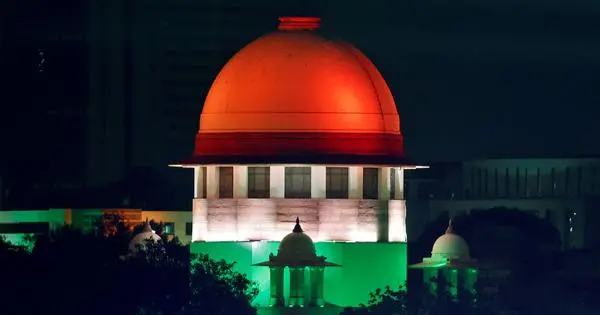
Not singing all six Vande Mataram stanzas shouldn't be a crime: SC
The Supreme Court on Tuesday said it expects that a person who does not sing all six stanzas of Vande Mataram for religious reasons should not face criminal prosecution. A bench of Chief Justice Surya Kant and Justices Joymalya Bagchi and V Mohana was hearing Carnatic singer TM Krishna's petition against the 2026 Prevention of Insults to National Honour Amendment Act, which criminalises insults to the national song. The Union government must respond in two weeks. The law, assented to on August 6, prescribes up to three years' imprisonment, a fine or both.
Source
Scroll.in · read the original report ↗
Desk check · compared with the source
What the desk checked (5)
- The Supreme Court said it expects that a person not singing all six stanzas of Vande Mataram for religious reasons should not face criminal prosecution. — Attributed in source to Live Law; an oral observation by the bench, not a judgment.
- The bench comprised Chief Justice Surya Kant and Justices Joymalya Bagchi and V Mohana, hearing TM Krishna's petition. — Names and composition appear in the source as reported; no order copy cited.
- The 2026 Prevention of Insults to National Honour Amendment Act received presidential assent on August 6 and prescribes up to three years' imprisonment, fine or both. — Date and penalty figures appear in source; no gazette reference given.
- MHA directions issued in February require all six stanzas to be sung at government, ceremonial and cultural occasions. — Stated in source as part of the challenged directions; no circular number cited.
- The 1986 Bijoe Emmanuel judgement held that expelling students for refusing to sing the national anthem violates fundamental rights. — Consistent with the source's description of the precedent cited by the court.
Analysts’ view opinion
The Supreme Court's preliminary observation on the six stanzas of Vande Mataram matters politically even though it is not a ruling — by recalling that Bijoe Emmanuel remains the law of the land, the bench has signalled doubt about how far the new penal provision can reach. That leaves the Union government in an awkward spot: it must defend the statute while also reassuring the court that those who abstain on religious grounds will not be prosecuted. The case also revives the broader contest between national-honour symbolism and religious freedom, an argument both political camps find useful for mobilisation.
- The court has not stayed the law; by giving the Centre two weeks it has channelled a political dispute into a judicial timetable.
- The remark that religious abstention should not invite prosecution gives critics moral leverage, but it carries no binding force yet.
- Because the additional stanzas invoke deities, the dispute is likely to be fought as a secularism-and-symbolism battle rather than a narrow legal one.
- A prominent classical musician as petitioner frames this as dissent arising from the cultural sphere, which supporters and opponents of the government will read very differently.
- How the Centre replies — full-throated defence of the February directions and penalties, or acceptance of exemptions — will reveal its political strategy.
What to watch — Watch the Union government's affidavit within two weeks and how firmly it defends the February directive and the three-year penalty, as that will decide whether this stays a courtroom matter or becomes a wider political argument.
The story does not establish how the court will finally rule on the law's validity, what the Centre's formal position is, or whether anyone has actually been prosecuted under the amendment.
Deep dive
Research brief · 8 facts · 6 dates · exam-readyThe brief
Context
The Prevention of Insults to National Honour Act, 1971 criminalises insults to the national anthem, national flag and the Constitution. A 2026 amendment extended similar statutory protection to Vande Mataram as the national song, prescribing up to three years' imprisonment, a fine or both for intentionally preventing its singing or disrupting a gathering singing it. Separately, a Union Home Ministry direction of February required all six stanzas to be sung at government, ceremonial and cultural occasions, whereas earlier only the first two stanzas were played at official functions. Carnatic singer TM Krishna has challenged both the amendment and the directions in the Supreme Court.
Key facts
- The Supreme Court said it expects that a person who does not sing all six stanzas of Vande Mataram for religious reasons should not face criminal prosecution.
- The bench comprised Chief Justice Surya Kant and Justices Joymalya Bagchi and V Mohana; it gave the Union government two weeks to respond.
- The petition was filed by Carnatic singer TM Krishna challenging the constitutional validity of the 2026 Prevention of Insults to National Honour Amendment Act.
- The amendment received presidential assent on August 6 and gives Vande Mataram the same statutory protection as the national anthem, Jana Gana Mana.
- Intentionally preventing the singing of the national song, or disrupting a gathering singing it, is punishable with up to three years' imprisonment, a fine or both.
- The 1971 Act already makes insulting the national anthem, national flag or Constitution punishable with up to three years' imprisonment, a fine or both.
- A Union Ministry of Home Affairs direction issued in February requires all six stanzas of Vande Mataram to be sung at government, ceremonial and cultural occasions; earlier only the first two were played.
- The stanzas beyond the first two invoke the Hindu goddesses Durga, Lakshmi and Saraswati and had previously been omitted.
Timeline
- January 24, 1950The Constituent Assembly adopted Jana Gana Mana as the national anthem, per Krishna's petition.
- 1971Prevention of Insults to National Honour Act makes insulting the national anthem, flag or Constitution punishable with up to three years' jail, fine or both.
- 1986Supreme Court's Bijoe Emmanuel judgement holds that expelling students for refusing to sing the national anthem while standing in respectful silence violates fundamental rights.
- FebruaryUnion Home Ministry issues directions requiring all six stanzas of Vande Mataram to be sung at government, ceremonial and cultural occasions.
- August 6The Prevention of Insults to National Honour Amendment Act receives presidential assent.
- Tuesday (of the report)Supreme Court hears TM Krishna's petition, says non-singing for religious reasons should not invite prosecution, and gives the Centre two weeks to respond.
Who has a stake
- TM Krishna, Carnatic singer and petitioner — Contends the mandated singing of devotional, deity-invoking stanzas under penal sanction creates a 'compelled orthodoxy'.
- Supreme Court bench (CJI Surya Kant, Justices Joymalya Bagchi, V Mohana) — Will examine whether the right not to sing the four stanzas, recognised in Bijoe Emmanuel, is protected.
- Union government / Ministry of Home Affairs — Must defend the 2026 amendment and its February directions; has two weeks to respond.
- Citizens with religious objections to devotional stanzas — Face possible criminal exposure of up to three years' imprisonment or fine under the amended law.
- Students and institutions — Bijoe Emmanuel protected students expelled for silent non-participation; its continued application is at issue.
Why it matters
The case tests whether the state can compel expression of a patriotic-devotional text under threat of criminal punishment, and whether the 1986 Bijoe Emmanuel protection for conscientious silence survives the new statute. It also raises the question of legal status: the source notes Vande Mataram was never formally categorised as the national song, though it has been customarily understood as such with two stanzas.
UPSC angle
Prelims pointers
- Prevention of Insults to National Honour Act, 1971 covers insults to the national anthem, national flag and the Constitution; punishment up to three years, fine or both.
- The 2026 Amendment Act, assented to on August 6, extends the same statutory protection to Vande Mataram as the national song.
- Bijoe Emmanuel (1986): expelling students for refusing to sing the national anthem while standing in respectful silence violates freedom of speech and religion.
- Jana Gana Mana was adopted as the national anthem by the Constituent Assembly on January 24, 1950 (per the petition).
- Union Home Ministry's February direction mandates all six stanzas of Vande Mataram at government, ceremonial and cultural occasions; earlier only the first two were played.
- Bench hearing the challenge: CJI Surya Kant with Justices Joymalya Bagchi and V Mohana.
Mains framing
The challenge to the 2026 Prevention of Insults to National Honour Amendment Act frames a classic conflict between state-defined patriotic symbolism and individual conscience. The immediate trigger is twofold: a statute that criminalises preventing or disrupting the singing of Vande Mataram with up to three years' imprisonment, and a February Home Ministry direction requiring all six stanzas at official occasions, including stanzas that invoke Durga, Lakshmi and Saraswati and had earlier been omitted. The petitioner's argument is that penal mandates convert a contested historical symbol into a 'compelled orthodoxy' and force citizens to utter expressly devotional, non-secular content; he also points out that Vande Mataram was never formally categorised as the national song, unlike Jana Gana Mana adopted on January 24, 1950. The Court's own framing suggests the way forward: the 1986 Bijoe Emmanuel declaration, which protected respectful silence as an exercise of free speech and religious freedom, has not been questioned and should govern the operation of the statute. A reading down that shields conscientious non-participation while penalising only deliberate disruption would reconcile respect for national symbols with the constitutional guarantee against compelled speech. The Union government's response, due in two weeks, will determine how squarely this balance is tested.
Key terms
- Prevention of Insults to National Honour Act, 1971
- Law making insults to the national anthem, national flag or Constitution punishable with up to three years' imprisonment, a fine or both.
- 2026 Amendment Act
- Amendment assented to on August 6 that criminalises insults to the national song, giving Vande Mataram protection equal to the national anthem.
- Bijoe Emmanuel case (1986)
- Supreme Court ruling that expelling students for refusing to sing the national anthem while standing in respectful silence violates their fundamental rights.
- Vande Mataram
- Customarily understood as the national song, usually sung in its first two stanzas; the remaining stanzas invoke Durga, Lakshmi and Saraswati.
- Jana Gana Mana
- The national anthem, adopted by the Constituent Assembly on January 24, 1950 according to the petition.
- Compelled orthodoxy
- Petitioner's term for the state mandating, under penal sanction, the recitation of a contested and devotional text.
Practice questions
- Does criminalising non-participation in the singing of the national song violate the freedoms of speech and religion as interpreted in Bijoe Emmanuel (1986)? Discuss.
- Examine the constitutional distinction between the national anthem and the national song, and the implications of granting them identical statutory protection.
- 'Respect for national symbols cannot be manufactured through penal law.' Critically evaluate in the light of the 2026 amendment to the Prevention of Insults to National Honour Act.
Grounded only in the source report — figures and dates are the source's, not inferred.