
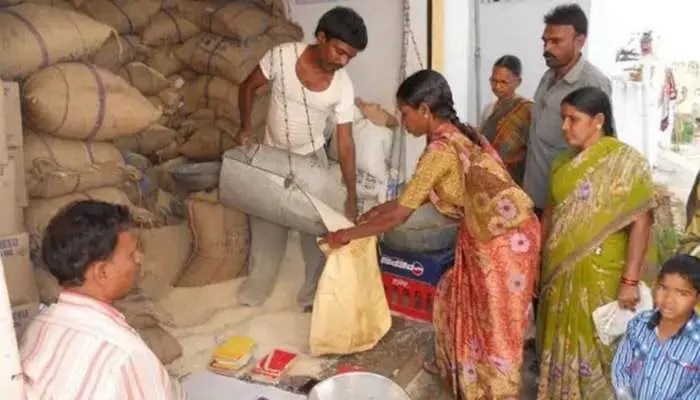
Three months' ration to be issued in one instalment from April 1
The central government has decided that from April 1 ration shops will distribute rice and other essentials for April, May and June in a single instalment. Ordinary card holders will receive 6 kg per month, or 18 kg for three months, while Antyodaya families will get 35 kg a month, totalling 105 kg. Software has been changed to release the quota on one biometric authentication. Dealers cite storage shortages, so stock will be supplied in phases.
Source
Ration & pensions · read the original report ↗
Desk check · some claims need care
What the desk checked (5)
- From April 1, ration shops will distribute rice and other essentials for April, May and June in a single instalment. — Stated in source as a central government decision; no official, order number or spokesperson named.
- Ordinary card holders get 6 kg per person per month, totalling 18 kg for three months. — Figure appears in source; no supporting document or official cited.
- Antyodaya card families get 35 kg per month, totalling 105 kg this month. — Figure appears in source and is internally consistent with the three-month pattern; unattributed.
- Software changed so a single biometric authentication releases the three-month quota. — Attributed generally to the government; no department or official named.
- Dealers say shops lack storage space for bulk stock; officials plan phased supply. — Attributed to unnamed dealers and officials; no individual quoted.
Analysts’ view opinion
Handing out three months of rations in one go looks like an administrative and logistical call, but its political value is far from negligible. Alongside the practical reasons — clearing warehouses and making room for fresh procurement — the move lets the Centre carry a pro-poor message directly to beneficiaries by sparing them monthly queues in the summer heat. At the same time, the weakest link is that dealers at the last mile absorb the storage and handling burden.
- Subsidised foodgrain distribution is one of the most visible welfare programmes anywhere in India, which makes credit for it politically valuable to any government.
- The decision is the Centre's, but delivery and monitoring run through state-level distribution machinery, so a tussle over who gets the credit is natural.
- Single biometric authentication for a three-month quota improves convenience, but the absence of monthly verification gives the opposition an opening to raise leakage and accountability questions.
- If dealers' storage-space concerns harden into organised protest, the promise of phased stock supply becomes a test of the government's follow-through.
- The stated groundwork for new ration shops touches local appointments and dealerships, and could therefore stir local political interest.
What to watch — Watch the first half of April for how stock supply and dealer storage complaints play out, and for how central and state leaders position themselves to claim credit for the distribution.
The story does not establish any electoral or political motive behind the decision, nor does it record opposition reaction, any formal dealer-association stand, or state-wise implementation detail.
Deep dive
Research brief · 8 facts · 3 dates · exam-readyThe brief
Context
The central government has decided that from April 1, ration shops in the Telugu states will distribute rice and other essential commodities for April, May and June in a single instalment instead of monthly issues. The stated reasons are to clear old foodgrain stocks from warehouses ahead of fresh procurement, and to spare beneficiaries — especially the elderly and women — repeated queuing in peak summer heat. A similar three-month bulk distribution was carried out during the last monsoon season. Software in the biometric system has been altered so that one authentication releases the full three-month quota.
Key facts
- From April 1, ration shops will distribute rice and other essentials for April, May and June in one instalment.
- Ordinary ration card beneficiaries get 6 kg of rice per month, i.e. 18 kg for the three months together.
- Antyodaya card families (poorest households) get 35 kg per month, i.e. 105 kg, to be handed over within this month.
- The e-PoS software has been modified so a single biometric authentication releases the three-month quota, instead of monthly biometric verification.
- Two official reasons cited: emptying accumulated old foodgrain stocks in warehouses for the coming procurement season, and shielding beneficiaries from summer heat.
- The same three-month single-instalment method was used during the last monsoon season.
- Ration dealers say shops lack storage space for the bulk stock arriving at once.
- Officials are supplying stock to dealers in phases as per need; the government is also working on setting up new ration shops.
Timeline
- Last monsoon seasonThree months' ration quota was distributed in one instalment, as an earlier precedent.
- This month (before April)Antyodaya families to be given 105 kg of rice covering three months.
- April 1 onwardsRation shops begin single-instalment distribution of April, May and June quotas.
Who has a stake
- Ordinary ration card holders in the Telugu states — Receive 18 kg of rice for three months at one go, avoiding monthly queues in the summer heat.
- Antyodaya card families — Get 105 kg of rice (35 kg a month) in one instalment, giving three months of food assurance.
- Ration dealers — Face storage space shortage as bulk stock arrives at once; to be supplied in phases.
- Central government / civil supplies officials — Clear old warehouse stocks for new procurement and ensure smooth distribution.
- Elderly persons and women beneficiaries — Relief from repeated trips and queuing at ration shops during peak summer.
Why it matters
Advance bulk distribution links two ends of the food security chain: it frees warehouse space for fresh procurement while reducing the physical burden on poor beneficiaries during summer. It also tests whether last-mile infrastructure — dealer storage space and biometric software — can handle three months' offtake at once, which is why stock is being released to dealers in phases.
UPSC angle
Prelims pointers
- From April 1, April-May-June ration quotas to be issued in a single instalment in the Telugu states.
- Ordinary card: 6 kg per person per month; 18 kg for three months.
- Antyodaya card: 35 kg per month per family; 105 kg for three months.
- Biometric rule changed: one authentication now releases the full three-month quota.
- Reasons stated: clearing old foodgrain stocks for new procurement, and summer heat relief.
- Precedent: similar three-month single-instalment distribution during the last monsoon season.
Mains framing
The decision to release three months' ration in one instalment from April 1 shows how the Public Distribution System balances supply-side and demand-side pressures. On the supply side, warehouses are congested with old foodgrain and space is needed for the coming procurement season; on the demand side, monthly visits to ration shops impose real costs on the elderly and women during severe summer heat, and bunching reduces crowding at outlets. The state has matched this with a technology change — modifying software so one biometric authentication unlocks the whole quarterly quota — showing that welfare delivery reform is as much administrative and digital as it is financial. But the constraint has shifted downstream: dealers lack storage capacity for bulk stock, forcing phased supply, and there are risks of household-level storage loss and early consumption of the quota. The stated way forward — phased stock release to dealers and setting up new ration shops to strengthen the PDS network — addresses capacity, though sustained gains would depend on last-mile storage and grievance redress for authentication failures.
Key terms
- Public Distribution System (PDS)
- The network of ration shops through which subsidised foodgrain and essentials reach cardholders.
- Antyodaya card
- Ration card for the poorest households; here entitled to 35 kg of rice per month.
- Biometric authentication
- Fingerprint-based verification at the ration shop; now required once for the whole three-month quota.
- Single instalment distribution
- Issuing several months' entitlement together instead of month by month.
- Procurement season
- The period when new crop is bought into government warehouses, requiring old stocks to be cleared.
Practice questions
- Discuss the administrative and welfare rationale for distributing multiple months' ration entitlements in a single instalment, and the risks such bunching creates at the last mile.
- How do storage capacity and digital authentication systems shape the effectiveness of the Public Distribution System? Illustrate with the April-June single-instalment distribution.
- Examine whether advance bulk distribution of foodgrain can serve both warehouse management for fresh procurement and beneficiary convenience without diluting food security objectives.
Grounded only in the source report — figures and dates are the source's, not inferred.