
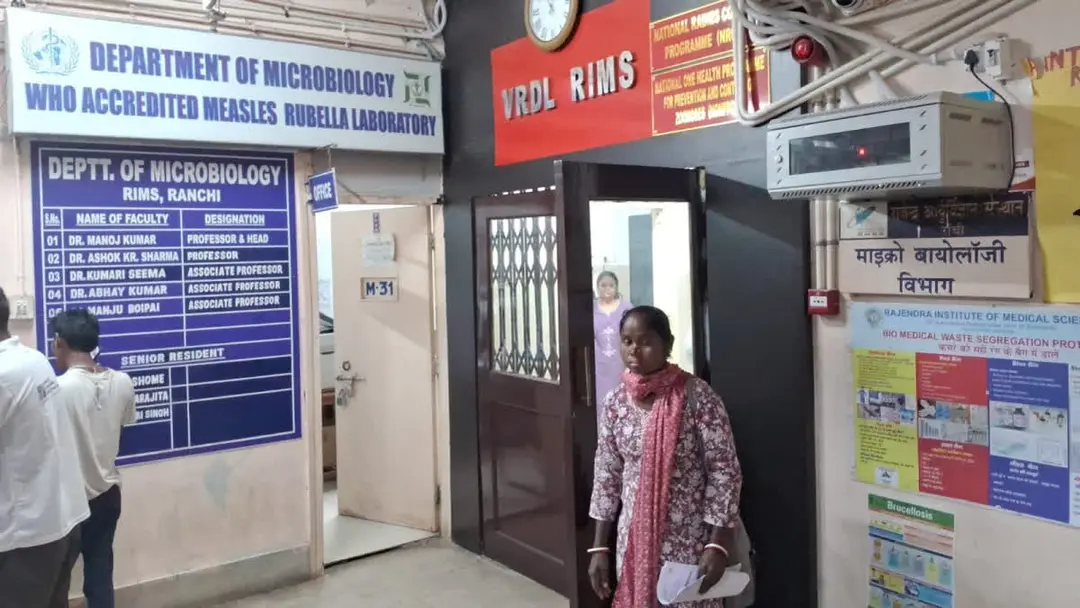
Jharkhand health experts rule out Rubella outbreak in state
Health authorities in Jharkhand have dispelled concerns over Rubella spread after a patient in Simdega district tested positive in an ELISA test. Dr. Manoj Kumar, Head of Microbiology at RIMS, said ELISA is not a confirmatory test and infection can be confirmed only by a positive PCR test. He said 21 of 875 samples tested this year were ELISA-positive but none tested PCR-positive, and no case has been recorded in the state since 2018.
Source
WHO · read the original report ↗
Desk check · compared with the source
What the desk checked (5)
- A patient in Simdega district tested positive for Rubella in an ELISA test. — Figure/event appears in source as the trigger for the concern; no test date or patient details given.
- ELISA is not a confirmatory test for Rubella in India or elsewhere; PCR is needed. — Attributed to Dr. Manoj Kumar, Head of Microbiology, RIMS.
- Of 875 samples tested this year at RIMS, 21 were ELISA-positive but none PCR-positive. — Figures attributed to Dr. Manoj Kumar; internally consistent.
- No Rubella case has been found in Jharkhand since 2018. — Attributed to the RIMS expert; no supporting data cited.
- By January 2025, 179 of 194 countries had included Rubella vaccine in national immunisation programmes. — Attributed to a WHO report; specific report not named.
Analysts’ view opinion
This is less an outbreak story than a story about how disease surveillance is designed and communicated. The alarm arose because a screening result (ELISA) was read as a confirmatory one — a communication gap somewhere between the district level and the public. RIMS's explanation (21 ELISA positives out of 875 samples, none PCR-positive) suggests the system is working as intended, while also exposing how easily preliminary results can escape into the public domain ahead of confirmation.
- Because vaccine-induced antibodies can themselves produce an ELISA positive, the two-tier ELISA-plus-PCR protocol is not a flaw in design but a deliberate safeguard.
- The rule that a case is logged on WHO and ICMR portals only after a positive PCR protects data quality, but it can fuel confusion when unconfirmed screening results circulate first.
- Centralising statewide testing in a single lab at RIMS helps quality control, yet creates a potential bottleneck for turnaround if sample volumes rise.
- The programme's real beneficiaries are pregnant women, women planning pregnancy and children — preventing Congenital Rubella Syndrome is the underlying public health objective.
- Free government-provided MR/MMR in two doses, alongside the fact that 179 of 194 countries have added rubella vaccine to national schedules, places India's approach broadly in line with global practice.
What to watch — Watch for the PCR result on the Simdega sample, district-level MR-1 and MR-2 coverage data, and whether the state issues a clearer protocol on releasing screening results before confirmation.
The story does not establish whether the Simdega patient underwent a PCR test or what it showed, nor does it tell us the state's actual vaccination coverage rates or the strength of district-level surveillance.
Deep dive
Research brief · 8 facts · 4 dates · exam-readyThe brief
Context
Concerns about a Rubella outbreak in Jharkhand arose after a patient in Simdega district tested positive in an ELISA test. Dr. Manoj Kumar, Head of the Microbiology Department at Rajendra Institute of Medical Sciences (RIMS), Ranchi — the lab that tests Rubella suspect samples from across the state — said ELISA is not a confirmatory test in India or anywhere else, and only a positive PCR test confirms Rubella infection. Antibodies generated by MR or MMR vaccination can themselves show up as ELISA-positive. He said no Rubella case has been found in the state since 2018.
Key facts
- A patient in Simdega district, Jharkhand, tested positive for Rubella in an ELISA test, triggering outbreak concerns.
- Dr. Manoj Kumar, Head of Microbiology at RIMS, said ELISA is not a confirmatory test for Rubella in India or anywhere in the world; only PCR confirms infection.
- Of 875 samples tested at the RIMS lab this year, 21 were ELISA-positive for Rubella but not a single one tested PCR-positive.
- No Rubella case has been recorded in Jharkhand since 2018, according to Dr. Manoj Kumar.
- Only when a PCR test report is positive is the case updated on the WHO and ICMR portals.
- WHO: Rubella infection in early pregnancy can cause miscarriage, fetal death or Congenital Rubella Syndrome (CRS); risk is highest in the first trimester.
- CRS birth defects include hearing loss, eye problems, congenital heart defects and developmental problems.
- In Jharkhand MR/MMR vaccine is given free by the government in two doses; after MR-1 and MR-2 there is over 95% chance of protection. WHO says a single dose gives long-term immunity in over 95% of people.
Timeline
- Since 2018Not a single Rubella case found in Jharkhand, as per RIMS Microbiology Department.
- By January 2025179 of 194 countries had included Rubella vaccine in national immunisation programmes (WHO report).
- This year (current year, as stated)RIMS lab tested 875 samples; 21 were ELISA-positive, none PCR-positive.
- RecentlyA Simdega district patient's ELISA-positive result sparked concern of Rubella spread; RIMS experts ruled out an outbreak.
Who has a stake
- Jharkhand health authorities — Must clarify test-based confusion and prevent public panic while maintaining Rubella surveillance.
- RIMS Microbiology Department, Ranchi — Tests Rubella suspect samples from across the state and determines confirmatory PCR status.
- Residents of Simdega district — Directly affected by the reported case and the outbreak scare.
- Pregnant women and women planning to conceive — Highest risk group; infection can cause miscarriage, fetal death or Congenital Rubella Syndrome.
- WHO and ICMR — Run ELISA-based checks on MMR/MR vaccine activity and maintain portals updated with PCR-confirmed cases.
- Children vaccinated under the government programme — Free two-dose MR/MMR vaccination offers over 95% protection; vaccine antibodies may show ELISA positivity.
Why it matters
Misreading a screening test as a diagnosis can create a false outbreak scare, divert public health attention and erode trust in vaccination — especially when vaccine-induced antibodies themselves turn ELISA-positive. At the same time Rubella remains a genuine public health concern because infection in early pregnancy can cause miscarriage, fetal death or Congenital Rubella Syndrome. The case underlines why confirmatory PCR testing and accurate reporting to WHO and ICMR portals matter.
UPSC angle
Prelims pointers
- Rubella, also called German Measles, is caused by the Rubella virus; usually mild but dangerous in pregnancy.
- ELISA (enzyme-linked immunosorbent assay) detects antibodies and is not confirmatory for Rubella; PCR is the confirmatory test.
- Congenital Rubella Syndrome (CRS) can cause hearing loss, eye defects, congenital heart defects and developmental problems.
- RIMS (Rajendra Institute of Medical Sciences), Ranchi, tests Rubella suspect samples for all of Jharkhand.
- In Jharkhand, MR/MMR vaccine is free in two doses (MR-1, MR-2), giving over 95% protection.
- WHO: by January 2025, 179 of 194 countries had Rubella vaccine in national immunisation programmes.
Mains framing
The Jharkhand episode illustrates a recurring problem in disease surveillance: the conflation of screening or serological tests with confirmatory diagnosis. ELISA detects antibodies, which may be generated either by natural infection or by MR/MMR vaccination — so, as RIMS noted, 21 ELISA-positive results out of 875 samples yielded zero PCR-positive confirmations, and no Rubella case has been recorded in Jharkhand since 2018. Reporting an unconfirmed case as an outbreak risks public panic, unnecessary treatment-seeking and possible vaccine hesitancy, while under-detection carries the opposite risk: Rubella infection in the first trimester can cause miscarriage, fetal death or Congenital Rubella Syndrome with lifelong hearing, vision, cardiac and developmental disability. The way forward, on the evidence in the story, lies in strict adherence to the PCR-confirmation protocol before a case is declared and updated on WHO and ICMR portals, clear communication by state health authorities, sustained two-dose free MR/MMR coverage that confers over 95% protection, pre-conception immunity checks for women planning pregnancy, and immediate medical consultation rather than self-medication when infection is suspected in pregnancy.
Key terms
- Rubella (German Measles)
- A viral disease, usually mild, but infection during pregnancy can seriously harm the fetus.
- ELISA
- Enzyme-linked immunosorbent assay; detects antibodies, used to check vaccine response, not confirmatory for Rubella infection.
- PCR test
- Polymerase chain reaction test; the confirmatory test for Rubella, reported to WHO and ICMR portals when positive.
- Congenital Rubella Syndrome (CRS)
- Birth defects from Rubella infection in pregnancy — hearing loss, eye problems, congenital heart defects, developmental delay.
- MR / MMR vaccine
- Measles-Rubella or Measles-Mumps-Rubella combination vaccine; given free in two doses in Jharkhand.
- RIMS, Ranchi
- Rajendra Institute of Medical Sciences; its Microbiology Department tests Rubella suspect samples for Jharkhand.
Practice questions
- Distinguish between screening and confirmatory tests in infectious disease surveillance, using the Rubella case in Jharkhand to explain why ELISA positivity alone cannot declare an outbreak.
- Discuss the public health significance of Rubella vaccination in India, with reference to Congenital Rubella Syndrome and the two-dose MR/MMR strategy.
- How can state health systems balance transparent disease reporting with the risk of creating unwarranted public panic? Illustrate with recent examples.
Grounded only in the source report — figures and dates are the source's, not inferred.