
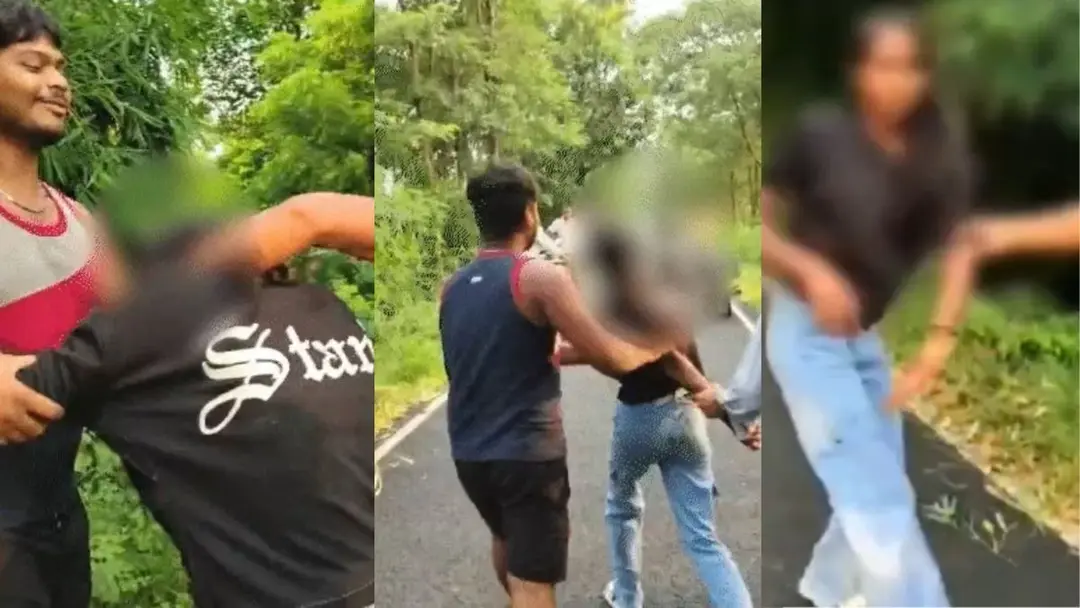
Four arrested over alleged harassment of woman in Samastipur
Police arrested four accused persons on Thursday morning in Bihar's Samastipur district after a video showing a young woman being physically harassed and verbally abused in broad daylight circulated widely. The incident took place at the Jagat Singh embankment area under Karpuri Gram police station limits. The video's authenticity and exact date remain unconfirmed. JD(U) leader Rajeev Ranjan condemned the incident, saying criminals who ignore the action taken in Jamui will end up behind bars. Investigation is underway.
Source
Republic TV · read the original report ↗
Desk check · some claims need care
What the desk checked (5)
- Four accused were arrested on Thursday morning in Samastipur after a video of a woman being harassed circulated. — Attributed to law enforcement action in the source; no named officer quoted.
- The incident occurred at the Jagat Singh embankment area under Karpuri Gram police station limits. — Stated in source without named attribution.
- The authenticity and exact date of the viral video are unconfirmed. — Explicitly acknowledged in the source as not independently verified.
- JD(U) leader Rajeev Ranjan said criminals who ignore the action taken in Jamui will end up behind bars. — Direct quote attributed by name in the source.
- In the Jamui case, an FIR was registered against about 120 social media profiles, and Kundan Kumar, Faiyaz and Ramashish Kumar were arrested. — Figure and names appear in source, hedged with 'reportedly' for the FIR count.
Analysts’ view opinion
Acting on a viral video is legally permissible in India — such footage can be treated as information that triggers a police case and investigation. But an arrest is only the first procedural step; on the story's own terms the video's authenticity and date remain unverified, which places the entire burden on investigators to convert it into evidence that survives a courtroom. Swift action matters for public confidence, but the presumption of innocence and the right to a fair trial remain intact for those arrested.
- An arrest based on video footage is lawful, but proving its authenticity, date and chain of custody will be decisive at trial.
- The unconfirmed date is a real legal vulnerability — without a fixed timeline, the defence can contest identification or raise alibi arguments.
- Video alone may not suffice; the victim's statement, identification procedure and forensic or medical corroboration typically carry the case.
- The reported FIR against accounts circulating the Jamui video underlines the legal bar on revealing a minor victim's identity and the privacy interest involved.
- A political leader's remark that offenders "will end up in jail" is condemnation, not adjudication — sentencing power rests with the courts, not the executive.
What to watch — Watch which offences are invoked in the FIR, how courts treat remand and bail, whether the footage is sent for forensic examination, and whether a chargesheet is filed within the statutory period.
The story does not establish that the four arrested are in fact guilty, nor does it clarify the specific charges, the legal provisions invoked, or the status of any complaint by the woman concerned.
Deep dive
Research brief · 8 facts · 4 dates · exam-readyThe brief
Context
A video circulating on social media showed a young woman being physically harassed and verbally abused in broad daylight at the Jagat Singh embankment area under Karpuri Gram police station limits in Bihar's Samastipur district. Police arrested four accused persons on Thursday morning after the footage spread widely, though the video's authenticity has not been independently verified and its exact date is unconfirmed. The case comes days after a purported video from Jamui district showed the alleged harassment and assault of two minors, including a Class 10 girl, triggering public outrage and political reactions. Investigation in the Samastipur case is underway.
Key facts
- Four accused persons were arrested on Thursday morning in Samastipur district after a viral video of harassment of a young woman circulated.
- The incident took place at the Jagat Singh embankment area under Karpuri Gram police station limits, Samastipur.
- The authenticity of the viral video has not been independently verified and the exact date of the video remains unconfirmed.
- JD(U) leader Rajeev Ranjan said criminals who fail to take warning from the action in the Jamui incident 'will end up behind bars'.
- Ranjan also said those who make such videos and use social media for such activities 'will not be spared'.
- The Samastipur case follows the assault of a Class 10 girl in Bihar's Jamui district days earlier.
- In the Jamui case, an FIR was reportedly registered against around 120 social media profiles for sharing footage that could reveal the minor's identity.
- Jamui police have arrested Kundan Kumar, Faiyaz and Ramashish Kumar; an accused injured in a police encounter is being treated at Jamui Sadar Hospital.
Timeline
- Days before the Samastipur arrestsA purported video from Jamui district showed the alleged harassment and assault of two minors, including a Class 10 girl, sparking outrage.
- After the Jamui video surfacedJamui police arrested Kundan Kumar, Faiyaz and Ramashish Kumar; an FIR was registered against about 120 social media profiles; raids continued for remaining suspects.
- Not stated in the source (date of video unconfirmed)Video of a young woman being harassed at Jagat Singh embankment, Karpuri Gram police station area, Samastipur, circulated widely.
- Thursday morningPolice arrested four accused persons in the Samastipur case; investigation underway.
Who has a stake
- The young woman in the Samastipur video — Victim of alleged physical harassment and verbal abuse in public; depends on police action and protection of her identity.
- Samastipur police (Karpuri Gram police station) — Acted on viral footage to arrest four accused; must verify the video's authenticity and complete the investigation.
- The two minors in the Jamui case — Alleged assault victims whose identity risks exposure through circulation of the video on social media.
- Jamui police — Arrested three accused, registered an FIR against around 120 profiles, and are raiding to catch remaining suspects.
- JD(U) leader Rajeev Ranjan — Politically condemned the incident and warned offenders and those circulating such videos of jail.
- Social media users who shared the footage — Face legal action, with an FIR reportedly against about 120 profiles in the Jamui case for revealing a minor's identity.
Why it matters
Two incidents in quick succession in Samastipur and Jamui show how videos of harassment of women and minors circulating on social media are now both the trigger for police action and a fresh source of harm to victims. The registration of an FIR against roughly 120 profiles in the Jamui case highlights that sharing footage which reveals a minor victim's identity is itself an offence. It also raises the question of whether policing is becoming reactive to viral outrage rather than preventive.
UPSC angle
Prelims pointers
- Samastipur harassment case: Jagat Singh embankment area, Karpuri Gram police station limits, Bihar; four arrested on Thursday morning.
- Jamui district, Bihar: alleged assault of a Class 10 girl and two minors shown in a purported viral video.
- Jamui case arrests named in the source: Kundan Kumar, Faiyaz and Ramashish Kumar.
- An FIR was reportedly registered against around 120 social media profiles in the Jamui case for sharing identity-revealing footage.
- JD(U) leader Rajeev Ranjan publicly condemned the Samastipur incident.
- An accused injured in a police encounter in the Jamui case is under treatment at Jamui Sadar Hospital.
Mains framing
The Samastipur and Jamui cases illustrate a pattern in which crimes against women and minors come to light only after video footage goes viral, forcing swift but reactive police response — four arrests in Samastipur within days of the Jamui assault of a Class 10 girl. Two distinct harms operate simultaneously: the original offence of physical harassment and verbal abuse in a public place in broad daylight, and the secondary victimisation caused by mass circulation of footage that can identify a minor survivor, which is why Jamui police reportedly registered an FIR against around 120 profiles and appealed to the public not to share such posts. The reliance on unverified footage also creates an evidentiary challenge, since the source notes the authenticity and even the date of the Samastipur video remain unconfirmed, making independent investigation essential rather than optional. The way forward, on the facts available, lies in prompt and verified investigation, strict enforcement against those who circulate identity-revealing content of victims, sustained pursuit of absconding suspects through raids, and public awareness so that bystanders report crimes to police rather than filming and sharing them.
Key terms
- FIR (First Information Report)
- The document police register to begin a criminal investigation; in Jamui one was reportedly filed against about 120 social media profiles.
- Karpuri Gram police station
- The Samastipur police station whose jurisdiction covers the Jagat Singh embankment area where the incident occurred.
- JD(U)
- Janata Dal (United), the political party whose leader Rajeev Ranjan condemned the Samastipur incident.
- Police encounter
- An armed confrontation between police and suspects; in the Jamui case an accused injured in one is being treated at Jamui Sadar Hospital.
- Viral video
- Footage that spreads rapidly online; here the trigger for arrests, though its authenticity was not independently verified.
Practice questions
- Viral videos increasingly drive police action in crimes against women. Discuss the benefits and risks of such evidence-led, outrage-driven policing, using the Samastipur and Jamui cases.
- Why is the circulation of footage that can reveal the identity of a minor victim treated as a punishable act? Examine with reference to the FIR against around 120 social media profiles in the Jamui case.
- Suggest measures to shift policing of crimes against women in public spaces from reactive arrests to effective prevention and victim protection.
Grounded only in the source report — figures and dates are the source's, not inferred.