
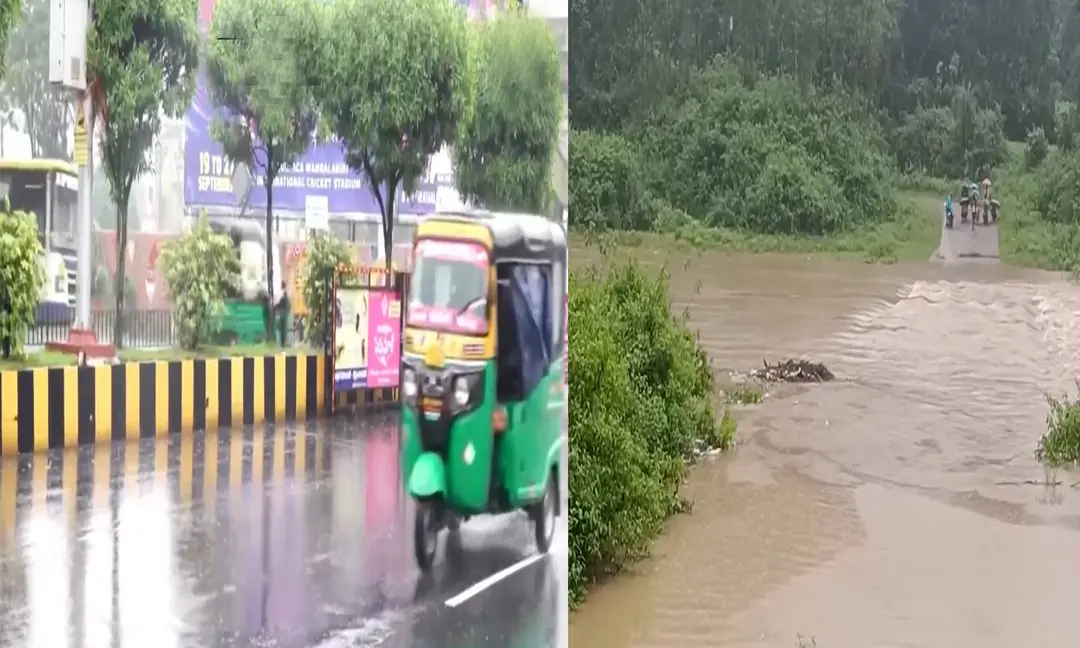
Heavy rains disrupt flights, flood low-lying areas in Andhra Pradesh
Heavy rains over two days disrupted flight operations, roads and crops across Andhra Pradesh. An IndiGo flight from Visakhapatnam to Vijayawada was diverted to Shamshabad, and a Star Air flight to Rajamahendravaram went to Bengaluru. Air India Express flight IX1373 could not land at Bhogapuram due to a non-functional signalling system and was diverted to Nagpur, with ministers K. Atchannaidu and Kondapalli Srinivas on board. Authorities released 14,500 cusecs from Prakasam barrage into the sea.
Source
Palnadu — weather · read the original report ↗
Desk check · compared with the source
What the desk checked (5)
- IndiGo flight from Visakhapatnam to Vijayawada was diverted to Shamshabad airport, Hyderabad, on Thursday. — Figure and route appear in source; no airline statement attributed.
- Air India Express flight IX1373 could not land at Bhogapuram around 9.40 pm Wednesday due to a non-functional signalling system, and was diverted to Nagpur. — Source explicitly attributes the rain link to an unnamed 'source'; flight number and time appear in source.
- Ministers K. Atchannaidu and Kondapalli Srinivas were among the passengers on the diverted flight. — Stated in source without attribution to an official confirmation.
- 14,500 cusecs of Krishna water released from Prakasam barrage into the sea at night. — Figure attributed to water resources authorities in the source; internally consistent.
- NTR collector Lakshmisha said there was no immediate threat from the Budameru canal. — Directly attributed to the named district collector.
Analysts’ view opinion
Heavy rain looks like an administrative story, but flood management in Andhra Pradesh has always been a political test. The diversion to Nagpur of a flight carrying two ministers — after a non-functional signalling system at Bhogapuram — is the kind of detail that invites questions about new airport infrastructure and hands the opposition an easy talking point. The government's rapid sequence of reviews, evacuations and damage-assessment orders can be read as pre-emptive defence against that criticism.
- Water resources minister Nimmala Ramanaidu personally reviewing reservoirs, Budameru and Munneru signals a government keen to project vigilance, given the state's recent flood memories.
- The diversion of the flight carrying ministers Atchannaidu and Kondapalli Srinivas is politically symbolic and could push Bhogapuram's operational readiness into public debate.
- Collector-level field visits and shifting residents to rehabilitation centres keep accountability inside the bureaucracy, which also cushions the political leadership.
- Ordering assessment of crop, road and house damage is the first step in the familiar politics of relief packages and claims on central assistance.
- No opposition reaction is recorded in the story, though blame-and-counter-blame over flood handling is standard fare in AP politics.
What to watch — Watch how quickly damage assessments translate into relief announcements, and whether the Bhogapuram signalling failure becomes a sustained political talking point.
The story does not establish the cause of or responsibility for the signalling failure, any loss of life or livestock, or the reaction of any political party.
Deep dive
Research brief · 8 facts · 4 dates · exam-readyThe brief
Context
Heavy rains and adverse weather over two days disrupted air travel, roads, low-lying settlements and crops across several parts of Andhra Pradesh. Flights to Vijayawada, Rajamahendravaram and the new Bhogapuram airport were diverted or cancelled, while streams such as Pedavagu overflowed and a road caved in near Nunna. Water resources minister Nimmala Ramanaidu reviewed the flood situation and district officials began evacuations and de-watering, while 14,500 cusecs of Krishna water was released from the Prakasam barrage into the sea.
Key facts
- An IndiGo flight from Visakhapatnam to Vijayawada could not land on Thursday due to bad weather and was diverted to Shamshabad airport, Hyderabad.
- A Star Air flight from Hyderabad to Rajamahendravaram was diverted to Bengaluru after being unable to land.
- Air India Express flight IX1373 from Vijayawada could not land at Bhogapuram airport at about 9.40 pm on Wednesday due to a non-functional signalling system, attributed to the rain, and was diverted to Nagpur.
- Ministers K. Atchannaidu and Kondapalli Srinivas were among the passengers on the diverted IX1373 flight.
- Water resources authorities released 14,500 cusecs of Krishna water from the Prakasam barrage downstream into the sea at night.
- A car was washed away in the overflowing Pedavagu stream near the Nunna mango orchards, and a portion of a road caved in near Nunna.
- NTR district collector Lakshmisha said there was no immediate threat from the Budameru canal, with officials monitoring the situation.
- Guntur, Bapatla and Palnadu districts also received heavy rainfall; rainwater inundated the RTC bus stand at Gudivada, where pumps were deployed.
Timeline
- Wednesday, about 9.40 pmAir India Express flight IX1373 from Vijayawada could not land at Bhogapuram due to a non-functional signalling system and was diverted to Nagpur.
- ThursdayIndiGo flight from Visakhapatnam to Vijayawada diverted to Shamshabad; Star Air Hyderabad-Rajamahendravaram flight diverted to Bengaluru; several Vijayawada-Visakhapatnam flights cancelled for some time.
- Same period (night)14,500 cusecs of Krishna water released from Prakasam barrage into the sea; people downstream alerted to avoid the riverbed.
- After weather improvedFlights were allowed to arrive and depart; state government ordered assessment of damage to infrastructure, crops, houses, human lives and livestock.
Who has a stake
- Air passengers and airlines (IndiGo, Star Air, Air India Express) — Diversions to Shamshabad, Bengaluru and Nagpur and cancellations on the Vijayawada-Visakhapatnam route disrupted schedules and travel.
- Bhogapuram airport operations — A non-functional signalling system, attributed to rain, prevented a landing, raising questions on all-weather readiness.
- Water resources minister Nimmala Ramanaidu — Directed officials to assess reservoir, river and rivulet levels and ensure public safety.
- NTR district collector Lakshmisha and municipal commissioner Dhyanachandra — Monitoring Budameru flood situation; ordered shifting of Kasturbaipeta residents facing rockfall risk to a rehabilitation centre.
- Farmers and residents of low-lying areas in Guntur, Bapatla, Palnadu and NTR districts — Crop damage, inundated homes and roads, and disrupted movement; eligible for relief after damage assessment.
- Downstream Krishna riverside communities — Alerted to stay cautious and avoid the riverbed after the 14,500 cusecs release from Prakasam barrage.
Why it matters
The episode shows how a single spell of heavy rain can simultaneously cripple aviation, urban drainage, road links and farm output in a coastal state. It also exposes dependence on functioning airport signalling systems and on real-time reservoir and rivulet monitoring for flood safety. For citizens, the speed of damage assessment determines how quickly relief and restoration reach affected households.
UPSC angle
Prelims pointers
- Prakasam barrage on the Krishna river at Vijayawada released 14,500 cusecs downstream into the sea.
- Bhogapuram airport diversion of Air India Express IX1373 was caused by a non-functional signalling system attributed to rain.
- Budameru and Munneru were the flood points specifically flagged for monitoring in the review.
- Pattiseema lift scheme pumps were ordered to be operated as required; Yeluru reservoir was to be monitored.
- Vamsadhara, Nagavali, Bahudha and Mahendratanaya rivers were listed for inflow monitoring.
- Districts named as rain-hit: NTR, Guntur, Bapatla and Palnadu.
Mains framing
The Andhra Pradesh rain event illustrates the cascading nature of hydro-meteorological disruption in a coastal, delta-dominated state: bad weather first hit aviation, with diversions of IndiGo, Star Air and Air India Express services and cancellations on the Vijayawada-Visakhapatnam route, and then translated into local flooding of low-lying areas, inundation of the Gudivada RTC bus stand, a road cave-in near Nunna, a car washed away in the overflowing Pedavagu stream, and crop damage across Guntur, Bapatla and Palnadu. The immediate causes are intense rainfall and swollen streams and rivulets; the vulnerabilities revealed are infrastructural, from a rain-affected signalling system at Bhogapuram airport to poor urban drainage and rockfall-prone housing at Kasturbaipeta. The response pattern is instructive: ministerial review of reservoir, river and rivulet levels, focused monitoring of Munneru and Budameru, operation of Pattiseema lift scheme pumps, pre-emptive evacuation to a rehabilitation centre, pump deployment for de-watering, a calibrated release of 14,500 cusecs from the Prakasam barrage with downstream alerts, and a state-ordered assessment of damage to infrastructure, crops, houses, lives and livestock. The way forward implicit in the source is stronger all-weather airport systems, continuous flood monitoring of the named rivers and canals, and prompt damage assessment-linked relief and restoration.
Key terms
- Cusec
- Unit of water flow (cubic feet per second) used to measure releases such as the 14,500 cusecs from the Prakasam barrage.
- Prakasam barrage
- Barrage across the Krishna river at Vijayawada from which flood water was released downstream into the sea.
- Budameru
- Canal/stream near Vijayawada flagged for close flood monitoring; the NTR collector said there was no immediate threat.
- Pattiseema lift scheme
- Lift irrigation scheme whose pumps officials were directed to operate as required during the flood situation.
- Bhogapuram airport
- Andhra Pradesh airport where flight IX1373 could not land due to a non-functional signalling system attributed to the rain.
- Rehabilitation centre
- Temporary shelter to which residents of rockfall-prone Kasturbaipeta were ordered to be shifted.
Practice questions
- Discuss how extreme rainfall events expose gaps in transport and urban drainage infrastructure, using the recent disruption in Andhra Pradesh as an illustration.
- Examine the role of barrages and lift irrigation schemes such as the Prakasam barrage and Pattiseema in flood management in the Krishna basin.
- What administrative steps did Andhra Pradesh authorities take during the recent heavy rains, and how do such measures link damage assessment to relief delivery?
Grounded only in the source report — figures and dates are the source's, not inferred.