
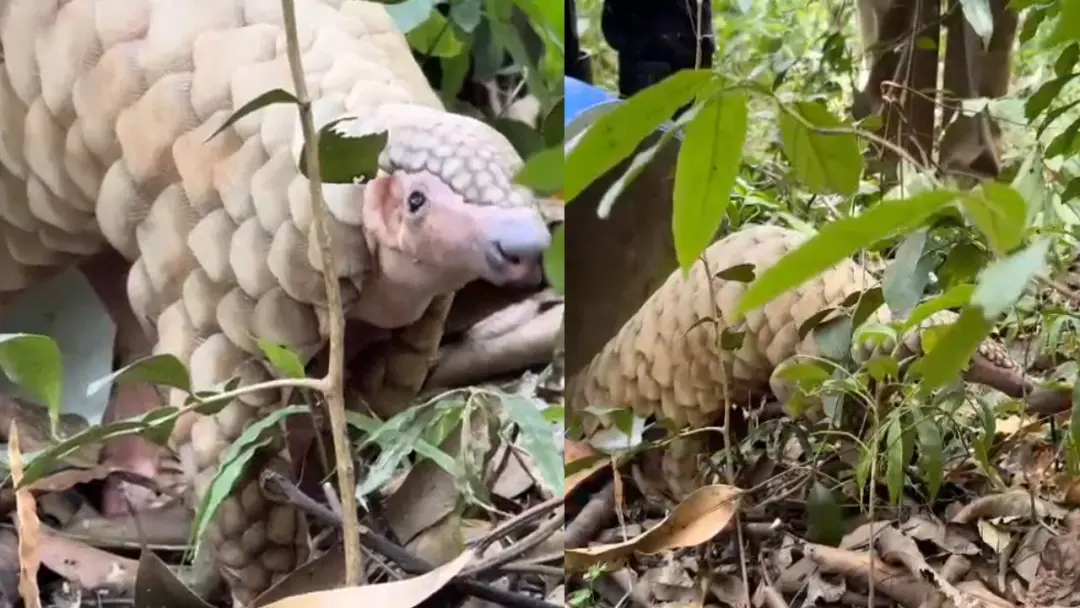
Pangolin found in construction pit rescued in Anakapalli district
A rare pangolin was found in a pit dug for a bathroom during house construction on farmer Vempa Subbaraju's field at Gollalapalem village in V. Madugula mandal of Anakapalli district. The family informed forest officials. Venkatesh, skilled at handling wild animals, rescued it safely and released it in nearby forests in the presence of officials. The pangolin is a nocturnal mammal feeding on ants and termites, and faces threats from poaching and illegal trade.
Source
Anakapalli — వార్తలు · read the original report ↗
Desk check · compared with the source
What the desk checked (5)
- A pangolin was found in a pit dug for a bathroom at farmer Vempa Subbaraju's field in Gollalapalem, V. Madugula mandal, Anakapalli district — Specific names and location appear in the source; no official document or quote cited.
- Wildlife handler Venkatesh rescued the animal and it was released in nearby forests in the presence of forest officials — Attributed in the source to the sequence of events; no direct quote from the handler or officials.
- Pangolin is a scaly, nocturnal mammal that feeds on ants and termites and has keratin scales — General background information in the source; consistent internally, no source cited.
- Hunting, transporting or selling pangolins is a serious offence under the Wildlife Protection Act, 1972 — Legal claim stated in the source without citation of a specific provision.
- Forest officials advised the public not to catch, harm or keep such animals and to inform authorities — Attributed to forest department officials generally; no named official.
Analysts’ view opinion
This is primarily a wildlife rescue story, but it carries a clear governance-politics angle: villagers chose to inform the forest department rather than handle the animal themselves, and officials responded — a small sign that local trust in the state machinery is functioning. Episodes like this are low-cost goodwill for the forest department and local representatives. At the same time, since the story itself notes that illegal hunting and trafficking continue, treating one rescue as proof of policy success would be an overreach.
- The family's decision to alert officials rather than capture the animal suggests awareness efforts and confidence in the department are working to some degree.
- For the forest department this is a positive-publicity opening, a chance to showcase field responsiveness.
- Reliance on a skilled individual for the actual rescue raises a fair question about whether departmental staffing and resources are adequate.
- The story's own point that poaching persists despite the Wildlife Protection Act, 1972, gives ammunition to debate about enforcement gaps.
- With more construction on farmland, human-wildlife encounters could become a policy issue at the local-body level.
What to watch — Watch whether the forest department or local representatives convert this episode into an awareness push or a broader anti-poaching drive.
The story reports no political reaction, government statement or new policy decision; what is offered here is analysis, not reporting.
Deep dive
Research brief · 8 facts · 4 dates · exam-readyThe brief
Context
During house construction on farmer Vempa Subbaraju's field at Gollalapalem village in V. Madugula mandal of Anakapalli district, workers dug a pit for a bathroom. The family later found an unfamiliar scaly animal inside it, which locals gathered to see and identified as a pangolin (locally called 'alugu' or 'alchippa'), one of the endangered species. Forest officials were informed, and Venkatesh, a person skilled at catching wild animals, rescued it and released it in nearby forests in the officials' presence. Pangolins are nocturnal, ant- and termite-eating mammals hunted illegally for their keratin scales and meat.
Key facts
- The pangolin was found in a pit dug for a bathroom during house construction on farmer Vempa Subbaraju's field at Gollalapalem village, V. Madugula mandal, Anakapalli district.
- Workers dug the pit and left in the evening; the family spotted the animal in the pit when they came to check.
- Villagers initially mistook it for a mongoose and were frightened by its body structure before recognising it as an endangered wild animal.
- Forest officials alerted Venkatesh, described as skilled at catching wild animals, who rescued the pangolin safely.
- The pangolin was released in nearby forests in the presence of forest officials.
- The pangolin is a nocturnal, scaly mammal that feeds only on ants and termites, has no teeth, and uses a long sticky tongue.
- Its entire body is covered with hard protective scales made of keratin, and it curls into a ball when attacked.
- Under the Wildlife Protection Act, 1972, hunting, transporting or selling a pangolin is a serious offence.
Timeline
- Day of construction workWorkers dig a pit for a bathroom on the farmer's field and leave in the evening.
- Same evening / first dayThe family visits the site and finds the animal in the pit; word spreads and villagers gather.
- After identificationForest officials are informed; Venkatesh reaches the spot and rescues the pangolin.
- After rescueThe pangolin is released in nearby forests in the presence of forest officials.
Who has a stake
- Vempa Subbaraju and family, Gollalapalem — Found the animal on their land and chose to protect it rather than harm it, informing the forest department.
- Forest Department officials, Anakapalli district — Responsible for rescue, release and enforcement of wildlife law; appeal to public to report sightings.
- Venkatesh, wildlife handler — Carried out the actual rescue of the pangolin without harm to it or to people.
- Villagers of Gollalapalem — Crowd gathered at the site; local awareness determines whether such animals are saved or killed.
- Pangolin population — Faces severe threat from illegal hunting and trafficking for meat and scales, with numbers declining.
Why it matters
The incident shows how construction and land-use change in rural areas brings shy, nocturnal wildlife into direct contact with people, where the outcome depends entirely on local awareness. Pangolins are among the most trafficked animals because of demand for their keratin scales in traditional medicine, and every rescue and safe release matters for a declining population. It also demonstrates that a public tip-off plus a trained handler can resolve human-wildlife encounters without harm on either side.
UPSC angle
Prelims pointers
- Pangolin, called 'alugu'/'alchippa' locally, is a scaly nocturnal mammal that eats only ants and termites and has no teeth.
- Pangolin scales are made of keratin; it rolls into a ball as a defence.
- Wildlife Protection Act, 1972: hunting, transporting or selling a pangolin is a serious offence.
- Location of rescue: Gollalapalem village, V. Madugula mandal, Anakapalli district, Andhra Pradesh.
- Pangolins dig burrows in the ground by day and forage at night; demand for scales in traditional medicine drives poaching.
Mains framing
The Anakapalli rescue illustrates the everyday face of human-wildlife interaction in India: a pit dug for a bathroom during house construction on farmland became a trap for a shy, burrowing, nocturnal pangolin. The immediate cause is habitat disturbance as construction extends into fields adjoining forests; the deeper threat, as the source notes, is illegal hunting and trafficking driven by demand for pangolin meat and keratin scales in traditional medicine, which is shrinking their numbers despite protection under the Wildlife Protection Act, 1972. The species is ecologically valuable because it controls ant and termite populations and thus contributes to biodiversity, so its loss is not merely a conservation statistic. The rescue also shows what works: villagers who recognised an endangered animal, a prompt tip-off to the forest department, a trained handler like Venkatesh who could restrain the animal without injuring it, and release into nearby forest under official supervision. The way forward suggested by the story itself is the forest officials' appeal—do not capture, injure or keep such animals at home, but report sightings—backed by local awareness, ready rescue capacity and strict enforcement against the illegal trade.
Key terms
- Pangolin (alugu / alchippa)
- A rare scaly, toothless nocturnal mammal that feeds on ants and termites using a long sticky tongue.
- Keratin
- The protein forming the pangolin's hard protective scales, prized in traditional medicine and hence a driver of poaching.
- Wildlife Protection Act, 1972
- Law under which hunting, transporting or selling a pangolin is a serious offence.
- Nocturnal
- Active only at night; the pangolin sleeps in ground burrows by day and forages after dark.
- V. Madugula mandal
- Mandal in Anakapalli district, Andhra Pradesh, where Gollalapalem village and the rescue site are located.
Practice questions
- Discuss how habitat disturbance from rural construction contributes to human-wildlife encounters, using the Anakapalli pangolin rescue as an illustration.
- Why are pangolins among the most trafficked mammals, and how effective is the Wildlife Protection Act, 1972 in countering this trade?
- What role can local communities and trained wildlife handlers play in wildlife rescue? Evaluate with reference to the Gollalapalem incident.
Grounded only in the source report — figures and dates are the source's, not inferred.