
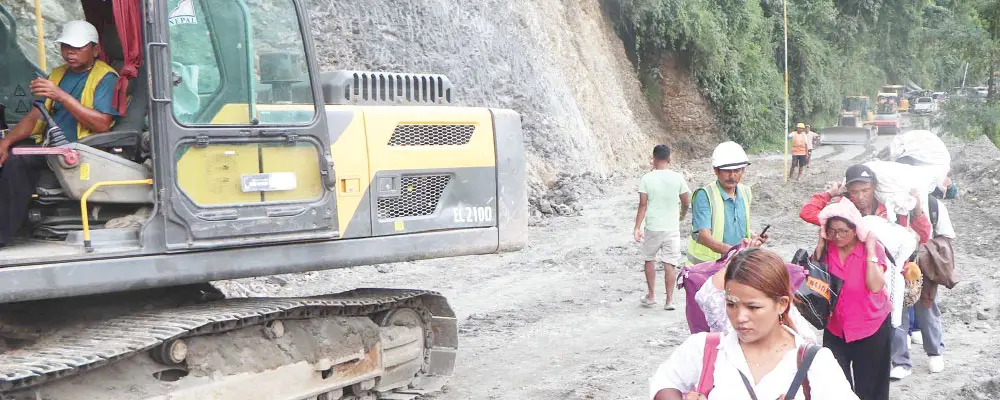
New 250-metre track at Krishnabhir completed; two-way traffic from Sept 17
Construction of a new 250-metre track at Krishnabhir on the Nagdhunga-Muglin section of Nepal's Prithvi Highway has been completed. Floods on August 26 and August 30 damaged and then destroyed the retaining wall, halting vehicular movement. Prime Minister Balendra Shah told parliament on September 2 the road would reopen within September. The hillside was excavated to a height of 35 metres and depth of up to 20 metres. About 50 people worked 12 to 16 hours daily. Trial movement began September 13; two-way traffic starts September 17.
Source
Nepal · read the original report ↗
Desk check · compared with the source
What the desk checked (5)
- A new 250-metre track at Krishnabhir on the Nagdhunga-Muglin section of the Prithvi Highway has been completed within the announced deadline. — Figure and completion claim appear in source, attributed to the Ministry of Physical Infrastructure and Transport's work; no independent verification cited.
- Prime Minister Balendra Shah announced on September 2 in the House of Representatives that the blocked road would reopen within September. — Attributed to the Prime Minister's parliamentary statement as reported in the source.
- Floods on August 26 and August 30 damaged and then destroyed the retaining wall at Krishnabhir, halting vehicular movement. — Dates and sequence given in source; no source agency named for the damage assessment.
- Around 50 people worked 12 to 16 hours a day; the hillside was excavated to a height of 35 metres and depth of up to 20 metres. — Figures appear in source without attribution to a named official or document.
- Trial transport resumed September 13 and two-way traffic will begin Thursday, September 17. — Forward-looking schedule stated in source; subject to change.
Analysts’ view opinion
A deadline announced on the floor of parliament and then visibly met is exactly the kind of small, checkable promise that builds political capital, and Prime Minister Balendra Shah's office will treat the Krishnabhir reopening as proof that his government can deliver on timelines rather than merely announce them. The Prithvi Highway is Nepal's main artery to Kathmandu, so the political dividend here is felt by traders, transporters and ordinary commuters, not just headline readers. The story also gives Physical Infrastructure Minister Sunil Lamsal a visible delivery credential, tying a line ministry's performance directly to the PM's word in the House.
- The political value lies less in 250 metres of track than in the sequence — promise made in parliament, promise kept within the month — which is a difficult claim for critics to contest on the facts.
- Shah's announcement came while briefing the House on flood response in Rasuwa, so the reopening lets the government reframe a disaster narrative into a competence narrative.
- Minister Lamsal's continuous monitoring is highlighted in the account, giving him a personal share of the credit and strengthening his standing within the government.
- Opposition pushback, if it comes, is likelier to target process and durability — cost, tendering, environmental clearance for cutting the hillside, and whether the fix survives the next monsoon — rather than the fact of reopening.
- Roads restored quickly along a national trade corridor tend to travel well as a governance message beyond the immediate constituency, which is why such wins are usually repeated in political messaging.
What to watch — Watch whether the government converts this into a broader 'deadlines delivered' pitch, and whether the new track holds up under full two-way load and later monsoon stress — durability, not the opening, will decide the political story.
The story does not establish the cost of the work, how contracts were awarded, what environmental or geotechnical safeguards were followed for a 35-metre hillside cut, or any opposition or expert criticism of the approach.
Deep dive
Research brief · 8 facts · 8 dates · exam-readyThe brief
Context
Nepal's Prithvi Highway, the key east-west link between Kathmandu and the country's western districts, was cut off at Krishnabhir on the Nagdhunga-Muglin section after floods in late August destroyed a retaining wall. Amid wider flood damage — including the Bhotekoshi River floods in Rasuwa — Prime Minister Balendra Shah told the House of Representatives on September 2 that the blocked road would reopen within September. Experts advised cutting through the Krishnabhir hillside to build a new 250-metre track rather than rebuilding the collapsed wall. The Ministry of Physical Infrastructure and Transport executed the work, with trial movement from September 13 and full two-way traffic set for September 17.
Key facts
- A new 250-metre-long track has been built at Krishnabhir on the Nagdhunga-Muglin section of the Prithvi Highway.
- A flood on the morning of August 26 damaged the Krishnabhir retaining wall; a second flood on August 30 destroyed it, halting all vehicular movement.
- Prime Minister Balendra Shah announced in the House of Representatives on September 2 that the road would reopen within September.
- The Ministry of Physical Infrastructure and Transport conducted a four-day rapid study with the Department of Roads and the Nepal Geotechnical Society.
- Experts recommended cutting the Krishnabhir hillside and building a new 250-metre track as the first option.
- The hillside was excavated to a height of 35 metres and a depth of up to 20 metres; tree felling began September 4.
- Around 50 people, including technical personnel, worked 12 to 16 hours a day on the project.
- Trial operation began September 13 — the 10th day after work started — including LPG bullet tankers; two-way traffic starts Thursday, September 17.
Timeline
- August 26 (morning)Flood damages the retaining wall at Krishnabhir on the Prithvi Highway.
- August 30A second flood destroys the retaining wall, completely disrupting vehicular movement.
- September 2PM Balendra Shah informs the House of Representatives on Rasuwa Bhotekoshi flood response and announces the road will reopen within September.
- After the floods (four days)Ministry of Physical Infrastructure and Transport carries out a rapid study with the Department of Roads and Nepal Geotechnical Society.
- September 4Tree felling begins for the new track alignment.
- September 13Trial transport services resume; some vehicles including LPG bullet tankers operate; essential vehicles allowed morning and evening.
- September 15-16Gravelling, drainage construction and road strengthening under way; gravelling expected to finish by September 17.
- September 17 (Thursday morning)Two-way traffic scheduled to come into operation.
Who has a stake
- Prime Minister Balendra Shah — Publicly committed in parliament to reopening the road within September; credibility tied to meeting the deadline.
- Ministry of Physical Infrastructure and Transport — Led the rapid study, construction and trial resumption of services on the section.
- Minister for Physical Infrastructure Sunil Lamsal — Continuously monitored and coordinated the reconstruction work.
- Department of Roads and Nepal Geotechnical Society — Provided technical support for the four-day rapid study and the hillside-cutting recommendation.
- Around 50 workers and technical personnel — Worked 12 to 16 hours daily to deliver the track within the announced deadline.
- Road users and freight operators (including LPG tanker transporters) — Restoration of movement on a key highway section disrupted since August 30.
- House of Representatives — Forum where the government's flood response and reopening commitment were reported.
Why it matters
The Prithvi Highway's Nagdhunga-Muglin section is a critical artery, and its closure after the August floods cut off vehicle movement, including LPG bullet tankers carrying essential supplies. The rapid ten-day delivery of an alternative 250-metre hill-cut track shows how disaster-hit road links can be restored through fast technical assessment and round-the-clock work. It also underlines how monsoon floods repeatedly threaten hill-highway structures such as retaining walls.
UPSC angle
Prelims pointers
- Krishnabhir lies on the Nagdhunga-Muglin section of Nepal's Prithvi Highway.
- Floods on August 26 damaged and on August 30 destroyed the Krishnabhir retaining wall.
- New track length: 250 metres; hillside cut to 35 m height and up to 20 m depth.
- PM Balendra Shah made the reopening announcement in the House of Representatives on September 2.
- Technical support came from the Department of Roads and the Nepal Geotechnical Society.
- Trial movement began September 13; two-way traffic from September 17.
Mains framing
The Krishnabhir episode illustrates the vulnerability of hill-highway infrastructure in the Himalayan region: two floods within five days, on August 26 and August 30, first damaged and then destroyed a retaining wall, severing the Nagdhunga-Muglin section of the Prithvi Highway. The response shows a workable model of emergency road restoration — a four-day rapid technical study by the Ministry of Physical Infrastructure and Transport with the Department of Roads and the Nepal Geotechnical Society, an expert recommendation to cut the hillside rather than rebuild the failed wall, and a 250-metre track delivered with about 50 personnel working 12 to 16 hours a day, allowing trial movement by the tenth day. Political ownership mattered: the Prime Minister's September 2 commitment in parliament created an accountable deadline, and ministerial monitoring sustained coordination. The implications extend beyond Nepal to India's own flood-prone hill corridors, where alignment choices, drainage, slope stability and the resilience of retaining structures determine whether connectivity survives the monsoon. The way forward suggested by the source's own sequence is completion of gravelling, drainage and strengthening works, since a rapidly cut hill track must still be consolidated against future floods.
Key terms
- Prithvi Highway
- Nepali highway whose Nagdhunga-Muglin section includes Krishnabhir, where the new track was built.
- Retaining wall
- Structure that holds back soil or slope material along a road; the Krishnabhir wall was destroyed by the August 30 flood.
- Nepal Geotechnical Society
- Technical body that, with the Department of Roads, supported the ministry's four-day rapid study at Krishnabhir.
- Ministry of Physical Infrastructure and Transport
- Nepali ministry that led the rapid study, track construction and resumption of transport services.
- LPG bullet tanker
- Pressurised road tanker carrying liquefied petroleum gas; among the first vehicles allowed on the trial track from September 13.
- Bhotekoshi River floods, Rasuwa
- Flood disaster on which PM Balendra Shah briefed the House of Representatives on September 2, along with the Krishnabhir reopening pledge.
Practice questions
- Discuss the vulnerability of hill-region highways to monsoon flooding, using the Krishnabhir disruption on Nepal's Prithvi Highway as an illustration.
- Emergency road restoration requires both rapid technical assessment and political accountability. Examine this statement with reference to the Krishnabhir track built between September 4 and September 17.
- What lessons can Indian road agencies draw from the decision to cut a new hillside track rather than rebuild a destroyed retaining wall?
Grounded only in the source report — figures and dates are the source's, not inferred.