
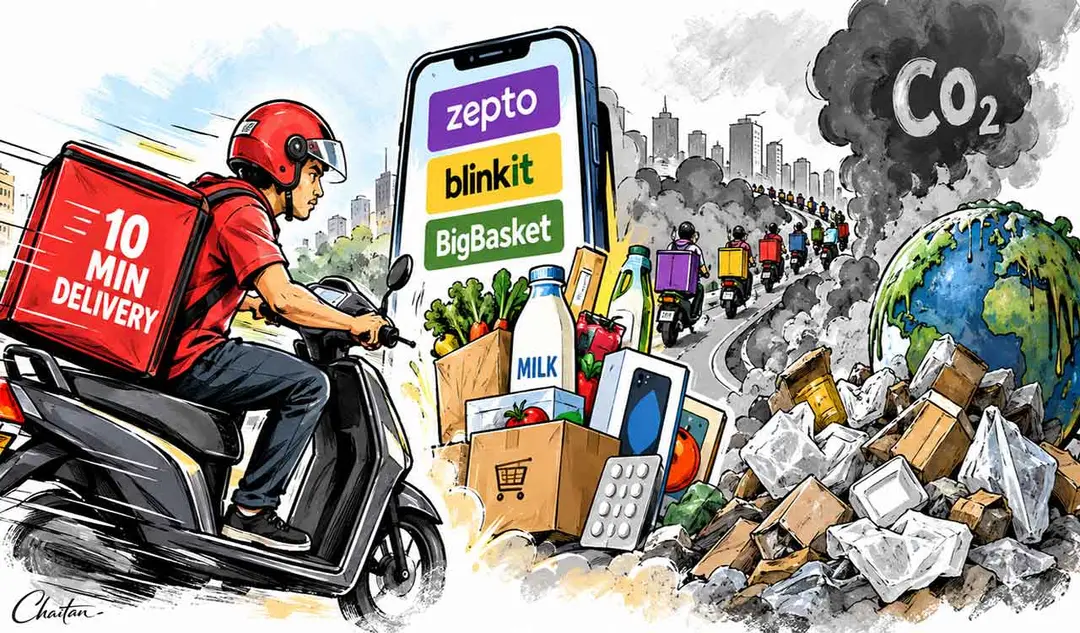
Quick commerce packaging waste raises environmental concern, says article
An opinion article says the spread of 10-minute delivery apps is adding to carbon emissions, fuel consumption and plastic waste. Citing the Central Pollution Control Board's 2022-23 annual report, it notes India generates 3.9 million tonnes of plastic waste annually and nearly 10,689 tonnes a day, with per capita generation rising from 700 grams in 2016-17 to over 2.5 kg by 2020. It suggests bioplastics, compostable mailers and returnable basket models.
Source
Telangana Today · read the original report ↗
Desk check · compared with the source
What the desk checked (4)
- India generates 3.9 million tonnes of plastic waste annually and nearly 10,689 tonnes per day. — Attributed in the source to the Central Pollution Control Board annual report for 2022-23.
- Per capita plastic waste generation rose from 700 grams in 2016-17 to over 2.5 kg by 2020. — Figure appears in source alongside the CPCB citation; described as a tripling in four years.
- Category I rigid plastic packaging must contain at least 30% recycled material, rising to 60% by 2028-29. — Attributed to the Plastic Waste Management Rules, 2016 and subsequent amendments as cited in the source.
- Quick commerce deliveries in 10-15 minutes increase carbon footprint, fuel use and packaging waste. — Author's analytical argument in an opinion column; no study or data source given.
Analysts’ view opinion
Though framed as an environmental argument, the piece really poses a political-economy question: who carries the regulatory cost of India's fast-delivery boom. With jobs and urban consumer convenience on one side and plastic waste management on the other, governments are likelier to lean toward incentives and voluntary standards than hard curbs. The remedies the author suggests — tighter EPR enforcement and recycled-content mandates — sit largely with the Centre, while collection and segregation infrastructure rests with states and municipal bodies, and that split is exactly where accountability tends to dissolve.
- Because quick commerce is a visible employment generator, any strict clampdown carries a political cost, setting up a familiar jobs-versus-environment tension.
- Since the Plastic Waste Management Rules and EPR framework already exist, the political fight is likely to be about implementation gaps rather than new legislation.
- With rules made centrally but collection and segregation delivered locally, failures invite Centre-versus-state and state-versus-municipality blame-shifting.
- Voluntary sustainability disclosure of the BRSR kind can function as a pre-emptive industry strategy to soften the case for binding regulation.
- The core user base is the urban middle class, so any measure that visibly raises costs for consumers, such as packaging levies, is politically sensitive.
What to watch — Watch whether the Centre moves to tighten verification of EPR credits, or whether policy settles for industry-led voluntary standards.
This is a single scholar's opinion piece and does not establish that the government is considering quick-commerce-specific regulation or that any party has taken up the demand.
Deep dive
Research brief · 8 facts · 8 dates · exam-readyThe brief
Context
Quick commerce platforms such as Zepto, Blinkit and BigBasket now deliver groceries, medicines and electronics within 10-15 minutes, a habit that grew during Covid-19 and has since become routine in many Indian households. An opinion article by Teegala Shruthi, a PhD scholar at the Centre for Economic and Social Studies (CESS), Hyderabad, argues that this hyper-convenience adds to carbon emissions, fuel use, congestion and single-use plastic waste. Each small order can involve bubble wrap, plastic carry bags, pouches, adhesive tape, insulated covers and single-use containers. The article argues quick commerce itself is not the enemy; unsustainable packaging and delivery practices are.
Key facts
- Central Pollution Control Board annual report 2022-23: India generates 3.9 million tonnes of plastic waste annually and nearly 10,689 tonnes per day.
- Per capita plastic waste generation rose from 700 grams in 2016-17 to over 2.5 kg by 2020 — a tripling in four years.
- Quick commerce deliveries of groceries, medicines and electronics now reach doorsteps in 10 to 15 minutes via apps like Zepto, Blinkit and BigBasket.
- Minimum order values and delivery/platform fees can push consumers to add unnecessary items, causing overconsumption and fragmented orders.
- Plastic Waste Management Rules, 2016 and amendments provide the regulatory framework for plastic packaging, including recycled content and reuse provisions.
- For 2025-26, Category I rigid plastic packaging (HDPE and PET containers) was introduced, requiring at least 30% recycled material, rising to 60% by 2028-29.
- Single-use plastic takes hundreds of years to degrade, blocks rainwater percolation, obstructs tree roots and spreads microplastics through the food chain.
- Suggested alternatives: bioplastics and compostable mailers from corn starch and cassava, honeycomb paper packaging, multilayered craft paper and returnable basket models.
Timeline
- 2016Plastic Waste Management Rules notified, creating the regulatory framework for plastic packaging; later amended.
- 2016-17Per capita plastic waste generation in India recorded at 700 grams.
- 2020Per capita plastic waste generation crosses 2.5 kg, roughly tripling in four years.
- Covid-19 periodUnusual circumstances drive a rise in quick commerce and same-day delivery services, which later becomes routine.
- 2022-23CPCB annual report records 3.9 million tonnes of plastic waste annually and nearly 10,689 tonnes a day.
- 2025-26Category I rigid plastic packaging (HDPE, PET) introduced with a minimum 30% recycled content requirement.
- 2028-29Recycled content requirement for Category I plastic packaging to rise to 60%.
- 18 September 2026Opinion article published raising environmental concerns over quick commerce packaging waste.
Who has a stake
- Quick commerce companies (Zepto, Blinkit, BigBasket) — Must shift to sustainable packaging and delivery, meet recycled-content norms and manage reputational and ESG risks.
- Consumers and households — Can choose minimal-packaging options, avoid small fragmented orders and back environmentally responsible brands.
- Central Pollution Control Board — Generates the national plastic waste data underpinning the debate and oversees pollution control.
- Government and regulators — Enforcement of single-use plastic and solid waste rules, Extended Producer Responsibility and verification of EPR credits.
- SEBI — Its Business Responsibility and Sustainability Reporting (BRSR) Core standards offer a transparency framework companies can adopt.
- Gig delivery workers — Quick commerce platforms provide employment to many people and facilitate millions of orders daily.
- Schools, parents and NGOs — Awareness building on waste segregation and sustainable consumption, including via Swachh Bharat Abhiyan programmes.
- Farmers and cooperatives — Potential tie-ups and contract farming to supply plant-based raw materials such as corn starch and cassava.
Why it matters
Quick commerce is expanding fast in Indian cities, and each 10-minute order adds packaging waste, fuel use, congestion and noise to already strained urban systems. With India generating 3.9 million tonnes of plastic waste a year and per capita generation tripling in four years, the packaging choices of a few large platforms carry outsized environmental consequences. The article's core point is that speed and convenience cannot become an excuse for environmental irresponsibility.
UPSC angle
Prelims pointers
- CPCB annual report 2022-23: India's plastic waste — 3.9 million tonnes a year, nearly 10,689 tonnes a day.
- Per capita plastic waste generation: 700 g (2016-17) to over 2.5 kg (2020).
- Plastic Waste Management Rules, 2016 govern plastic packaging, recycled content and reuse.
- Category I plastic packaging = rigid plastic, including HDPE and PET containers; 30% recycled content in 2025-26, 60% by 2028-29.
- Extended Producer Responsibility (EPR) and EPR credits are the accountability tools proposed for quick commerce firms.
- SEBI's BRSR Core is the sustainability reporting standard cited for transparency and ESG disclosure.
Mains framing
India's quick commerce boom, accelerated by Covid-19 and now habitual, illustrates how convenience-driven consumption externalises environmental costs: fragmented small orders raise trips, fuel use, emissions, congestion and noise, while minimum order values and fee thresholds nudge overconsumption. The packaging layer — bubble wrap, pouches, tapes, insulated covers, single-use containers — is cheap for firms but hard to recycle, ending in landfills and drains, obstructing rainwater percolation and root growth, and dispersing microplastics through the food chain. India's regulatory architecture already exists in the Plastic Waste Management Rules, 2016 and the phased Category I rigid-plastic norms (30% recycled content in 2025-26 rising to 60% by 2028-29), but the gap is enforcement and verification, particularly of EPR credits, and weak collection, segregation and recycling infrastructure. A workable path combines material substitution (bioplastics and compostable mailers from corn starch and cassava, honeycomb and multilayered craft paper), system redesign such as hyper-local returnable basket models, supply-side tie-ups with cooperatives and contract farming, voluntary disclosure through SEBI BRSR Core with transaction-level sustainability scorecards, and demand-side change via consumer choices, school programmes under Swachh Bharat Abhiyan and NGO awareness work. The framing is that quick commerce is not the enemy; unsustainable packaging and delivery practices are.
Key terms
- Quick commerce
- Delivery of groceries, medicines and other essentials to doorsteps within 10 to 15 minutes via apps.
- Extended Producer Responsibility (EPR)
- Obligation on producers for collection and recycling of the packaging waste they generate; tracked through EPR credits.
- Category I plastic packaging
- Rigid plastic packaging including HDPE and PET containers, easier to collect, segregate and recycle.
- BRSR Core (SEBI)
- SEBI's Business Responsibility and Sustainability Reporting standard for transparent ESG disclosure by companies.
- Bioplastics and compostable mailers
- Packaging made from plant-based polymers and materials such as corn starch and cassava.
- Microplastics
- Tiny plastic fragments from degrading throwaway plastic that spread through aquatic ecosystems and the food chain.
Practice questions
- Quick commerce offers employment and convenience but generates significant packaging and emissions externalities. Critically examine, suggesting regulatory and market-based remedies.
- Discuss how effective implementation of the Plastic Waste Management Rules, 2016 and Extended Producer Responsibility can curb India's rising per capita plastic waste generation.
- Can voluntary sustainability reporting frameworks such as SEBI's BRSR Core substitute for regulatory enforcement in reducing packaging waste? Argue with reference to the quick commerce sector.
Grounded only in the source report — figures and dates are the source's, not inferred.