
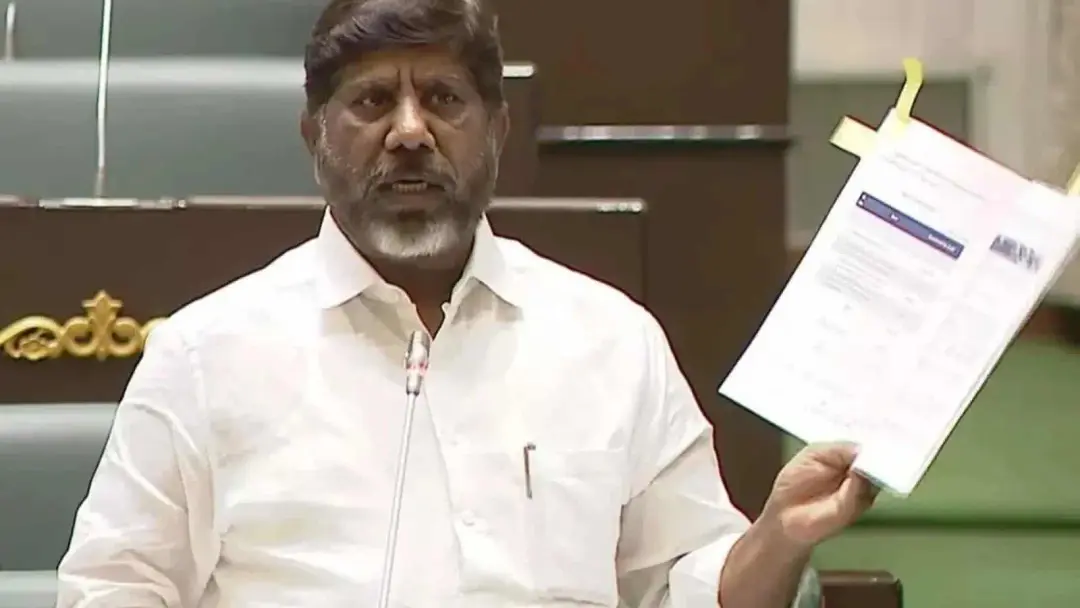
Telangana Assembly passes resolutions seeking central aid for drought relief
The Telangana Legislative Assembly on Friday, September 18, unanimously passed resolutions moved by Deputy Chief Minister Bhatti Vikramarka Mallu seeking immediate central financial aid after severe rainfall deficits. It sought NDRF assistance, release of the Centre's SDRF share and a field assessment team. Demands included a Rs 20,000 crore special package for drinking water, irrigation and drought relief, 1,500 MW extra power, 5 million tonnes of coal, and raising the FRBM limit from 3% to 3.5% for 2026-27.
Source
Telangana — CM & govt · read the original report ↗
Desk check · compared with the source
What the desk checked (5)
- Telangana Assembly unanimously passed resolutions on September 18 seeking immediate central financial aid after rainfall deficits. — Stated in source as Assembly proceedings; resolutions attributed to Deputy CM Bhatti Vikramarka Mallu.
- The Assembly sought a special package of Rs 20,000 crore for drinking water, irrigation and drought relief. — Figure appears in source, attributed to the Assembly resolution.
- Telangana needs an additional 1,500 MW from the central grid, 5 million tonnes of coal and rail wagons. — Attributed to Bhatti Vikramarka in the source; no independent data cited.
- Request to raise the FRBM borrowing limit from 3% to 3.5% of GSDP for 2026-27. — Appears in source as part of the resolution; no central response reported.
- Demand for 50 extra days of employment over the 125 days under the VB-G RAM G scheme, with full central funding. — Attributed to the Deputy CM; scheme name reproduced as written in source.
Analysts’ view opinion
These drought resolutions are a fiscal request and a political document at the same time. By passing them unanimously, the state government has put on record that it asked — which means credit if Delhi responds, and a ready grievance if it does not. Since demands like a Rs 20,000 crore package and a higher FRBM ceiling are unlikely to be granted quickly, this lays the groundwork for a Centre-versus-state narrative in the months ahead.
- Having the Deputy Chief Minister himself move the resolutions shifts drought from an administrative problem to the terrain of Centre-state fiscal relations.
- Unanimous passage leaves the opposition little room — voting against farm relief is politically expensive for anyone in the House.
- The request to lift the FRBM borrowing limit from 3 to 3.5 per cent is the most sensitive ask, since the Centre is typically strict on state borrowing, making it a likely friction point.
- Demanding a central team for field inspection is shrewd: a visit validates the state's distress claim, a no-show becomes evidence of neglect.
- Extra rural employment days, fertiliser, power and coal together read as a broad package aimed squarely at rural voters.
What to watch — Watch whether the Centre sends an assessment team and how much it sanctions — and how quickly the ruling party converts that response into political messaging.
The story does not establish the Centre's response, the opposition's stated position, or any official estimate of the crop and rainfall losses.
Deep dive
Research brief · 8 facts · 3 dates · exam-readyThe brief
Context
Telangana has faced severe rainfall deficits, which the state government attributes to El Niño conditions, threatening crops, drinking water supply, groundwater levels and power demand. On Friday, September 18, the Telangana Legislative Assembly unanimously passed resolutions moved by Deputy Chief Minister Bhatti Vikramarka Mallu urging the Union Government for immediate financial and material assistance. The resolutions span disaster relief funds, rural employment, agriculture inputs, power and coal supply, and a higher borrowing limit for the state.
Key facts
- The Telangana Legislative Assembly unanimously passed the resolutions on Friday, September 18, moved by Deputy CM Bhatti Vikramarka Mallu.
- The resolutions seek adequate National Disaster Response Fund (NDRF) assistance and immediate release of the Centre's share of the State Disaster Response Fund (SDRF).
- The state asked the Union Government to send a representative team at the earliest to assess El Niño conditions at the field level.
- A special central package of Rs 20,000 crore was sought for drinking water, irrigation and drought relief.
- Telangana sought an additional 1,500 MW from the central grid, 5 million tonnes of coal and sufficient rail wagons to move it to power plants.
- The Assembly sought 50 additional days of employment over and above the 125 days provided under the VB-G RAM G scheme, with the entire expenditure borne by the Centre.
- It asked for relaxation of the existing 60-day seasonal suspension period in the state and an increased labour budget for rural households.
- The state sought raising the FRBM borrowing limit from 3 per cent to 3.5 per cent of GSDP for the 2026-27 financial year.
Timeline
- Friday, September 18Telangana Legislative Assembly unanimously passes resolutions moved by Deputy CM Bhatti Vikramarka Mallu seeking central aid for drought relief.
- At the earliest (sought)Union Government team to visit Telangana for field-level assessment of El Niño conditions.
- Financial year 2026-27Period for which the state seeks the FRBM borrowing limit raised from 3% to 3.5% of GSDP.
Who has a stake
- Telangana government / Legislative Assembly — Seeks central funds, power, coal and higher borrowing headroom to finance urgent drought relief measures.
- Union Government — Must decide on NDRF assistance, release of SDRF share, the Rs 20,000 crore package, coal and power allocations, and the FRBM relaxation.
- Farmers in Telangana — Depend on crop loss compensation or input subsidy, fertilisers, subsidised seeds for alternative crops, drip irrigation and horticulture support.
- Rural households — Seek 50 extra days of work beyond 125 days under VB-G RAM G and relaxation of the 60-day seasonal suspension for employment security.
- Livestock owners — Assistance sought for fodder supply and protection of livestock during the rainfall deficit.
- Power utilities and consumers — Need 1,500 MW extra supply, 5 million tonnes of coal, rail wagons and lower transmission charges to meet demand.
Why it matters
Rainfall deficits cascade from crop loss into drinking water scarcity, falling groundwater, fodder shortages and higher power demand for irrigation, making the state dependent on central fiscal and physical resources. The demands also test the Centre-state fiscal relationship, particularly on NDRF/SDRF releases and the FRBM borrowing ceiling, which caps how much a state can borrow for relief.
UPSC angle
Prelims pointers
- NDRF (National Disaster Response Fund) and SDRF (State Disaster Response Fund) are the two-tier disaster relief funding mechanism referred to in the resolutions.
- FRBM borrowing limit is expressed as a percentage of Gross State Domestic Product (GSDP); Telangana seeks 3% raised to 3.5% for 2026-27.
- Per Drop More Crop (PDMC) is cited for expanding drip irrigation; MIDH support sought for vegetable cultivation.
- VB-G RAM G scheme currently provides 125 days of employment; Telangana seeks 50 additional days fully funded by the Centre.
- Telangana's power-sector demands: 1,500 MW from the central grid, 5 million tonnes of coal, rail wagons and lower transmission charges.
- El Niño conditions were cited as the basis for seeking a central field assessment team.
Mains framing
Telangana's unanimous Assembly resolutions illustrate how climatic shocks such as El Niño-linked rainfall deficits rapidly become fiscal and federal questions. The immediate cause is a severe rainfall deficit, whose implications run across sectors: crop loss requiring input subsidy, drinking water and fodder scarcity, depleted groundwater and dried tanks, greater pressure on rural employment, and a spike in power and coal requirements including rail wagons for transport. The state's response bundles relief demands (NDRF sanction, release of the Centre's SDRF share, a Rs 20,000 crore special package, relaxation of scheme guidelines) with resilience measures (drip irrigation under PDMC, horticulture support under MIDH, subsidised seeds for alternative crops, revival of tanks and faster irrigation projects) and a fiscal ask (FRBM limit from 3% to 3.5% of GSDP for 2026-27, plus 50 extra VB-G RAM G days fully centrally funded and relaxation of the 60-day seasonal suspension). The way forward, as framed in the resolutions, rests on an early central field assessment team, timely fund releases, flexible guidelines, and an enlarged labour budget so that employment security and water security are addressed together rather than sequentially. Beyond the source, no claim can be made about the Centre's response.
Key terms
- NDRF
- National Disaster Response Fund, the central fund from which assistance is sanctioned for disaster relief.
- SDRF
- State Disaster Response Fund, jointly financed, with Telangana seeking immediate release of the Centre's share.
- FRBM
- Fiscal Responsibility and Budget Management framework that caps state borrowing as a share of GSDP; here 3% sought to be raised to 3.5%.
- GSDP
- Gross State Domestic Product, the base against which the state's borrowing limit is calculated.
- Per Drop More Crop (PDMC)
- Central scheme component for micro-irrigation; more funding sought to rapidly expand drip irrigation.
- VB-G RAM G
- Rural employment scheme providing 125 days of work; state seeks 50 more days with full central funding.
Practice questions
- Examine how rainfall deficits translate into fiscal stress for states, using Telangana's September 18 Assembly resolutions as a case study.
- Discuss the role of NDRF and SDRF in India's disaster relief architecture and the issues that arise in Centre-state fund transfers.
- Should states be allowed higher FRBM borrowing limits during drought or disaster years? Critically evaluate.
Grounded only in the source report — figures and dates are the source's, not inferred.