
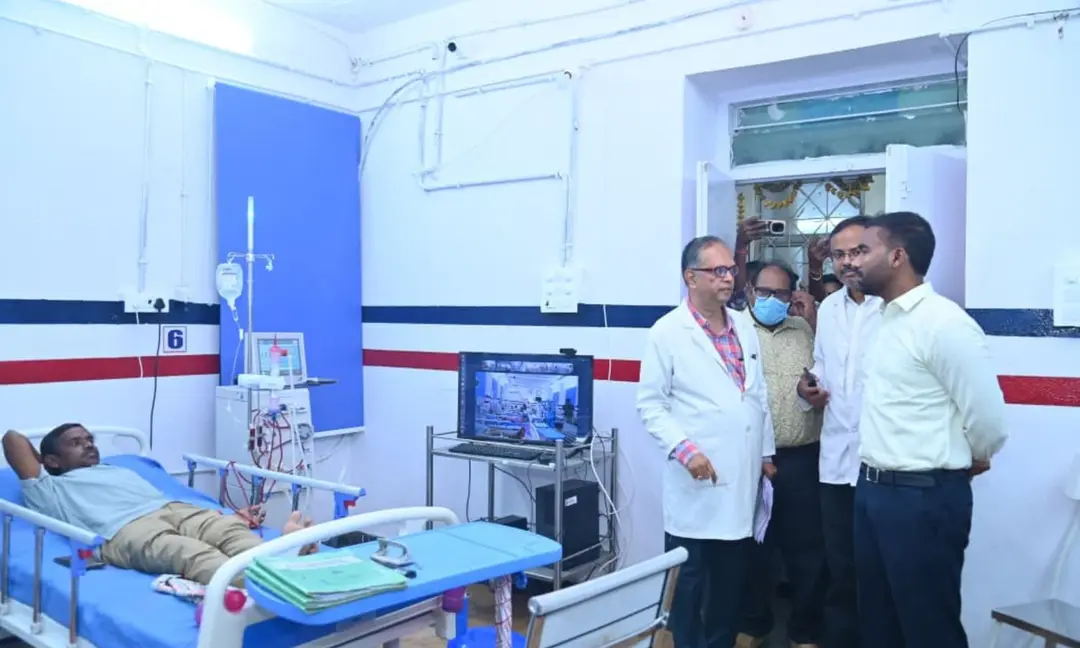
Jagtial Collector conducts surprise inspection of area hospital
Jagtial District Collector B. Satyaprasad made a surprise inspection of the local area hospital on Wednesday, telling doctors and staff to stay alert about seasonal fevers spreading amid the rains. He reviewed emergency services, dialysis and emergency wards and sanitation. Officials flagged parking, roof leakage, dhobi room and kitchen problems, which he ordered resolved within a month. Terrace waste is to be cleared in two weeks and Aarogyasri registrations raised in 2-3 months. RDO Madhusudan attended.
Source
Jagtial — ఆరోగ్యం · read the original report ↗
Desk check · compared with the source
What the desk checked (5)
- Jagtial Collector B. Satyaprasad made a surprise inspection of the local area hospital on Wednesday. — Stated directly in the source with named official and day; no independent confirmation available.
- He told doctors and staff to stay alert about seasonal fevers spreading amid rains. — Attributed to the collector in the source.
- Officials flagged parking, roof leakage, dhobi room and kitchen problems, and were ordered to fix them within one month. — Figure and instruction appear in the source, attributed to the collector.
- Waste accumulated on the terrace to be removed within two weeks; Aarogyasri registrations to be raised in 2-3 months. — Timelines appear in the source as the collector's directions.
- Remaining works of the medical college under construction to be completed in a month; RDO Madhusudan and others attended. — Named participants and directive appear in the source; no further details given.
Analysts’ view opinion
On the surface this is a routine surprise-inspection story, but in policy terms it is another instance of "governance by visit": the problems were already there, officials already knew them, and a deadline appeared only once the Collector walked in. Roof leaks, the dhobi room, the kitchen and waste piled on the terrace point less to a funding gap than to a weak routine-maintenance system. Attaching explicit timelines — two weeks, one month, two to three months — is good administrative practice; who tracks those timelines and what follows non-compliance is not established in the story.
- The beneficiaries are mainly poorer and rural patients dependent on the public hospital, and the focus on dialysis and emergency wards acknowledges exactly that dependence.
- Linking terrace waste and sanitation to monsoon fever risk is sound policy logic — it shifts attention from treatment to prevention.
- The push to raise Aarogyasri enrolment opens a revenue path for the hospital, but enrolment targets can strain a facility if staffing, beds and specialist capacity do not grow alongside.
- A one-month deadline for the under-construction medical college is ambitious; construction projects of this kind commonly see timelines extended.
- Single inspections change little without structured follow-up and publicly reported compliance against the stated deadlines.
What to watch — Whether the two-week waste clearance, the one-month repairs and the medical college handover are actually reviewed on time, and whether that compliance is reported publicly.
The story says nothing about staffing levels, drug availability, patient load, budget allocation or the outcome of earlier inspections, so it does not establish the hospital's actual service quality or that these orders will be implemented.
Deep dive
Research brief · 8 facts · 4 dates · exam-readyThe brief
Context
Jagtial district in Telangana, like much of the State during the monsoon, is seeing a spread of seasonal fevers. Against this backdrop, District Collector B. Satyaprasad made an unannounced inspection of the local area hospital on Wednesday to check emergency care, dialysis services and sanitation. Area hospitals are secondary-level government facilities that handle referrals and emergency cases from primary health centres. The Collector also inspected the medical college under construction in the district.
Key facts
- Jagtial District Collector B. Satyaprasad carried out a surprise inspection of the local area hospital on Wednesday.
- He directed doctors and staff to remain alert at all times about seasonal fevers spreading in the wake of the rains.
- He reviewed emergency medical services being provided to patients and inspected the dialysis and emergency wards and sanitation management.
- Officials brought parking, roof leakage, dhobi (laundry) room and kitchen problems in the hospital to the Collector's notice.
- The Collector ordered concerned officials to resolve these hospital problems within one month.
- Waste accumulated on the hospital terrace is to be cleared within two weeks.
- Registration of Aarogyasri services is to be increased over the coming 2-3 months as part of hospital development.
- At the medical college under construction, he ordered remaining works to be completed in a month and put to use; RDO Madhusudan, the hospital superintendent, principal and tahsildar took part.
Timeline
- Wednesday (day of the inspection)Collector B. Satyaprasad makes a surprise inspection of Jagtial area hospital, reviews emergency, dialysis wards and sanitation, then visits the medical college works.
- Within two weeks of the inspectionDeadline set for clearing waste accumulated on the hospital terrace.
- Within one monthDeadline for fixing parking, roof leakage, dhobi room and kitchen problems, and for completing the remaining medical college works and putting them to use.
- Over the next 2-3 monthsAarogyasri service registrations to be increased as part of hospital development.
Who has a stake
- Jagtial District Collector B. Satyaprasad — Administrative head responsible for monitoring health services and enforcing deadlines on hospital repairs and the medical college.
- Doctors and hospital staff at the area hospital — Directed to stay alert on seasonal fevers and deliver emergency, dialysis and sanitation services.
- Patients of Jagtial area hospital — Depend on emergency care, dialysis, clean premises and Aarogyasri coverage for treatment.
- Hospital superintendent and principal — Accountable for resolving flagged infrastructure problems and raising Aarogyasri registrations.
- RDO Madhusudan and tahsildar — Revenue officials associated with implementing the Collector's directions locally.
- Medical college under construction in Jagtial — Remaining works ordered to be finished within a month so the facility can be brought into use.
Why it matters
Monsoon months typically bring a surge in fevers, making the readiness of district-level hospitals — emergency wards, dialysis units and sanitation — a direct determinant of patient outcomes. The inspection shows how basic infrastructure gaps such as roof leakage, laundry, kitchen and terrace waste can undercut clinical care and even invite vector breeding. Deadlines on the medical college and Aarogyasri registrations also link immediate service delivery to longer-term expansion of public health capacity in the district.
UPSC angle
Prelims pointers
- Jagtial District Collector: B. Satyaprasad; RDO who accompanied him: Madhusudan.
- Aarogyasri is the health scheme whose service registrations the Collector wants increased in 2-3 months.
- Area hospital wards inspected: dialysis and emergency; sanitation management also reviewed.
- Problems flagged: parking, roof leakage, dhobi room, kitchen — to be fixed in one month.
- Terrace waste removal deadline: two weeks.
- Medical college under construction in Jagtial: remaining works to be completed in a month.
Mains framing
Surprise inspections by district collectors, as in Jagtial, expose a familiar pattern in Indian public health: clinical services such as emergency care and dialysis run alongside unresolved support-infrastructure failures — leaking roofs, defective laundry and kitchen arrangements, inadequate parking and waste piled on terraces. During the monsoon, when seasonal fevers spread, such lapses compound risk, since stagnant water and accumulated waste can aid vector breeding while overstretched staff manage a higher patient load. The Collector's response — time-bound deadlines of two weeks for waste clearance, a month for repairs and completion of the medical college works, and 2-3 months to raise Aarogyasri registrations — illustrates a governance model that relies on administrative follow-up rather than routine institutional maintenance systems. The way forward suggested by the story is continuous monitoring: making infrastructure upkeep and sanitation part of regular hospital management, expanding insurance-scheme enrolment so patients actually access free treatment, and commissioning the new medical college promptly to strengthen district-level capacity beyond one-off inspections.
Key terms
- Area hospital
- A government secondary-level hospital serving a cluster of mandals, offering emergency, inpatient and specialist services above primary health centres.
- Aarogyasri
- Telangana's health coverage scheme; the Collector directed that registration of its services at the hospital be increased in 2-3 months.
- Dialysis ward
- Hospital unit providing renal dialysis to kidney patients; one of the wards inspected by the Collector.
- Dhobi room
- Hospital laundry facility for washing linen and patient clothing; flagged as a problem area needing repair within a month.
- RDO (Revenue Divisional Officer)
- Revenue official heading a division under the Collector; RDO Madhusudan accompanied the inspection.
- Seasonal fevers
- Fevers that spread during the rainy season, prompting the Collector's instruction that doctors and staff stay alert.
Practice questions
- Surprise inspections by district collectors improve public hospital accountability but cannot substitute for institutional maintenance systems. Examine with reference to the Jagtial area hospital inspection.
- How do sanitation and waste management failures in hospital premises aggravate monsoon-season disease burden? Suggest measures for district health administrations.
- Discuss the role of publicly funded health insurance schemes such as Aarogyasri in improving access to care at district and area hospitals.
Grounded only in the source report — figures and dates are the source's, not inferred.