
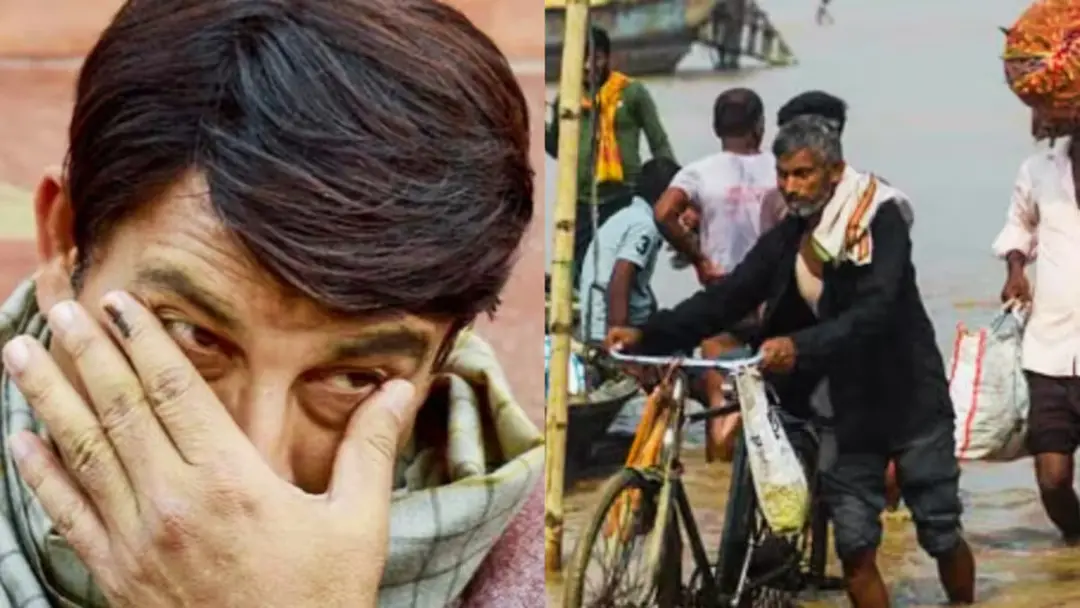
Bihar floods affect 49 lakh people across 15 districts
The Disaster Management Department said 49.36 lakh people across 15 Bihar districts were affected by floods as of September 14, with the Ganga, Kosi and other rivers above danger marks. Officials reported 1,260 community kitchens and 13 relief camps operating. On September 15, Chief Minister Samrat Choudhary transferred Rs 579.23 crore to 8.27 lakh families at Rs 7,000 each. Tejashwi Yadav sought national-disaster status and Rs 5,000 crore, criticising the Centre. BJP MP Manoj Tiwari faces social media criticism.
Source
News18 — India · read the original report ↗
Desk check · some claims need care
What the desk checked (5)
- 49.36 lakh people affected across 15 Bihar districts as of September 14 — Attributed in source to the Disaster Management Department; figure appears consistently in the text.
- Bihar received 111.7 mm rainfall in September up to September 14, about 13% above normal — Attributed to the local weather office in the source.
- CM Samrat Choudhary transferred Rs 579.23 crore to 8.27 lakh families at Rs 7,000 each on September 15 — Stated in source as a government action; no document cited, but figures are internally consistent.
- Tejashwi Yadav sought national-disaster status and Rs 5,000 crore central aid — Sourced to a Daily Pioneer report; source explicitly notes these are allegations, not established findings.
- Manoj Tiwari is facing social media criticism over absence during floods — Based on circulating videos and posts described in the source; no named source or verification of the posts.
Analysts’ view opinion
Bihar's floods are now as much a political test as a humanitarian emergency. By transferring Rs 7,000 each to 8.27 lakh families, the state government is building a "we moved fast" narrative; by demanding national disaster status and Rs 5,000 crore, Tejashwi Yadav is pushing a "Bihar is being short-changed" narrative. The Centre's decision to send an assessment team is also an attempt to blunt that charge politically — which story sticks will depend on how quickly relief actually reaches the ground.
- Direct cash transfer is a classic political instrument: visible, countable and delivered straight to the beneficiary, though the opposition can contrast 8.27 lakh families and just 13 relief camps against nearly 49.36 lakh people affected.
- The national-disaster-status demand works for Tejashwi even if it is not granted, since a refusal can be framed as neglect — but these remain his allegations, not independently established findings.
- The social media criticism of Manoj Tiwari signals a newer dynamic: online "presence politics", where voters contrast a leader's election-time visibility with their perceived absence during a disaster.
- Pappu Yadav attacking the opposition rather than only the government creates a three-cornered contest, diluting pressure on the ruling side while raising the risk of a split anti-NDA vote.
- Lalu Prasad's push on Farakka and a permanent solution for Nepal-origin rivers, met by the Deputy CM's reminder of the 1996 agreement, shifts the debate from today's relief to a longer blame contest over who neglected Bihar.
What to watch — Watch the size of any package announced after the central team's September 16 visit and the district magistrates' damage reports — these will decide which side's narrative gains strength.
Beyond the relief figures cited, the story does not independently establish the quality or speed of relief delivery, nor whether administrative failure contributed to the flooding, and it offers no evidence of electoral impact.
Deep dive
Research brief · 8 facts · 6 dates · exam-readyThe brief
Context
Heavy September rainfall in Bihar and in the Nepal catchments of its rivers has pushed the Ganga, Kosi, Budhi Gandak, Punpun, Bagmati and Ghaghara above danger marks at several points, flooding 15 districts. The state's Disaster Management Department put the affected population at about 49.36 lakh as of September 14, with community kitchens, relief camps and SDRF/NDRF teams deployed. The state government has begun cash transfers to affected families, while the Centre has sent an assessment team led by the Union Agriculture Minister. The crisis has simultaneously triggered a political blame game involving Tejashwi Yadav, CM Samrat Choudhary, Lalu Prasad Yadav, Pappu Yadav and BJP MP Manoj Tiwari.
Key facts
- Around 49.36 lakh people across 15 Bihar districts were reported affected by floods as of September 14, per the Disaster Management Department.
- Affected districts: Patna, Bhojpur, Saran, Vaishali, Bhagalpur, Begusarai, Buxar, Samastipur, Munger, Katihar, Lakhisarai, Khagaria, Purnea, Madhepura and Araria.
- Bihar recorded 111.7 mm rainfall in September up to September 14, about 13% above normal, per the local weather office.
- At Sultanganj (Bhagalpur), the Ganga flowed at 36.21 metres at 6 am on September 14 — 1.71 metres above the danger level.
- 1,260 community kitchens and 13 relief camps were operating, with about 11,060 people given shelter, food and medical care.
- 27 State Disaster Response Force teams and 10 National Disaster Response Force teams were deployed for relief and rescue.
- Gandak barrage at Valmiki Nagar discharged 90,600 cusecs at 10 am on September 14; Kosi Barrage at Birpur 1,51,015 cusecs against this year's peak of 2,55,425 cusecs on July 20.
- On September 15, CM Samrat Choudhary transferred Rs 579.23 crore to 8.27 lakh flood-affected families at Rs 7,000 per eligible family.
Timeline
- July 20Kosi Barrage at Birpur records this year's peak discharge of 2,55,425 cusecs.
- September 7Tejashwi Yadav writes to PM Narendra Modi seeking national-disaster status and Rs 5,000 crore in immediate assistance.
- September 13Tejashwi Yadav alleges Bihar is getting "stepmotherly" treatment in flood relief.
- September 14Disaster Management Department reports 49.36 lakh people affected across 15 districts; several rivers above danger marks.
- September 15CM Samrat Choudhary transfers Rs 579.23 crore to 8.27 lakh families and directs DMs to prepare damage reports.
- September 16Central team led by Union Agriculture Minister Shivraj Singh Chouhan scheduled to visit Bihar to assess flood damage.
Who has a stake
- Around 49.36 lakh affected residents of 15 districts — Immediate need for rescue, food, shelter, medical aid and compensation; about 11,060 are in relief camps.
- Bihar Disaster Management Department and district magistrates — Running 1,260 community kitchens and 13 relief camps; DMs asked to prepare detailed damage reports.
- Chief Minister Samrat Choudhary — Faces opposition criticism over relief adequacy; announced Rs 579.23 crore transfer and cited rainfall in Nepal and neighbouring states.
- Tejashwi Yadav, Leader of Opposition — Demands national-disaster status and Rs 5,000 crore central aid; accuses Centre and state of inadequate response.
- Union government (PM Modi, Amit Shah, Shivraj Singh Chouhan) — Directed formation of a central assessment team; its aid decisions are the core of the political dispute.
- SDRF and NDRF personnel — 27 SDRF and 10 NDRF teams carrying out rescue and relief on the ground.
- BJP MP Manoj Tiwari — Facing social media criticism over the visibility of political leaders during the disaster.
Why it matters
A flood affecting nearly 50 lakh people in a single state tests the entire disaster-response chain, from barrage discharge management and Nepal-linked upstream rainfall to community kitchens, cash transfers and central damage assessment. The dispute over "national disaster" status and the size of central assistance shows how Centre-state fiscal relations shape relief outcomes. It also revives long-standing questions about permanent flood management for rivers flowing in from Nepal and Bihar's interests in Ganga water-sharing arrangements.
UPSC angle
Prelims pointers
- Rivers above danger marks in the September 2025 Bihar floods: Ganga, Kosi, Budhi Gandak, Punpun, Bagmati, Ghaghara.
- Kosi Barrage is at Birpur; Gandak barrage is at Valmiki Nagar — both in Bihar, fed by Nepal catchments.
- NDRF (national) and SDRF (state) response forces were deployed — 10 and 27 teams respectively.
- Tejashwi Yadav's demand: declare the floods a national disaster and give Rs 5,000 crore in central assistance.
- Relief transfer: Rs 7,000 per eligible family; Rs 579.23 crore to 8.27 lakh families on September 15.
- The 1996 India-Bangladesh Ganga water-sharing agreement (Farakka) is at the centre of a Bihar political dispute.
Mains framing
Bihar's September floods, affecting about 49.36 lakh people in 15 districts, illustrate that the state's flood vulnerability is structural rather than merely meteorological: rainfall was only around 13% above normal and, by the Chief Minister's own account, Bihar had received less than 30% of its annual rainfall, yet continuous rain in Nepal's catchments and neighbouring states pushed the Ganga, Kosi, Bagmati, Budhi Gandak, Punpun and Ghaghara above danger levels, with barrage discharges at Valmiki Nagar and Birpur rising. The immediate response combined relief infrastructure — 1,260 community kitchens, 13 relief camps sheltering about 11,060 people, 27 SDRF and 10 NDRF teams — with direct benefit transfers of Rs 7,000 per family totalling Rs 579.23 crore. Simultaneously, the crisis has become a contest over responsibility and resources: the Leader of Opposition demands national-disaster status and Rs 5,000 crore, alleging "stepmotherly" treatment; an independent MP calls the disaster "man-made"; and the RJD chief seeks a permanent solution and funds for river maintenance while reopening the Farakka/1996 Ganga water-sharing question, which the Deputy Chief Minister turns back on the earlier RJD and United Front governments. The way forward suggested by the story's own facts lies in objective damage assessment (district-wise reports and the central team led by the Union Agriculture Minister), transparent criteria for central assistance, and sustained investment in transboundary river data-sharing and river maintenance so that relief does not remain the only instrument of flood governance.
Key terms
- Danger mark
- The river water level beyond which flooding of surrounding areas is likely; the Ganga at Sultanganj was 1.71 m above it.
- Cusec
- Cubic foot per second, the unit used to measure river or barrage water discharge, as at Birpur and Valmiki Nagar.
- NDRF / SDRF
- National and State Disaster Response Forces — specialised teams deployed for rescue and relief during disasters.
- National disaster status
- A demand, made here by Tejashwi Yadav, for the Centre to treat the floods as a calamity warranting large-scale central assistance.
- Community kitchen
- Government-run kitchen providing cooked meals to displaced or marooned people; 1,260 were operating in Bihar.
- 1996 India-Bangladesh Ganga water-sharing agreement
- The Farakka-related treaty on sharing Ganga waters, invoked in the Bihar debate over the state's neglected interests.
Practice questions
- Bihar's recurring floods are as much a problem of transboundary river management as of rainfall. Discuss with reference to the September 2025 floods.
- Examine the institutional mechanisms for disaster relief in India, including the roles of NDRF, SDRF and central assessment teams, and the debate over declaring a flood a 'national disaster'.
- Direct cash transfers to flood-affected families are increasingly the default relief tool. Critically assess their adequacy compared with structural flood-mitigation investment.
Grounded only in the source report — figures and dates are the source's, not inferred.