
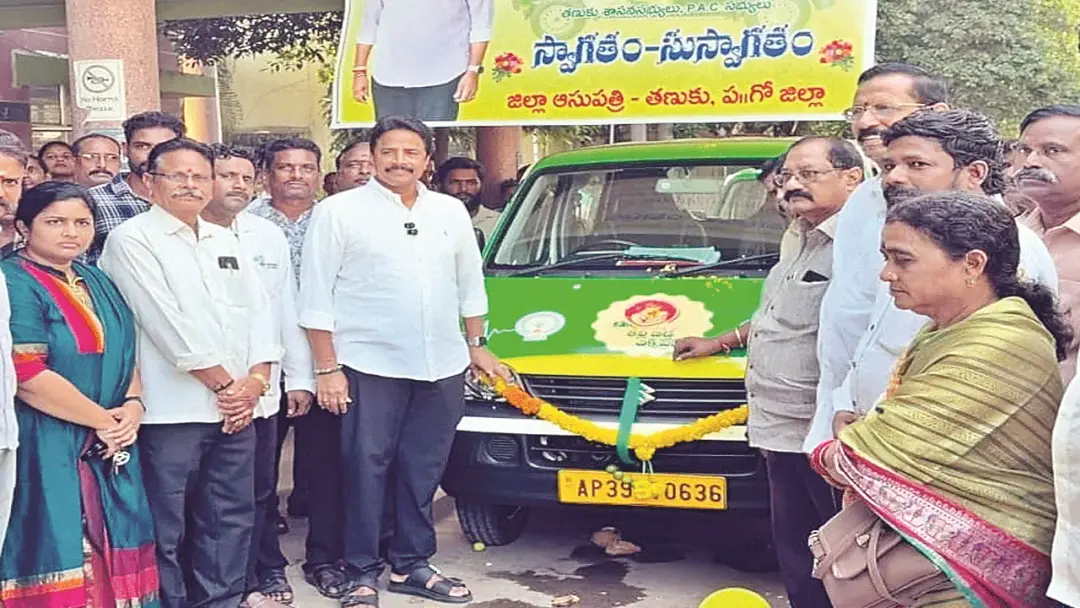
Ten Thalli Bidda Express vehicles reach West Godavari district
Thalli Bidda Express vehicles, meant to take mothers who deliver in government hospitals and their newborns home safely, have reached the district. The state medical and health minister flagged off 300 vehicles at Narasaraopet on Tuesday. Of the 14 allotted to the district, ten have arrived. They have six airbags, footrests, GPS tracking and an SOS button. The existing 14 vehicles are run by Aurobindo, while the new ones will be managed by Vidyaveda Foundation. MLA Arimilli Radhakrishna launched five vehicles at Tanuku.
Source
Tanuku — MLA & నియోజకవర్గం · read the original report ↗
Desk check · compared with the source
What the desk checked (5)
- State Health Minister flagged off 300 Thalli Bidda Express vehicles at Narasaraopet on Tuesday. — Figure and event appear in source; minister not named in the text.
- The district is to get 14 vehicles, of which 10 have arrived so far. — Both figures appear in the source; remainder said to arrive soon, no date given.
- Vehicles have six airbags, footrests, GPS tracking and an SOS button. — Specifications listed in source with no source attribution.
- Existing 14 vehicles were run by Aurobindo; new vehicles will be run by Vidyaveda Foundation. — Stated in source without attribution to an official.
- MLA Arimilli Radhakrishna launched five vehicles at Tanuku and said the YSRCP government weakened the scheme started by Chandrababu in 2014. — Attributed directly to the MLA; political claim, opinion of the speaker.
Analysts’ view opinion
Thalli Bidda Express is not a new idea but the revival and upgrading of a design that dates to 2014. Its policy logic is sound: closing the postnatal "last mile" transport gap makes institutional delivery in government hospitals more attractive, and airbags, GPS tracking and an SOS button push the scheme toward safety and monitorability. But only ten of the district's allotted 14 vehicles have arrived and operations are shifting from Aurobindo to the Vidyaveda Foundation — so the test lies in daily running, not the flag-off.
- The main beneficiaries are rural and lower-income mothers who use government hospitals and for whom private transport home is a real cost burden.
- GPS tracking and an SOS button are useful accountability tools, but the story does not say who monitors that data or how complaints are acted on.
- The outsourced operating model can reduce direct state expenditure, yet handovers between operators raise familiar questions about service continuity, staffing and fuel or running costs.
- Arriving with ten of 14 vehicles means partial coverage from day one; equity will depend on how units are distributed across mandals rather than clustered near larger hospitals.
- Because the scheme's history is politically contested — including an MLA's claim that the previous government let it lapse — performance is hard to judge without independent utilisation data.
What to watch — Watch when the remaining four vehicles arrive and whether monthly trip counts, response times and grievance redressal hold up under the new operator.
The story establishes allotment and launch only — it does not set out funding, the terms of the operating agreement, coverage targets or independent verification of claims about the earlier disruption of the service.
Deep dive
Research brief · 8 facts · 4 dates · exam-readyThe brief
Context
Thalli Bidda Express is an Andhra Pradesh government vehicle service that drops mothers who deliver in government hospitals, along with their newborns, safely home, and also ferries anaemic or vitamin-deficient pregnant women to nearby PHCs and back. The scheme was introduced in 2014 by the then Telugu Desam Party government. A fresh fleet of 300 vehicles was flagged off by the state medical and health minister at Narasaraopet, of which West Godavari district was allotted 14 and has received ten so far. MLA Arimilli Radhakrishna launched five of the vehicles at the Tanuku district central hospital.
Key facts
- The state medical and health minister flagged off 300 Thalli Bidda Express vehicles at Narasaraopet on Tuesday, August 11, 2026.
- West Godavari district was allotted 14 vehicles; ten have already arrived and the rest are expected soon.
- Each new vehicle has six airbags, footrests, GPS tracking and an SOS button system.
- The district's existing 14 vehicles are managed by Aurobindo; the newly arrived vehicles will be run under the Vidyaveda Foundation.
- The Thalli Bidda vehicle service was introduced in 2014 by the then Telugu Desam Party government.
- MLA Arimilli Radhakrishna launched five Thalli Bidda Express vehicles at the Tanuku district central hospital on Tuesday.
- The service also takes pregnant women suffering from iron and vitamin deficiency to nearby PHCs and drops them back home after treatment.
- Tanuku MLA said Chandrababu started the scheme under the earlier TDP government and the subsequent YSRCP government weakened it completely.
Timeline
- 2014The then Telugu Desam Party government introduced the Thalli Bidda vehicle service, which drew a good response.
- Subsequent YSRCP government periodAccording to the Tanuku MLA, the service was completely weakened.
- Tuesday, August 11, 2026State medical and health minister flags off 300 Thalli Bidda Express vehicles at Narasaraopet.
- Tuesday, August 11, 2026MLA Arimilli Radhakrishna launches five vehicles at Tanuku district central hospital; ten of the district's 14 vehicles have reached.
Who has a stake
- Mothers who deliver in government hospitals and newborns — Safe, free transport home from hospital in vehicles fitted with airbags, footrests, GPS and an SOS button.
- Pregnant women with iron and vitamin deficiency — Transport to the nearest PHC for treatment and a ride back home.
- Andhra Pradesh medical and health department — Rolling out and monitoring the 300-vehicle fleet across districts; delivery of maternal and newborn transport services.
- West Godavari district administration — Deployment of 14 allotted vehicles, of which ten have arrived, across hospitals including Tanuku.
- Aurobindo and Vidyaveda Foundation — Operating agencies: Aurobindo runs the existing 14 vehicles, Vidyaveda Foundation will manage the new ones.
- MLA Arimilli Radhakrishna (Tanuku) — Launched five vehicles locally and framed the revival as a correction of the previous government's neglect.
Why it matters
Safe transport home after institutional delivery is a practical link in the chain that keeps mothers and newborns alive in the first hours and days after birth, especially for poor rural families. The relaunch with safety features such as six airbags, GPS tracking and an SOS button signals an attempt to make maternal transport both safer and monitorable, while the shift of management to a new agency raises questions of service continuity and accountability.
UPSC angle
Prelims pointers
- Thalli Bidda Express: Andhra Pradesh scheme to drop mothers who deliver in government hospitals and their newborns home; introduced in 2014.
- 300 vehicles flagged off at Narasaraopet by the state medical and health minister on August 11, 2026.
- West Godavari allotted 14 vehicles; ten received; five launched at Tanuku district central hospital.
- New vehicle features: six airbags, footrests, GPS tracking, SOS button.
- Operators: Aurobindo (existing 14 vehicles) and Vidyaveda Foundation (new vehicles).
- Service also transports iron- and vitamin-deficient pregnant women to nearby PHCs and back.
Mains framing
Maternal and newborn health outcomes depend not only on institutional delivery but on the whole continuum of care, including safe transport between home and facility; the Thalli Bidda Express, launched in Andhra Pradesh in 2014, addresses precisely this last-mile gap by carrying post-delivery mothers and newborns home and by ferrying anaemic and vitamin-deficient pregnant women to nearby primary health centres. The current relaunch of 300 vehicles, with six airbags, footrests, GPS tracking and SOS buttons, shows an evolution from mere transport provision to safety engineering and real-time monitoring, which can also help fix accountability when services fail. The story, however, also illustrates two structural risks: political discontinuity, with the Tanuku MLA alleging that the earlier scheme was weakened under the previous government, and operational fragmentation, as older vehicles are run by Aurobindo while the new ones move to the Vidyaveda Foundation. The way forward suggested by the facts is phased completion of allotments (ten of 14 vehicles have reached West Godavari), uniform service standards across operating agencies, use of GPS and SOS data for performance audit, and insulation of such last-mile health logistics from changes in government.
Key terms
- Thalli Bidda Express
- Andhra Pradesh vehicle service that takes mothers delivering in government hospitals and their newborns safely home; started in 2014.
- PHC (Primary Health Centre)
- First-level government health facility to which the service takes iron- and vitamin-deficient pregnant women for treatment.
- SOS button
- In-vehicle emergency alert system fitted in the new Thalli Bidda Express vehicles.
- GPS tracking
- Satellite-based location monitoring installed in the new vehicles to track their movement.
- Vidyaveda Foundation
- Agency that will manage the newly arrived Thalli Bidda Express vehicles in the district.
- Aurobindo
- Organisation that has been managing the district's existing 14 Thalli Bidda vehicles.
Practice questions
- Last-mile transport is often the weakest link in maternal health services. Examine this with reference to Andhra Pradesh's Thalli Bidda Express scheme.
- Discuss the advantages and risks of running government health transport services through outside agencies and foundations.
- How can technology such as GPS tracking and SOS alerts strengthen accountability in public health delivery? Illustrate with examples.
Grounded only in the source report — figures and dates are the source's, not inferred.