
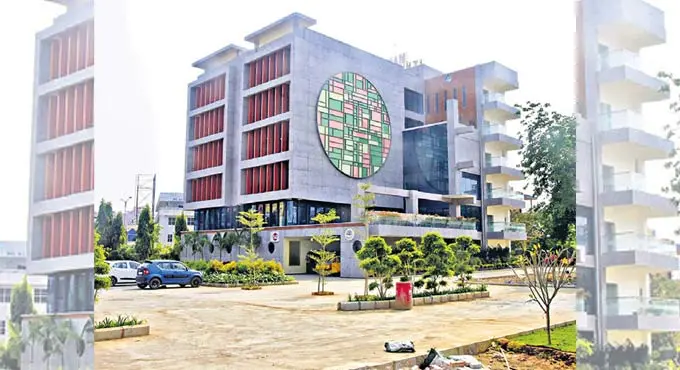
Telangana plans IT hubs in tier II, III towns
The Telangana government has decided to expand IT hubs to tier II and tier III towns, including Ramagundam and Wanaparthy. IT Hubs CEO Vijay Rangineni said the aim is employment for 25,000 IT professionals in existing and upcoming hubs over the next two years. IT towers already operate in Warangal, Khammam and Karimnagar. Minister K T Rama Rao laid the foundation stone for Khammam's phase II tower, with 55,000 sq ft space and 570 seats.
Source
Wanaparthy — jobs · read the original report ↗
Desk check · compared with the source
What the desk checked (5)
- Telangana government aims to provide employment to 25,000 IT professionals in existing and upcoming hubs within two years. — Attributed to Vijay Rangineni, CEO IT Hubs, speaking to Telangana Today.
- Khammam Phase II tower will have 55,000 sq ft built-up space and 570 seats; Phase I at Yellandu circle has 430 seats. — Figures appear in the source; foundation stone attributed to Minister K T Rama Rao.
- About 3,000 professionals currently work in the Warangal, Karimnagar and Khammam Phase I hubs. — Figure appears in source; no supporting data or agency cited.
- Talks are on with 31 companies for Khammam Phase II, and companies have shown interest in 1,350 of 1,500 seats in the planned Nalgonda hub. — Attributed to Vijay Rangineni; company names not disclosed.
- Cyient, Tech Mahindra and other IT/ITES firms already operate units in tier II and III towns. — Stated in source without direct attribution or detail on locations.
Analysts’ view opinion
Pushing IT work beyond Hyderabad is economically sensible: the capital's rising rents, wages and congestion costs make cheaper seats in smaller towns attractive to employers. But the numbers in the story show this is still an early-stage shift — about 3,000 professionals currently work in the Warangal, Karimnagar and Khammam hubs, so a 25,000-job target in two years implies several-fold growth. The state is spending on buildings and plug-and-play infrastructure; the return on that outlay depends on actual occupancy and on local skill supply.
- The cost logic is clear — lower real estate, wage and living costs in Tier II and Tier III towns reduce operating expenses for companies.
- Jobs closer to home can slow out-migration, and that local income tends to multiply through rentals, transport, retail and food services.
- The upfront cost sits with the public purse — towers, land and infrastructure — while the early gains accrue to firms getting ready-to-use space cheaply.
- Demand signals are encouraging but not yet committed: the story reports talks with 31 companies for Khammam Phase II and interest in about 1,350 of 1,500 seats in Nalgonda.
- The real test is skills and connectivity — without locally trained talent, reliable power and broadband, the towers risk under-occupancy, which is a cost to the state.
What to watch — Watch whether the interested companies in Khammam Phase II and Nalgonda convert into signed tenants filling seats, and how quickly the current 3,000-strong headcount actually scales.
The story sets out government plans and targets only — it does not establish the capital outlay, the incentives offered, the quality or pay levels of the jobs, or whether earlier announced targets were met.
Deep dive
Research brief · 8 facts · 5 dates · exam-readyThe brief
Context
Telangana's IT industry has historically been concentrated in Hyderabad. To spread IT jobs and investment beyond the capital, the State government has been building government-supported IT towers in smaller district towns, offering "plug and play" office space to companies. As per this April 2021 report, the government is now extending that push from tier II cities such as Warangal, Khammam and Karimnagar to tier III towns like Ramagundam and Wanaparthy, with a target of 25,000 IT jobs in two years.
Key facts
- IT Hubs CEO Vijay Rangineni said the aim is employment for 25,000 IT professionals in existing and upcoming IT hubs in the next two years.
- IT Towers have already come up in Warangal, Khammam and Karimnagar; about 3,000 professionals currently work in Warangal, Karimnagar and Khammam Phase I hubs.
- IT and Industries Minister K T Rama Rao recently laid the foundation stone for the phase II Tower in Khammam.
- Khammam Phase II tower will have 55,000 sq ft of built-up space and a 570-seat capacity.
- Khammam's existing Phase I hub at Yellandu circle has a seating capacity of 430 seats.
- Discussions were on with 31 companies for commencing operations in Khammam Phase II.
- A new hub is coming up in Nalgonda district, where companies have shown interest in occupying about 1,350 of the total 1,500 seats.
- More IT towers are planned in Nizamabad, Nalgonda, Mahabubnagar and Siddipet districts, plus tier III towns Ramagundam and Wanaparthy.
Timeline
- Recent years (as of the report)IT Towers come up in Warangal, Khammam and Karimnagar; Cyient, Tech Mahindra and other IT/ITES firms set up units in tier II/III towns.
- Recently before 30 April 2021Minister K T Rama Rao lays the foundation stone for Khammam Phase II IT Tower (55,000 sq ft, 570 seats).
- 30 April 2021 (report date)Government announces focus on IT hubs in tier III towns such as Ramagundam and Wanaparthy; talks on with 31 companies for Khammam Phase II.
- Next couple of months (from report)A leading IT player likely to announce launch of operations in Warangal, per Vijay Rangineni.
- Next two yearsTarget of 25,000 IT professionals employed across existing and upcoming hubs.
Who has a stake
- Telangana government / IT Department — Driving IT expansion beyond Hyderabad, setting up hubs and facilitating plug-and-play operations without logistics hurdles.
- K T Rama Rao, IT and Industries Minister — Politically championing the tier II/III IT push and promising State help to companies setting up new units.
- Vijay Rangineni, CEO, IT Hubs — Executing the hub programme, negotiating with companies and delivering the 25,000-job target.
- IT/ITES companies such as Cyient and Tech Mahindra — Access to lower-cost office space and local talent in smaller towns; 31 firms in talks for Khammam Phase II.
- Youth in tier II and tier III towns — Local employment opportunities without migrating to Hyderabad.
- District towns (Warangal, Khammam, Karimnagar, Nizamabad, Nalgonda, Mahabubnagar, Siddipet, Ramagundam, Wanaparthy) — Prospect of IT-led economic transformation and real estate/services growth.
Why it matters
India's IT employment has clustered in a few metros, and Hyderabad dominates Telangana's tech economy; spreading hubs to district towns is an attempt at more balanced regional growth. If the 25,000-job target and the plug-and-play model work, small-town graduates could find IT work locally instead of migrating. It also offers companies a lower-cost, decentralised delivery base.
UPSC angle
Prelims pointers
- Telangana IT hub target: employment for 25,000 IT professionals in existing and upcoming hubs within two years.
- Existing Telangana IT Towers: Warangal, Khammam and Karimnagar; about 3,000 professionals working in them.
- Khammam IT Tower Phase II: 55,000 sq ft, 570 seats; Phase I at Yellandu circle has 430 seats.
- Tier III towns identified for IT towers: Ramagundam and Wanaparthy.
- Upcoming hub districts named: Nizamabad, Nalgonda, Mahabubnagar and Siddipet; Nalgonda hub total capacity 1,500 seats.
- K T Rama Rao is Telangana's IT and Industries Minister; Vijay Rangineni is CEO, IT Hubs.
Mains framing
Telangana's decision to seed IT towers in tier II and tier III towns such as Ramagundam and Wanaparthy reflects an attempt to correct the spatial concentration of India's IT economy, which in the State has overwhelmingly favoured Hyderabad. The chosen instrument is state-built, plug-and-play office infrastructure — Khammam's Phase I (430 seats) and Phase II (55,000 sq ft, 570 seats), Warangal and Karimnagar hubs hosting about 3,000 professionals, and a 1,500-seat hub in Nalgonda where 1,350 seats have already drawn interest — paired with ministerial assurance of State support so firms face no logistics hurdles. The stated pay-off is employment for 25,000 IT professionals in two years, retaining local youth and reducing migration pressure on the capital. Implications include wider demand for skilling, connectivity and urban services in district towns, and a delivery-cost advantage for firms like Cyient and Tech Mahindra. The way forward, on the evidence in the source, lies in converting expressions of interest (31 companies for Khammam Phase II, an expected announcement for Warangal) into actual occupancy and jobs, since the model's success depends on sustained corporate commitment rather than built space alone.
Key terms
- Tier II / Tier III towns
- Smaller, non-metro urban centres; here Warangal, Khammam, Karimnagar (tier II) and Ramagundam, Wanaparthy (tier III).
- ITES
- IT enabled services — business services delivered using IT, such as BPO and support operations.
- IT Tower / IT Hub
- Government-developed office building offering ready seating capacity for IT and ITES companies in district towns.
- Plug and play mode
- Ready-to-use office space with infrastructure in place so a company can start operations immediately.
- Seat capacity
- Number of employee workstations a hub can accommodate, used as the measure of an IT tower's size.
Practice questions
- Examine how state-led 'plug and play' IT infrastructure in tier II and tier III towns can help decentralise India's IT sector. Use Telangana's IT hub programme as an illustration.
- Telangana aims to employ 25,000 IT professionals in its district IT hubs within two years. What conditions must be met for such targets to translate into durable local employment?
- Discuss the regional development implications of concentrating IT growth in a single metropolitan centre, and evaluate measures to spread technology jobs to smaller towns.
Grounded only in the source report — figures and dates are the source's, not inferred.