
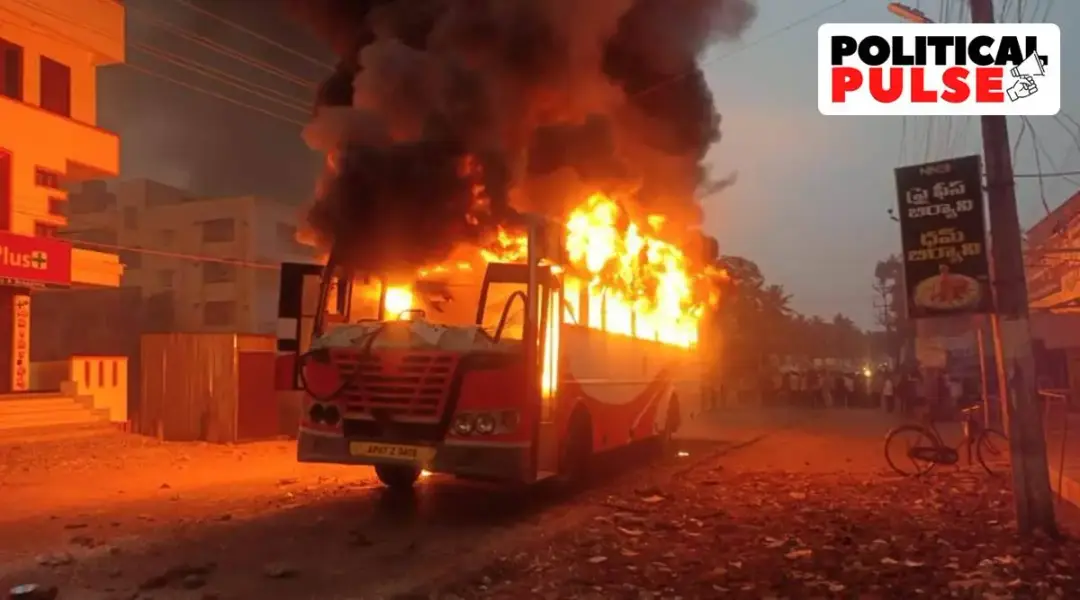
Curfew in Amalapuram after Konaseema renaming violence; over 200 detained
An uneasy calm prevailed under curfew in Amalapuram after Tuesday's violence and arson over the proposal to rename the new Konaseema district after Dr B R Ambedkar. SP K Subba Reddy said over 200 people were detained or arrested. DGP K V Rajendranath Reddy said 10 IPS officers, including an IG, and several police companies were deployed, and seven FIRs registered. The YSRCP government said it will not roll back the proposal.
Source
Konaseema — politics · read the original report ↗
Desk check · compared with the source
What the desk checked (5)
- Over 200 persons have been detained or arrested for Tuesday's violence in Amalapuram. — Attributed in source to Konaseema SP K Subba Reddy.
- 10 IPS officers, including an IG and SPs from neighbouring regions, plus several police companies moved to the district; 7 FIRs registered. — Attributed to AP DGP K V Rajendranath Reddy.
- Protesters torched police vehicles, buses and the houses of transport minister P Viswarup and YSRCP MLA P Satish. — Stated as reported fact in source; no separate attribution given.
- Konaseema is among 13 new districts announced early last month; notification issued on May 18. — Dates and figure appear in source; year not specified.
- SCs and STs form nearly 19% and 5% of the district population respectively. — Figures appear in source without a named data source.
Analysts’ view opinion
The Konaseema renaming row places the Jagan Mohan Reddy government in a genuinely awkward caste arithmetic. Rolling back the Ambedkar proposal would cost it credibility with Dalit voters; pushing ahead risks deepening resentment among the Kapu and BC groups who form the bulk of the district's population. Hence the twin-track approach visible in the story: no retreat on the proposal, but a heavy law-and-order response — effectively converting a political cost into a policing question.
- By ruling out a rollback, the YSRCP is protecting its standing with SC and ST voters, who the story puts at roughly 19% and 5% of the district's population.
- The story says the homes of transport minister P Viswarup and YSRCP MLA P Satish were torched — anger turning on the ruling party's own local representatives is a ground-level warning sign.
- Deploying 10 IPS officers including an IG, detaining or arresting over 200 people and registering seven FIRs signals a government choosing administrative firmness over visible negotiation.
- The DGP's account of dissuading Dalit groups from protesting suggests the state recognises the danger of counter-mobilisation turning the dispute into an open caste confrontation.
- Because local voices insist the objection is to losing regional identity rather than to Ambedkar himself, a compromise formula accommodating both sentiments remains a politically available exit.
What to watch — Watch how strongly Kapu and BC organisations mobilise once the curfew lifts, how far opposition parties press the issue, and whether the government keeps the May 18 notification process untouched or quietly looks for a middle path.
The story does not establish who instigated the violence, whether any political actors were involved, or the profile of those detained — and it offers no evidence of electoral impact either way.
Deep dive
Research brief · 8 facts · 5 dates · exam-readyThe brief
Context
Andhra Pradesh's YSRCP government carved 13 new districts out of existing ones early last month, among them Konaseema, formed out of East Godavari district with Amalapuram as its headquarters. A government proposal to rename Konaseema district after Dr B R Ambedkar, notified on May 18, triggered protests by sections of Kapus and Backward Classes groups who want the traditional regional name retained. On Tuesday the protests turned violent in Amalapuram, with police vehicles and buses torched and the homes of two ruling-party politicians attacked, leading to curfew and mass detentions.
Key facts
- Konaseema SP K Subba Reddy said over 200 persons were detained or arrested for the Tuesday violence in the district headquarters, Amalapuram.
- DGP K V Rajendranath Reddy said 10 IPS officers, including an IG, plus SPs from neighbouring regions and several companies of police personnel were moved to Amalapuram and other parts of the district.
- Seven FIRs had been registered so far, according to the DGP.
- Protesters clashed with police and torched police vehicles, buses and the houses of transport minister P Viswarup and YSRCP MLA from Mummidivaram, P Satish.
- Konaseema is among 13 new districts announced by the YSRCP government early last month, carved out of East Godavari district.
- The state government issued the notification on the renaming proposal on May 18.
- SCs and STs make up nearly 19% and 5% of the district's population respectively; the rest is mainly Kapus and BCs.
- The Y S Jagan Mohan Reddy-led government asserted it will not roll back the proposal to rename Konaseema district after Ambedkar.
Timeline
- Early last monthYSRCP government announces 13 new districts, including Konaseema carved out of East Godavari district.
- Several days before the violenceBC- and Kapu-dominated bodies such as Konaseema Parirakshana Samithi, Konaseema Sadhana Samiti and Konaseema Udyama Samiti hold protests against the renaming.
- May 18State government issues notification regarding the proposal to rename Konaseema district after Dr B R Ambedkar.
- TuesdayViolent clashes and arson in Amalapuram: police vehicles and buses torched, houses of minister P Viswarup and MLA P Satish attacked.
- A day after the violenceUneasy calm under curfew in Amalapuram; over 200 detained or arrested; 7 FIRs registered; Dalit groups dissuaded from holding a counter-protest.
Who has a stake
- YSRCP government led by Y S Jagan Mohan Reddy — Caught in a difficult situation; has asserted it will not roll back the renaming proposal despite the violence.
- Andhra Pradesh police (DGP K V Rajendranath Reddy, Konaseema SP K Subba Reddy) — Maintaining law and order under curfew, identifying participants in the violence, registering cases.
- Kapu and BC organisations (Konaseema Parirakshana Samithi, Sadhana Samiti, Udyama Samiti) — Demand retention of the traditional name Konaseema; have been protesting for several days.
- Dalit groups — Sought permission to protest against Tuesday's violence; police convinced them not to hold protests.
- Transport minister P Viswarup and Mummidivaram MLA P Satish — Their houses were torched during the violence.
- Local residents of Konaseema — Fear renaming would take away the traditional identity of the tourist region.
Why it matters
The episode shows how administrative decisions such as district creation and naming can become flashpoints for caste assertion and regional identity politics. With SCs at nearly 19% of the district's population and Kapus and BCs forming the rest, the renaming has become a contest over symbolic recognition, while arson targeting ministers' homes and a curfew underline the law-and-order costs of such disputes.
UPSC angle
Prelims pointers
- Konaseema district was carved out of East Godavari district; Amalapuram is its headquarters.
- Andhra Pradesh's YSRCP government announced 13 new districts; renaming notification issued on May 18.
- Andhra Pradesh DGP: K V Rajendranath Reddy; Konaseema SP: K Subba Reddy.
- SCs form nearly 19% and STs nearly 5% of Konaseema district's population; Kapus were the most dominant caste in erstwhile East Godavari.
- Groups opposing the renaming: Konaseema Parirakshana Samithi, Konaseema Sadhana Samiti, Konaseema Udyama Samiti.
- Houses of transport minister P Viswarup and Mummidivaram MLA P Satish were torched in the Tuesday violence.
Mains framing
The Konaseema agitation illustrates how reorganisation of administrative units intersects with identity politics in India. The immediate trigger was the Andhra Pradesh government's proposal, notified on May 18, to name one of 13 newly created districts after Dr B R Ambedkar; the opposition came from Kapu and BC-dominated outfits, with veteran CPI leader C K Narayana arguing the move had united BCs and Kapus because they do not want the district's name associated with the Dalit icon. A parallel strand of opposition, voiced by local residents and students, is non-caste: that a name change would erase the region's established geographical and tourist identity. The consequences were violent — clashes with police, torching of buses, police vehicles and the homes of a minister and an MLA, a curfew in Amalapuram, over 200 detentions and seven FIRs, and the deployment of 10 IPS officers including an IG. The way forward, on the source's evidence, lies in the state combining a firm law-and-order response with consultation, while Dalit groups' grievance over the violence is addressed through prompt registration of cases rather than counter-mobilisation, as the DGP indicated.
Key terms
- Konaseema district
- A new Andhra Pradesh district carved out of East Godavari, with Amalapuram as headquarters, among 13 districts created by the YSRCP government.
- YSRCP
- The ruling party in Andhra Pradesh, led by Chief Minister Y S Jagan Mohan Reddy.
- Konaseema Parirakshana Samithi / Sadhana Samiti / Udyama Samiti
- BC- and Kapu-dominated organisations that have been protesting for several days against the renaming of Konaseema district.
- FIR
- First Information Report; seven were registered in connection with the Amalapuram violence, as per the DGP.
- Kapus
- The most dominant caste in the erstwhile East Godavari district, a section of which opposes the renaming proposal.
Practice questions
- Why do decisions on naming and creating administrative districts often trigger identity-based mobilisation in India? Discuss with reference to the Konaseema case.
- Examine the challenges before state governments in balancing symbolic recognition of social justice icons with local demands for preserving regional identity.
- Evaluate the role of the police in managing caste-linked agitations, using the law-and-order response to the Amalapuram violence as an example.
Grounded only in the source report — figures and dates are the source's, not inferred.