
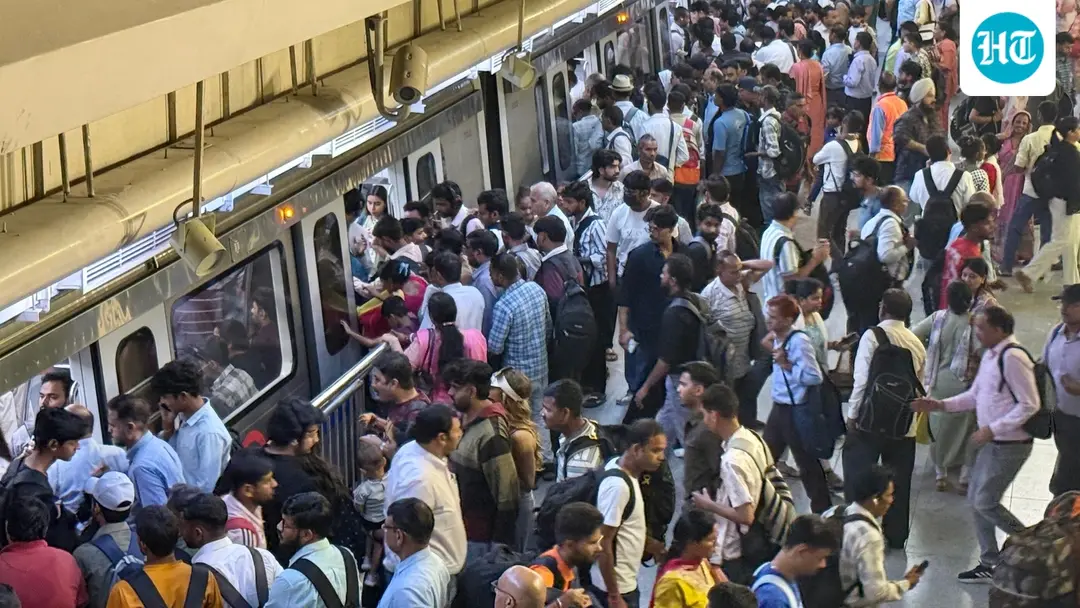
Delhi Metro logs record 82.4 lakh boardings amid DTC strike
The Delhi Metro Rail Corporation (DMRC) said on Friday that 82,44,903 passengers travelled on its network on September 17, its highest-ever single-day passenger boardings. The record came as private agency drivers employed with the Delhi Transport Corporation entered the fourth day of a strike over wage hikes and medical and social security benefits, keeping thousands of buses off the roads. DMRC had increased 20 train trips and deployed eight additional trains to manage the rush.
Source
Hindustan Times — India · read the original report ↗
Desk check · compared with the source
What the desk checked (5)
- 82,44,903 passengers travelled on the Delhi Metro network on September 17, the highest-ever single-day boardings. — Attributed to DMRC, including a quoted post on X; figure appears consistently twice in source.
- DTC private agency drivers are in the fourth day of a strike over wage hikes and medical and social security benefits. — Stated in source without named official attribution; depot names listed.
- DMRC increased 20 train trips and deployed eight additional trains on September 16, continuing on September 17 between 08:00 and 20:00 hrs. — Quoted directly from a DMRC statement on X.
- CISF DMRC unit DIG Santosh Chalke called the milestone a reflection of joint CISF-DMRC efforts. — Quote attributed to Chalke via an ANI report.
- DMRC, set up on May 3, 1995, operates about 416 km with 303 stations and manages Mumbai Metro Line 3, Chennai Metro Phase 2 and Patna Metro. — Background detail in source; no separate sourcing given.
Analysts’ view opinion
The Metro's record may read as an operational triumph, but politically it is a scoreboard of the bus system's breakdown. With the strike by private agency drivers employed with DTC in its fourth day and thousands of buses off the road, the outsourcing model itself becomes the question — awkward for the government, easy ground for the opposition. Because DMRC, a Union–Delhi joint venture, absorbed the load with extra trains, the narrative that "the Metro rescued the city while the bus system collapsed" could harden.
- The 82,44,903 boardings figure is a publicity win for DMRC, but it reflects strike-driven displacement rather than organic ridership growth.
- That the strikers are drivers hired through a private agency pushes outsourcing, wages and social security in public transport into the political debate.
- The spread of the protest across multiple depots — Rani Khera, Rajghat, Nehru Place, Burari, Wazirpur, Ghumanhera, Sarita Vihar — signals organised strength rather than an isolated flare-up.
- Bus-dependent lower-income commuters bear the heaviest cost, so the political price of a prolonged strike tends to fall on the incumbent.
- As DMRC is jointly owned by the Union and Delhi governments, both sides have room to claim credit for the Metro and shift blame for the buses.
What to watch — Watch how quickly the government moves to the negotiating table on wages, and whether any review of the outsourced-driver hiring model is announced if the strike drags on.
The story establishes nothing about the government's response, any talks under way, or how political parties have reacted — this is analysis built only on the reported details.
Deep dive
Research brief · 8 facts · 4 dates · exam-readyThe brief
Context
The Delhi Metro Rail Corporation (DMRC) reported its highest-ever single-day passenger boardings — 82,44,903 — on September 17, 2026. The surge coincided with a strike by private agency drivers employed with the Delhi Transport Corporation (DTC), who were in the fourth day of a protest over wage hikes and medical and social security benefits, keeping thousands of buses off the roads. DMRC responded by adding 20 train trips and deploying eight additional trains to handle peak-hour crowds. DMRC, set up on May 3, 1995, is a joint venture between the Union Government and the Government of the NCT of Delhi.
Key facts
- DMRC recorded 82,44,903 passenger boardings on 17 September 2026, its highest-ever single-day figure, announced via a post on X on Friday.
- The record coincided with the fourth day of a strike by private agency drivers employed with the DTC over wage hikes and medical and social security benefits.
- Thousands of DTC buses remained off the roads; drivers from depots including Rani Khera, Rajghat, Nehru Place, Burari, Wazirpur, Ghumanhera and Sarita Vihar joined the protest.
- On 16 September 2026, DMRC increased 20 train trips across its network and operated eight additional trains as per requirement.
- DMRC said eight extra trains would be inducted and operated between 08:00 hrs and 20:00 hrs on 17 September 2026 as per operational needs.
- DMRC's network spans about 416 km with 303 stations, including the Noida-Greater Noida corridor and Gurugram's Rapid Metro line.
- DMRC was established on 3 May 1995 as a joint venture between the Union Government and the Government of the NCT of Delhi.
- DMRC also manages operations and maintenance of Mumbai Metro Line 3, Chennai Metro Phase 2 and Patna Metro.
Timeline
- 3 May 1995Delhi Metro Rail Corporation established as a joint venture of the Union Government and the Government of NCT of Delhi.
- 16 September 2026DMRC announces extensive arrangements amid the DTC bus strike: 20 additional train trips and eight extra trains operated.
- 17 September 2026DMRC records highest-ever single-day passenger boardings of 82,44,903; eight extra trains run between 08:00 and 20:00 hrs.
- 18 September 2026 (Friday)DMRC announces the record on X; DTC private agency drivers' strike enters its fourth day, with heavy rush at Rajiv Chowk station.
Who has a stake
- Delhi Metro Rail Corporation (DMRC) — Had to absorb a record surge of 82,44,903 boardings, adding 20 trips and eight trains while maintaining reliable service.
- Private agency drivers employed with DTC — On strike for the fourth day demanding wage hikes and medical and social security benefits.
- Delhi Transport Corporation (DTC) — Thousands of its buses stayed off the roads across multiple depots, disrupting the city's bus network.
- Delhi-NCR commuters — Faced costlier and crowded commutes; outstation patients were reportedly left in the lurch as the strike continued.
- Central Industrial Security Force (CISF) unit at DMRC — Responsible for security and passenger facilitation during the record footfall; DIG Santosh Chalke called it a joint DMRC-CISF milestone.
Why it matters
The record shows how dependent Delhi-NCR is on a single mass transit backbone: when the bus system falters, the Metro absorbs the shock almost overnight. It also highlights the vulnerability of public transport that relies on contracted private agency drivers whose wage and social security grievances can paralyse thousands of buses. For commuters, especially low-income and outstation users who depend on buses, such disruptions translate directly into costlier and harder journeys.
UPSC angle
Prelims pointers
- DMRC established on 3 May 1995; joint venture between the Union Government and the Government of NCT of Delhi.
- Highest-ever single-day DMRC boardings: 82,44,903 on 17 September 2026.
- DMRC network: about 416 km and 303 stations, including Noida-Greater Noida corridor and Gurugram Rapid Metro.
- DMRC handles O&M for Mumbai Metro Line 3, Chennai Metro Phase 2 and Patna Metro.
- Security at Delhi Metro is provided by the Central Industrial Security Force (CISF).
- DMRC's surge measures during the DTC strike: 20 extra train trips and eight additional trains (08:00-20:00 hrs).
Mains framing
Delhi's record Metro footfall of 82,44,903 boardings on 17 September 2026 was less a celebration of capacity than a symptom of systemic fragility in urban transport: a four-day strike by private agency drivers engaged by the DTC over wage hikes and medical and social security benefits took thousands of buses off the roads, forcing modal shift onto the rail network. The episode raises three linked issues — the labour conditions of outsourced workers in public transport, the absence of redundancy when one mode fails, and the equity impact on bus-dependent users such as outstation patients and low-income commuters facing costlier journeys. DMRC's response, increasing 20 train trips and deploying eight additional trains between 08:00 and 20:00 hrs, shows operational elasticity but also the limits of surge management in one of the world's busiest transit systems, where security and crowd facilitation depend on coordination with the CISF. The way forward, on the evidence of the source, lies in institutionalised grievance-resolution mechanisms for contracted drivers, integrated multi-modal contingency planning across DTC and DMRC, and continued capacity augmentation on a network already spanning about 416 km and 303 stations. Beyond Delhi, DMRC's role in Mumbai Metro Line 3, Chennai Metro Phase 2 and Patna Metro suggests these lessons in resilience have national relevance.
Key terms
- DMRC
- Delhi Metro Rail Corporation, set up 3 May 1995, a Union Government-Delhi Government joint venture running rapid transit in Delhi-NCR.
- DTC
- Delhi Transport Corporation, the city's public bus operator, whose private agency drivers were on strike.
- Passenger boardings
- The count of passengers entering the network; DMRC logged 82,44,903 boardings on 17 September 2026.
- CISF
- Central Industrial Security Force, the central armed police force providing security at Delhi Metro stations.
- National Capital Region (NCR)
- The wider Delhi region served by DMRC, including Noida-Greater Noida and Gurugram corridors.
Practice questions
- Record Delhi Metro footfall during a bus strike reveals the fragility rather than the strength of urban transport planning. Critically examine.
- Discuss the challenges of employing contracted or private agency workers in public transport utilities, using the DTC drivers' strike as a case study.
- How can Indian cities build multi-modal redundancy and contingency planning into public transport systems? Illustrate with the Delhi Metro-DTC experience.
Grounded only in the source report — figures and dates are the source's, not inferred.