
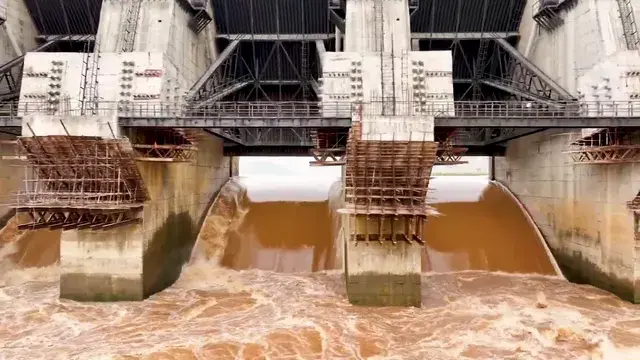
Godavari crosses 40 feet at Bhadrachalam as inflows rise
The Godavari water level at Bhadrachalam is rising steadily due to floodwaters coming from upstream. The flow, which stood at 17 feet two days earlier, crossed 40 feet by Sunday morning. Many steps at the bathing ghats have been submerged as a result. Officials are set to issue the first flood warning if the water level reaches 43 feet.
Source
Bhadrachalam — స్థానికం · read the original report ↗
Desk check · compared with the source
What the desk checked (5)
- Godavari water level at Bhadrachalam crossed 40 feet by Sunday morning. — Figure appears in source; no named official or agency attribution given.
- The level was 17 feet two days earlier. — Figure appears in source; unattributed but internally consistent with the reported rise.
- Many steps at the bathing ghats are submerged. — Stated in source as observation; no source named.
- Officials will issue the first flood warning if the level reaches 43 feet. — Attributed generically to 'officials'; no department or spokesperson named.
- The rise is due to inflows from upstream. — Stated in source without supporting data or attribution.
Analysts’ view opinion
The Godavari climbing from 17 feet to past 40 feet at Bhadrachalam in two days is primarily a weather event, but in Telangana river levels are always politically sensitive. With the first warning threshold of 43 feet close by, the speed and visibility of the administration's response will shape public judgement on governance capacity. If the warning stage is reached, the familiar cycle of ministerial visits and opposition criticism is likely to follow.
- Bhadrachalam is a chronically flood-prone town, so pre-emptive evacuation and relief arrangements land squarely on the ruling party's administrative ledger.
- The 43-feet first warning mark is a technical trigger, but whether it is issued early or late can quickly become a political argument.
- Submerged bathing ghat steps in a temple town produce highly shareable visuals that raise pressure on the government to be seen acting.
- Upstream inflows make the Godavari an inter-state matter, so escalation could bring coordination with neighbouring states and central assistance into the conversation.
- No leader's statement or political reaction is recorded in this story, so for now it is purely an administrative test.
What to watch — Watch whether the level crosses 43 feet and a formal warning is issued, and how quickly ministerial field visits and opposition questions on relief preparedness follow.
The story establishes only the rising level and the warning threshold; it says nothing about damage, evacuations, or any government or political response.
Deep dive
Research brief · 7 facts · 3 dates · exam-readyThe brief
Context
Bhadrachalam, a temple town in Telangana's Bhadradri Kothagudem district, sits on the banks of the Godavari and is the standard gauging point at which flood warnings for the river are announced. Water levels there are driven largely by inflows from upstream catchments. According to the source, floodwaters from upstream pushed the Godavari level at Bhadrachalam from 17 feet two days earlier to above 40 feet by Sunday morning, submerging many steps of the bathing ghats. Officials will issue the first flood warning if the level touches 43 feet.
Key facts
- Godavari level at Bhadrachalam crossed 40 feet by Sunday morning, as reported in the source dated Sep 27, 2026.
- The same flow stood at 17 feet two days earlier, a rise of over 23 feet in about two days.
- The rise is attributed to floodwater arriving from upstream of Bhadrachalam.
- Many steps at the bathing ghats (snana ghattalu) at Bhadrachalam have gone under water.
- Officials will issue the first flood warning (first danger warning) if the level reaches 43 feet.
- The report is filed from Telangana (TG) and carries the timestamp Sep 27, 2026, 05:09 IST.
- Number of people evacuated, damage or rainfall figures: not stated in the source.
Timeline
- Two days before Sunday (around Sep 25, 2026)Godavari flow at Bhadrachalam measured 17 feet.
- Sunday morning (Sep 27, 2026)Water level crossed 40 feet; many bathing ghat steps submerged.
- If level reaches 43 feetOfficials to issue the first flood warning.
Who has a stake
- Residents of Bhadrachalam town — Face possible flooding and disruption if the river keeps rising past warning levels.
- Pilgrims and devotees using the bathing ghats — Access to ghats restricted as many steps are already submerged.
- District officials / revenue and irrigation authorities — Responsible for monitoring the gauge and issuing the first flood warning at 43 feet.
- Upstream catchment areas of the Godavari — Rainfall and releases there determine the inflows reaching Bhadrachalam.
Why it matters
Bhadrachalam is the reference gauge for Godavari flood management in Telangana, so a jump from 17 feet to above 40 feet in two days signals a fast-developing flood situation for the low-lying town and nearby habitations. Because the first warning is triggered at 43 feet, the river is close to the threshold that sets evacuation and relief machinery in motion.
UPSC angle
Prelims pointers
- Bhadrachalam, on the Godavari in Telangana, is the key flood-gauging station for the river's lower reaches.
- First flood warning at Bhadrachalam is issued when the Godavari reaches 43 feet.
- Level rose from 17 feet to above 40 feet within about two days in late September 2026.
- Cause cited: floodwater inflows from upstream of Bhadrachalam.
- Visible impact reported: submergence of steps at the bathing ghats.
Mains framing
The Bhadrachalam episode illustrates how monsoon-end flooding on a large peninsular river is transmitted downstream: heavy inflows from upstream catchments raised the Godavari by more than 23 feet in roughly two days, submerging bathing ghats and bringing the river within three feet of the 43-foot mark at which the first official flood warning is declared. The case underlines the importance of graded warning thresholds at a single trusted gauging point, real-time monitoring of upstream inflows, and pre-positioned evacuation and relief arrangements for a town whose temple economy draws pilgrims to the riverfront. The way forward, on the evidence available here, lies in timely dissemination of warnings to ghat users and low-lying settlements, coordinated upstream-downstream communication on inflows, and restricting access to submerged ghats before levels cross danger marks. The source does not detail rainfall data, reservoir operations, evacuation numbers or damage, so any assessment of preparedness must remain limited to the warning mechanism itself.
Key terms
- Godavari
- Major peninsular river; its level at Bhadrachalam is the benchmark for flood alerts in the region.
- Bhadrachalam
- Telangana temple town on the Godavari where the river's flood gauge and bathing ghats are located.
- First flood warning
- Initial official danger alert, issued at Bhadrachalam when the Godavari touches 43 feet.
- Bathing ghats (snana ghattalu)
- Stepped riverfront used by pilgrims; many steps are now under water.
- Upstream inflows
- Floodwater flowing in from catchment areas above Bhadrachalam, driving the level rise.
Practice questions
- Explain how graded flood-warning thresholds at gauging stations such as Bhadrachalam help in disaster response on the Godavari.
- Discuss the factors that cause rapid rises in water level in peninsular rivers towards the end of the monsoon, with reference to the Godavari.
- What institutional arrangements are needed to protect riverfront pilgrim towns from sudden flooding? Illustrate with the Bhadrachalam case.
Grounded only in the source report — figures and dates are the source's, not inferred.