
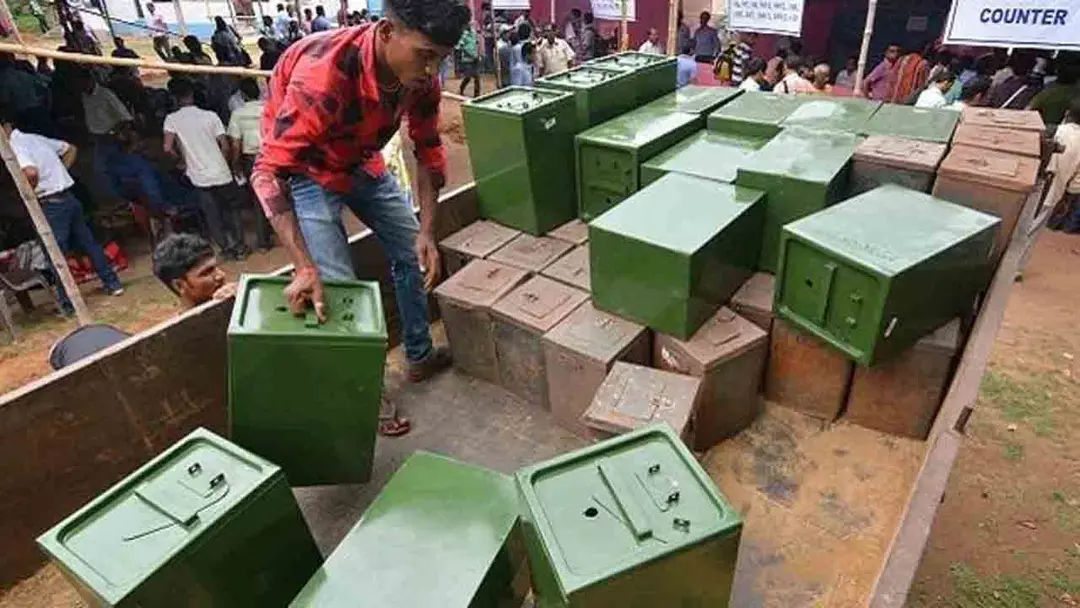
Narayanpet completes arrangements for third phase panchayat polls
Third-phase panchayat elections in Narayanpet district will be held in Narva, Maganur, Krishna, Makthal and Utkoor mandals of Makthal constituency. Of 110 gram panchayats, 10 sarpanch posts were filled unanimously, and 327 candidates are contesting the remaining 100. Of 994 wards, 229 were unanimous, while 1,992 candidates are contesting 775 ward seats. Officials said web cameras were installed at 55 sensitive centres, with 920 polling stations, 2,586 staff, 79 buses and micro observers at 183 stations.
Source
Narayanpet — వార్తలు · read the original report ↗
Desk check · compared with the source
What the desk checked (5)
- Third-phase panchayat polls will be held in Narva, Maganur, Krishna, Makthal and Utkoor mandals of Makthal constituency. — Stated in source; no separate attribution given but consistent throughout.
- Of 110 gram panchayats, 10 sarpanch posts were elected unanimously; polls are being held for 100 with 327 candidates. — Figures appear in source and are internally consistent (110 minus 10 equals 100).
- Of 994 wards, 229 were filled unanimously; 775 ward seats go to polls with 1,992 candidates. — Figures appear in source; 994 minus 229 equals 765, not 775 — minor arithmetic discrepancy in source, ward total reported as given.
- 55 sensitive polling stations identified and fitted with web cameras. — Attributed to election officials in the source.
- 920 polling stations, 2,586 election staff, 79 buses and micro observers at 183 polling stations. — Attributed to election officials; no independent confirmation possible.
Analysts’ view opinion
Panchayat polls are formally non-party contests, but this third phase across five mandals of the Makthal constituency will in practice be read as a village-level strength test. With 327 candidates for 100 sarpanch posts and 1,992 for 775 wards, the average of more than three contestants per seat points to high leadership ambition at the village level — and to a real chance of vote-splitting. At the same time, the 10 unanimous sarpanch seats and 229 unanimous wards suggest that in some villages local consensus, or prior coordination by dominant groups, did the deciding before polling day.
- Because the phase is concentrated in one constituency, both the sitting MLA and rival parties are likely to claim the outcome as a measure of their grassroots hold.
- More than three candidates per sarpanch seat on average suggests that caste, kinship and local faction arithmetic may matter as much as any informal party backing.
- The unanimous seats can be read two ways politically — as village unity or as pressure that discouraged contest — and the story settles neither.
- Web cameras at 55 sensitive booths and micro observers at 183 booths indicate the administration anticipated friction, disputes or inducement complaints.
- The scale of arrangements — 920 booths, 2,586 staff, 79 buses — reflects an official priority on leaving little room for criticism of the conduct of the poll.
What to watch — Watch how many sarpanch wins each party claims as its "supporters" after counting, and whether complaints or repoll demands emerge from the identified sensitive booths.
The story covers only arrangements and candidate numbers; it establishes nothing about party strength, the reasons behind the unanimous elections, or who is backing whom.
Deep dive
Research brief · 8 facts · 3 dates · exam-readyThe brief
Context
Telangana is holding gram panchayat elections in phases, and the third phase covers five mandals — Narva, Maganur, Krishna, Makthal and Utkoor — of the Makthal assembly constituency in Narayanpet district. Officials in the district have announced that polling arrangements, including staff deployment, transport and surveillance at sensitive booths, are complete. Panchayat polls in India are conducted by the State Election Commission for the third tier of local self-government created under the 73rd Constitutional Amendment; the source itself does not name the conducting authority.
Key facts
- Third-phase panchayat polls in Narayanpet district cover Narva, Maganur, Krishna, Makthal and Utkoor mandals of the Makthal constituency.
- The five mandals have 110 gram panchayats in total; 10 sarpanch posts were filled unanimously.
- Elections are being held for 100 sarpanch posts, with 327 candidates in the fray.
- Of 994 ward seats, 229 were decided unanimously; polls are being held for 775 wards with 1,992 candidates contesting.
- Officials identified 55 sensitive (problematic) polling centres and installed web cameras there.
- A total of 920 polling stations have been set up across the five mandals.
- 2,586 election staff have been deployed on poll duty and 79 buses arranged for transport.
- Micro observers have been posted at 183 polling stations.
Timeline
- Before polling dayNominations and withdrawals conclude; 10 sarpanch posts and 229 ward seats in the five mandals are decided unanimously.
- December 16, 2025Narayanpet district election officials announce that arrangements for the third phase are complete — 920 polling stations, 2,586 staff, 79 buses, web cameras at 55 sensitive centres and micro observers at 183 stations.
- Not stated in the sourceActual date of third-phase polling in the five mandals.
Who has a stake
- Voters of Narva, Maganur, Krishna, Makthal and Utkoor mandals — Choose sarpanches for 100 gram panchayats and members for 775 ward seats that will run local governance.
- 2,319 candidates (327 for sarpanch, 1,992 for wards) — Contesting for village-level executive and ward posts in the third phase.
- District election officials, Narayanpet — Responsible for peaceful, orderly polling across 920 stations, including surveillance at 55 sensitive centres.
- 2,586 election staff and micro observers at 183 stations — Conduct polling and report irregularities at the booth level.
- Villages with unanimous elections (10 sarpanch, 229 wards) — Avoid contested polling; unanimity is often incentivised in panchayat elections.
Why it matters
Panchayat elections decide who controls the delivery of basic village services and local development funds, making them the most direct democratic exercise for rural voters. The scale of the arrangements — web cameras at 55 sensitive booths and micro observers at 183 stations — signals official concern about localised tension and malpractice in village-level contests, where rivalries are personal and margins are small.
UPSC angle
Prelims pointers
- Narayanpet district's third-phase panchayat polls cover five mandals of the Makthal assembly constituency: Narva, Maganur, Krishna, Makthal, Utkoor.
- 110 gram panchayats in the five mandals; 10 sarpanch posts unanimous, 100 going to polls with 327 candidates.
- 994 ward seats in all: 229 unanimous, 775 contested by 1,992 candidates.
- Poll machinery: 920 polling stations, 2,586 staff, 79 buses, micro observers at 183 stations.
- Web cameras installed at 55 polling centres identified as sensitive.
- Gram panchayat and ward member are the elected units at the village tier of panchayati raj; sarpanch heads the gram panchayat.
Mains framing
Phased panchayat polling, as seen in Narayanpet district's third phase across five mandals of Makthal constituency, reflects both administrative practicality and the security-sensitive nature of village elections. The numbers tell two stories: a high density of competition — 327 candidates for 100 sarpanch posts and 1,992 for 775 wards — alongside a significant share of unanimous elections (10 sarpanch posts and 229 wards), which can reflect genuine village consensus or, as critics of unanimity incentives argue, pressure and exclusion of weaker claimants. The deployment of 2,586 staff, 920 polling stations, 79 buses, micro observers at 183 stations and web cameras at 55 sensitive centres shows that the credibility of grassroots democracy still rests on intensive surveillance and human oversight rather than settled electoral norms. The way forward lies in strengthening the independence and capacity of state election machinery, making the identification of "sensitive" booths transparent, auditing unanimous elections for coercion, and ensuring that elected panchayats receive the funds, functions and functionaries that make the contest meaningful after polling day.
Key terms
- Gram panchayat
- The elected village-level body of local self-government; 110 of them fall in the five mandals going to polls in this phase.
- Sarpanch
- The elected head of a gram panchayat; 100 sarpanch posts are being contested here after 10 were filled unanimously.
- Ward member
- Elected representative of a ward within a gram panchayat; 775 of 994 wards are going to polls in this phase.
- Unanimous (ekagriva) election
- A post filled without contest because only one candidate remains — 10 sarpanch posts and 229 wards here.
- Sensitive polling centre
- A booth flagged as prone to trouble; 55 such centres were identified and fitted with web cameras.
- Micro observer
- An official posted inside a booth to monitor the poll process and report lapses; deployed at 183 stations.
Practice questions
- Why are panchayat elections in states like Telangana conducted in phases, and what administrative and security considerations shape this practice?
- Unanimous elections to sarpanch and ward posts are often celebrated as village consensus. Critically examine whether they strengthen or weaken grassroots democracy.
- Discuss the role of measures such as micro observers and web camera surveillance at sensitive polling stations in ensuring free and fair local body elections.
Grounded only in the source report — figures and dates are the source's, not inferred.