
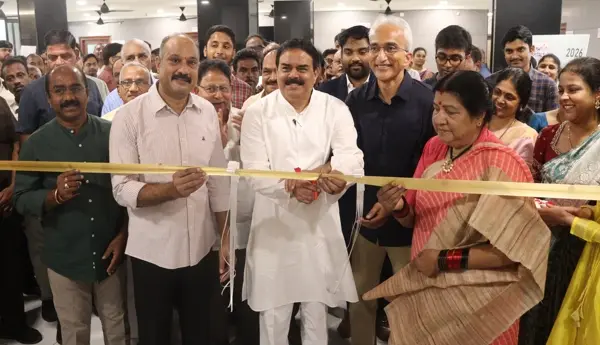
Cath lab, cardiac ICU inaugurated at Tenali Health Hospital
State Civil Supplies Minister Nadendla Manohar on Friday inaugurated a newly set up cath lab and cardiac ICU at Health Hospital on Prakasam Road in Tenali, Guntur district. He said timely treatment is crucial in heart-related cases and that local facilities must be strengthened so patients need not travel elsewhere. He congratulated hospital chairman Dr Nannapaneni Pratap and managing director Manne Harish, adding the cath lab would enable cardiac tests and interventional cardiology services.
Source
Guntur — ఆరోగ్యం · read the original report ↗
Desk check · compared with the source
What the desk checked (5)
- A new cath lab and cardiac ICU were inaugurated at Health Hospital on Prakasam Road, Tenali, on Friday. — Stated as fact in the source report with venue and day specified; no independent documentation cited.
- State Civil Supplies Minister Nadendla Manohar attended as chief guest and said timely treatment in cardiac cases is crucial. — Directly attributed to the minister in the source.
- The minister congratulated hospital chairman Dr Nannapaneni Pratap and managing director Manne Harish. — Attributed to the minister; names appear in the source.
- The cath lab will enable cardiac tests and interventional cardiology services, and the cardiac ICU will allow continuous monitoring. — Presented as the minister's statement, not independently verified capability data.
- Attendees included former State Women's Commission chairperson Nannapaneni Rajakumari and Kumar Pumps head Kotha Subramanyam. — Listed in the source's attendee roll; no further sourcing given.
Analysts’ view opinion
A private hospital in Tenali adding a cath lab and a cardiac ICU is a small but telling data point in India's tier-2 health infrastructure story: advanced cardiac care is migrating outward from metros, but largely on private capital, with the state present as a guest of honour rather than as a funder. The minister's framing — that people should not have to travel elsewhere in an emergency — is the correct policy diagnosis, since the 'golden hour' for heart attacks is essentially a geography problem. The open governance question is affordability and integration: a cath lab close to home only becomes a public health gain if it is reachable in terms of cost and covered by insurance or state health-assurance schemes, and this story does not tell us whether it is.
- The announcement reflects a decentralisation logic long embedded in Indian health policy — moving tertiary capability closer to district and sub-district populations rather than concentrating it in big cities.
- Delivery here is private, not public, and the minister's own call for government and private institutions to work together signals reliance on a public-private mix rather than new state capacity.
- Interventional cardiology is staff-intensive, and the minister's emphasis on coordination among doctors, nursing and technical staff points to the real constraint: retaining trained personnel in a smaller town, not buying the equipment.
- Equity depends on payment design — whether procedures are empanelled under insurance or state health-assurance coverage determines who actually benefits, and that is not stated.
- Compared with past inaugural-event politics around health facilities, the value test is utilisation over time: catheterisation volumes, round-the-clock availability and referral links with nearby government hospitals.
What to watch — Watch whether the unit runs genuine 24x7 emergency cardiac cover, whether its procedures are brought under insurance or government health-assurance empanelment, and whether the district's referral and ambulance chain is rewired to use it.
The story establishes only that the facility was inaugurated; it does not establish its capacity, staffing, pricing, insurance empanelment, any government financial involvement, or measured patient outcomes.
Deep dive
Research brief · 8 facts · 1 dates · exam-readyThe brief
Context
A private hospital in Tenali, Guntur district of Andhra Pradesh, has added emergency cardiac care infrastructure — a catheterisation laboratory (cath lab) and a cardiac intensive care unit. State Civil Supplies Minister Nadendla Manohar inaugurated the units on Friday at Health Hospital on Prakasam Road as chief guest. The event highlights a recurring gap in India's smaller towns: patients with heart emergencies often have to travel to larger cities for interventional cardiology, losing critical time. The Minister used the occasion to call for strengthening local facilities and for government and private medical institutions to work together on quality care.
Key facts
- State Civil Supplies Minister Nadendla Manohar inaugurated a newly set up cath lab and cardiac ICU at Health Hospital, Prakasam Road, Tenali, Guntur district, on Friday.
- The Minister first reviewed the hospital's newly available medical facilities, emergency cardiac treatment services and patient amenities through its doctors.
- He said timely treatment is the most crucial factor when heart-related problems arise.
- He congratulated hospital chairman Dr Nannapaneni Pratap and managing director Manne Harish for bringing better cardiac services to the Tenali area.
- He said local facilities must be strengthened so patients need not travel to other places for cardiac emergencies.
- The new cath lab will allow various heart-related diagnostic tests and interventional cardiology services.
- The cardiac ICU will allow continuous monitoring of patients in emergency conditions.
- Attendees included former State Women's Commission chairperson Nannapaneni Rajakumari, Kumar Pumps head Kotha Subramanyam, Dr Avula Chakravarthi, doctors, hospital staff and local representatives.
Timeline
- Friday (date not stated in the source)Minister Nadendla Manohar inaugurates the cath lab and cardiac ICU at Health Hospital, Tenali, after reviewing facilities and interacting with doctors.
Who has a stake
- Patients in and around Tenali — Access to local emergency cardiac diagnosis and interventional treatment instead of travelling to other places during the critical window.
- Health Hospital, Tenali (chairman Dr Nannapaneni Pratap, MD Manne Harish) — Running the new cath lab and cardiac ICU effectively and expanding its emergency care profile.
- State Civil Supplies Minister Nadendla Manohar — Represented the government's stated commitment to quality healthcare and urged public-private cooperation.
- Andhra Pradesh government — Said to be always at the forefront in delivering quality medical care to people.
- Doctors, nursing and technical staff — Asked by the Minister to work in coordination to run cath lab and cardiac ICU services efficiently.
Why it matters
Heart attacks are time-critical emergencies, and the absence of a cath lab in a town means patients must travel to bigger centres, often losing the hours that determine survival. Adding interventional cardiology and a monitored cardiac ICU in a taluk-level town like Tenali shortens that distance for a large surrounding population. It also illustrates the role private hospitals play in filling tertiary-care gaps, and the Minister's call for government and private institutions to work together.
UPSC angle
Prelims pointers
- Tenali is a town in Guntur district, Andhra Pradesh; the new facility is on Prakasam Road.
- Nadendla Manohar is Andhra Pradesh's Minister for Civil Supplies, as named in the source.
- A cath lab (catheterisation laboratory) enables cardiac diagnostic tests and interventional cardiology procedures.
- A cardiac ICU provides continuous monitoring of patients in cardiac emergencies.
- Health Hospital, Tenali: chairman Dr Nannapaneni Pratap; managing director Manne Harish.
- Nannapaneni Rajakumari, present at the event, is a former chairperson of the State Women's Commission.
Mains framing
The inauguration of a cath lab and cardiac ICU at a private hospital in Tenali points to a structural feature of Indian health care: advanced, time-sensitive tertiary services such as interventional cardiology have historically clustered in metropolitan and district headquarters, forcing patients in smaller towns to travel during the very hours when outcomes are decided. The Minister's own framing — that timely treatment is the most crucial element in heart cases and that local facilities must be strengthened so people need not go elsewhere — captures both the diagnosis and the prescription. The implications are twofold: decentralising cardiac capability reduces transport delay and mortality risk for a wide catchment, but where such capacity comes largely from private providers, questions of affordability and equitable access follow. The Minister's appeal that government and private medical institutions work together, and that doctors, nursing and technical staff coordinate to run the cath lab and ICU efficiently, indicates the way forward: pairing infrastructure with trained human resources, and linking private tertiary capacity to public systems so that emergency cardiac care is available close to home without becoming exclusive.
Key terms
- Cath lab (catheterisation laboratory)
- An imaging-equipped facility where catheters are used for heart-related diagnostic tests and interventional procedures.
- Interventional cardiology
- Catheter-based treatment of heart conditions, enabled at the hospital by the new cath lab, as stated by the Minister.
- Cardiac ICU
- An intensive care unit for heart patients providing continuous monitoring and treatment during emergencies.
- State Civil Supplies Ministry
- The Andhra Pradesh department headed by Nadendla Manohar, the chief guest at the inauguration.
- State Women's Commission
- A state body whose former chairperson, Nannapaneni Rajakumari, attended the event.
Practice questions
- Why is proximity of cath lab facilities critical in cardiac emergencies, and what does the Tenali case suggest about the spread of tertiary care in small towns?
- Examine the role of private hospitals in filling gaps in specialised care in India, and the equity concerns this raises.
- Infrastructure alone cannot deliver emergency cardiac care. Discuss with reference to the need for coordinated doctors, nursing and technical staff.
Grounded only in the source report — figures and dates are the source's, not inferred.