
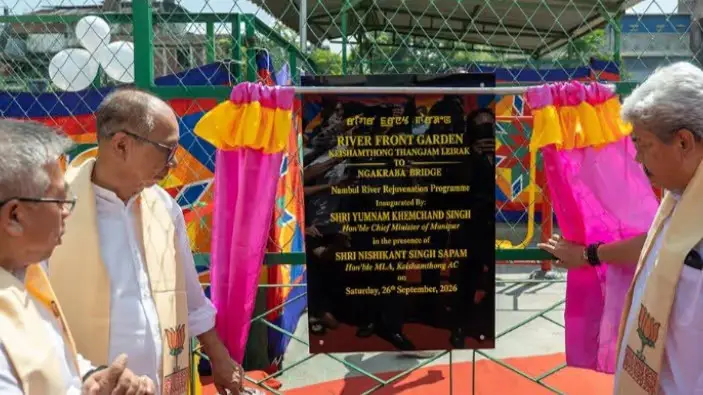
Manipur CM opens River Front Garden along Nambul River
Manipur Chief Minister Yumnam Khemchand Singh on September 26 inaugurated the River Front Garden at Keishamthong Thangjam Leirak in Imphal, in the presence of Keishamthong MLA Nishikanta Singh Sapam. The project is being executed by the Department of Environment and Climate Change under the 'Rejuvenation of the Nambul River' project, part of the Ministry of Jal Shakti's National River Conservation Plan. The stretch up to Ngakraba Bridge is now open to the public. The Chief Minister said the government alone could not restore the river without public participation.
Source
Manipur — CM & govt · read the original report ↗
Desk check · compared with the source
What the desk checked (5)
- Manipur Chief Minister Yumnam Khemchand Singh inaugurated the River Front Garden at Keishamthong Thangjam Leirak, Imphal, on September 26. — Attributed to the source report with named official and date; internally consistent.
- Keishamthong MLA Nishikanta Singh Sapam was present at the inauguration. — Stated in source; name and constituency appear as given, not externally verified.
- The garden stretch from Keishamthong Thangjam Leirak to Ngakraba Bridge has been opened to the public. — Figure/detail appears in source text; consistent with story highlights.
- The project is executed by the Department of Environment and Climate Change under the 'Rejuvenation of the Nambul River' project, part of the National River Conservation Plan of the Ministry of Jal Shakti. — Programme attribution given in source; scheme names consistent across highlights and body.
- The Chief Minister said the government alone could not restore the river without local cooperation and appealed for public participation. — Paraphrased remarks attributed to the Chief Minister; no direct quote provided.
Analysts’ view opinion
Inaugurating a riverfront garden looks like routine administration, but in the Manipur context such events double as a signal that normal governance and visible public works are back on the agenda. The fact that it runs through the state Environment and Climate Change Department under the Centre's National River Conservation Plan gives the government a ready Centre–state cooperation narrative. The presence of the local MLA points to shared credit at the constituency level, and the Chief Minister's call for public participation is politically useful too — collective ownership of success, and shared responsibility if results are slow.
- A visible, usable amenity in central Imphal is a low-controversy, high-visibility project — politically safe ground for any incumbent.
- Central funding under the National River Conservation Plan paired with state execution allows the government to showcase Centre–state coordination.
- The Keishamthong MLA's presence spreads the credit between the Chief Minister and the local representative, which matters at constituency level.
- The framing that 'government alone cannot do it' genuinely enlists civil society and local clubs, but also functions as political insulation if the river does not visibly improve.
- The real test for the opposition and local bodies will not be the ribbon-cutting but whether pollution and sewage load in the Nambul actually fall over time.
What to watch — Watch how well the opened stretch is maintained and how fast the next phases move — above all whether pollution levels visibly improve, since that will decide the political payoff of the project.
The story does not establish project cost, completion timelines, measurable pollution outcomes, or any party's reaction; what is offered here is political interpretation, not new reporting.
Deep dive
Research brief · 8 facts · 1 dates · exam-readyThe brief
Context
The Nambul River flows through Imphal and has become heavily polluted as it passes through dense urban settlements. Manipur's state government, through its Department of Environment and Climate Change, is running a 'Rejuvenation of the Nambul River' project under the Union Ministry of Jal Shakti's National River Conservation Plan. As a visible component of that project, a River Front Garden has been developed along the river's banks in Imphal and has now been thrown open to the public.
Key facts
- Manipur Chief Minister Yumnam Khemchand Singh inaugurated the River Front Garden at Keishamthong Thangjam Leirak in Imphal on September 26.
- Keishamthong MLA Nishikanta Singh Sapam was present at the inauguration.
- The garden stretch from Keishamthong Thangjam Leirak up to Ngakraba Bridge has been opened to the public.
- The initiative is executed by the state Department of Environment and Climate Change.
- It falls under the 'Rejuvenation of the Nambul River' project.
- The project is implemented as part of the National River Conservation Plan of the Ministry of Jal Shakti, Government of India.
- The Chief Minister said the government alone could not achieve the challenging goal of restoring the river without cooperation of local residents.
- He appealed to stakeholders, civil society organisations, local clubs and citizens living near the river to take collective ownership of the initiative.
Timeline
- September 26Manipur CM Yumnam Khemchand Singh inaugurates the River Front Garden at Keishamthong Thangjam Leirak, Imphal, and the stretch up to Ngakraba Bridge opens to the public.
Who has a stake
- Manipur Chief Minister Yumnam Khemchand Singh — Leading the riverfront initiative and publicly appealing for community participation in rejuvenating the Nambul.
- Department of Environment and Climate Change, Manipur — Executing agency for the River Front Garden and the Nambul rejuvenation project.
- Ministry of Jal Shakti, Government of India — Provides the National River Conservation Plan framework under which the project is implemented.
- Keishamthong MLA Nishikanta Singh Sapam — Local elected representative of the constituency where the garden has come up.
- Residents, local clubs and civil society organisations near the river — Asked to take collective ownership of protecting and rejuvenating the polluted river.
- Public visitors to the riverfront — Gain access to a new open green space along the Keishamthong Thangjam Leirak-Ngakraba Bridge stretch.
Why it matters
Urban rivers like the Nambul carry the pollution load of the cities they pass through, and cleaning them depends as much on everyday civic behaviour as on government works. By pairing a centrally-backed conservation project with a public riverfront garden, the state is trying to convert an eyesore into a shared civic asset that residents have an incentive to protect. The Chief Minister's appeal underlines that river restoration is a co-production between the state and riverside communities.
UPSC angle
Prelims pointers
- Nambul River flows through Imphal, Manipur; it is the subject of a state 'Rejuvenation of the Nambul River' project.
- National River Conservation Plan (NRCP) is administered by the Ministry of Jal Shakti, Government of India.
- The Nambul riverfront project is executed by Manipur's Department of Environment and Climate Change.
- River Front Garden inaugurated on September 26 at Keishamthong Thangjam Leirak, Imphal.
- Open stretch runs from Keishamthong Thangjam Leirak to Ngakraba Bridge.
- Manipur Chief Minister named in the story: Yumnam Khemchand Singh.
Mains framing
The inauguration of the River Front Garden along the Nambul in Imphal illustrates how urban river conservation in India is increasingly being attempted through a combination of central funding frameworks and local place-making. The Nambul is described as polluted, a typical outcome of a river flowing through a densely settled state capital where waste and sewage discharge accumulate; the state's response, under the 'Rejuvenation of the Nambul River' project within the Ministry of Jal Shakti's National River Conservation Plan, is being executed by the Department of Environment and Climate Change. The riverfront garden serves a dual purpose: it creates a usable public green space and it makes the river visible and valued, which is the logic behind the Chief Minister's explicit statement that the government alone cannot restore the river without the cooperation of residents. The way forward implied by the story is institutionalising that participation, by involving stakeholders, civil society organisations and local clubs in stewardship of the stretch, so that maintenance and pollution control do not rest solely on departmental capacity. The source does not detail funding, timelines or pollution-abatement works beyond the garden, so those remain areas to watch.
Key terms
- Nambul River
- A polluted river flowing through Imphal, Manipur, targeted for rejuvenation by the state government.
- National River Conservation Plan (NRCP)
- A Government of India programme under the Ministry of Jal Shakti under which the Nambul rejuvenation project is implemented.
- Rejuvenation of the Nambul River project
- The state-run project, under NRCP, aimed at restoring and protecting the Nambul River.
- Department of Environment and Climate Change, Manipur
- The state department executing the River Front Garden and the Nambul rejuvenation work.
- River Front Garden
- A public garden developed along the Nambul's bank from Keishamthong Thangjam Leirak to Ngakraba Bridge.
Practice questions
- Urban river rejuvenation in India succeeds only when civic participation is built into project design. Discuss with reference to the Nambul River initiative in Imphal.
- What is the National River Conservation Plan, and how does it structure centre-state responsibility for cleaning polluted urban rivers?
- Riverfront development can either aid or distract from pollution abatement. Critically examine in the Indian context.
Grounded only in the source report — figures and dates are the source's, not inferred.