
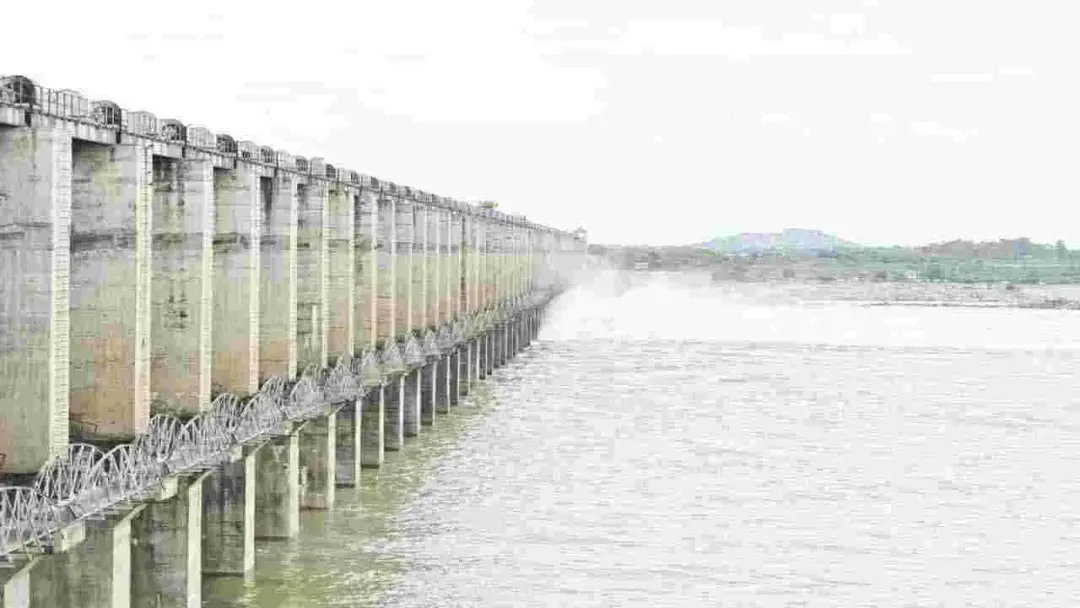
Narayanpur water to flow to Jurala until November
Water release from Karnataka's Narayanpur project to the Jurala reservoir will continue until November to meet drinking water needs. Karnataka agreed to release 3 TMC this season following a request by Telangana ministers, and Telangana sought the release in phases rather than at once. Jurala was receiving an inflow of 800 cusecs at 6 pm Wednesday, holding 8.87 TMC of its 9.66 TMC capacity, while Narayanpur held 32.43 TMC of 37.64 TMC.
Source
తెలంగాణ వార్తలు — Telangana · read the original report ↗
Desk check · compared with the source
What the desk checked (5)
- Karnataka agreed to release 3 TMC of water from Narayanpur to Jurala this season following a request by Telangana ministers — Stated in source as Karnataka government's agreement to a ministers' request; no official named or quoted.
- Water will be released in phases until November rather than at once, as sought by Telangana — Attributed in the source to Telangana's request; figure and timeline appear in source.
- Jurala had 8.87 TMC against full capacity of 9.66 TMC, with inflow of 800 cusecs at 6 pm Wednesday — Specific figures with time stamp given in source; no source agency named.
- Narayanpur held 32.43 TMC against 37.64 TMC capacity; Almatti releasing 11,308 cusecs and Narayanpur receiving 9,684 cusecs — Figures appear in source; internally consistent, unattributed.
- Medigadda receiving 74,000 cusecs, Sammakka Sagar 3.13 lakh cusecs, Sitamma Sagar 3.52 lakh cusecs — Downstream Godavari figures as listed in source; no source given.
Analysts’ view opinion
Against the usual grain of Telangana–Karnataka friction over Krishna waters, Karnataka's agreement to release 3 TMC following a ministerial-level request counts as a small but notable act of quiet diplomacy. Framing the ask around drinking water is politically the least contestable route — hard for anyone to publicly object to. Telangana's request for phased releases up to November, rather than one bulk discharge, signals a management-first rather than confrontation-first approach.
- The outcome gives the Telangana government something to show for negotiation rather than litigation or public sparring on river water.
- Keeping the framing on 'drinking water' rather than allocation shares is a politically safe container for both states.
- Phased release reduces wastage, but it also leaves Telangana dependent on sustained Karnataka cooperation right through November.
- The deal comes while storage is comfortable — Jurala at 8.87 of 9.66 TMC, Narayanpur at 32.43 of 37.64 — so the real test is whether goodwill survives a lean upstream year.
- For legislators in the Jurala command and drinking-water belt, this is an immediately demonstrable local benefit.
What to watch — Watch whether the 3 TMC actually arrives on schedule through November, and whether the tone between the two states shifts once upstream inflows thin out.
The story does not establish which ministers negotiated, when or how, whether the understanding is documented, or what it implies for wider allocation disputes.
Deep dive
Research brief · 8 facts · 5 dates · exam-readyThe brief
Context
Jurala, Telangana's first major reservoir on the Krishna after the river enters the state, depends on releases from upstream Karnataka projects — Almatti and Narayanpur. With drinking water needs in the coming months in view, Karnataka has responded positively to a request from Telangana ministers and agreed to release 3 TMC this season from the Narayanpur project to Jurala. Telangana asked that the water be sent in phases up to November rather than in one go, and releases will continue accordingly.
Key facts
- Karnataka agreed to release 3 TMC from the Narayanpur project to Jurala this season, at the request of Telangana ministers.
- Releases will be made in phases and will continue until November, as Telangana sought, instead of all at once.
- At 6 pm on Wednesday, Jurala was receiving an inflow of 800 cusecs.
- Jurala's full storage capacity is 9.66 TMC; current storage was 8.87 TMC.
- Narayanpur, in the Krishna basin, has a full capacity of 37.64 TMC and held 32.43 TMC.
- Almatti reservoir upstream was releasing 11,308 cusecs; Narayanpur's inflow was 9,684 cusecs and its downstream release 400 cusecs.
- Tungabhadra project had an inflow of 9,651 cusecs with matching outflow; Srisailam was releasing 51,078 cusecs and Nagarjunasagar had an inflow of 2,300 cusecs.
- In the Godavari basin, Jayakwadi (Maharashtra), Singur and Nizamsagar were receiving no inflow; Sriramsagar had 1,157 cusecs inflow against 2,023 cusecs released; Kadem had 400 cusecs.
Timeline
- Before the report (date not stated in the source)Telangana ministers request Karnataka to release water from Narayanpur for drinking water needs.
- SubsequentlyKarnataka agrees to release 3 TMC this season; Telangana asks for phased release rather than a single release.
- Wednesday, 6 pmJurala recording an inflow of 800 cusecs, with 8.87 TMC in storage.
- September 30 (report datelined Hyderabad)Report notes upper Godavari flood flows have slowed while lower Godavari continues to see heavy flows.
- Until NovemberNarayanpur releases to Jurala to continue in phases.
Who has a stake
- Government of Telangana / state ministers — Sought the release to secure drinking water supply in the coming months and asked for it in phases.
- Government of Karnataka — Agreed to release 3 TMC from Narayanpur this season, responding positively to Telangana's request.
- Residents in the Jurala command and dependent areas — Drinking water availability, given first priority in the release.
- Irrigation/reservoir operators on the Krishna (Almatti, Narayanpur, Jurala, Srisailam, Nagarjunasagar, Tungabhadra) — Managing inflows, storage and downstream releases across the basin.
- Godavari basin projects (Jayakwadi, Singur, Nizamsagar, Sriramsagar, Kadem, Medigadda, Sammakkasagar, Sitammasagar) — Wide variation in inflows — zero in some upper projects, lakhs of cusecs in the lower Godavari.
Why it matters
Jurala is nearly full at 8.87 TMC of 9.66 TMC, but its dependence on upstream Karnataka releases makes inter-state cooperation central to Telangana's drinking water security in the non-monsoon months. The phased release of 3 TMC until November shows how sharing arrangements on the Krishna are negotiated project-to-project, with drinking water given first priority.
UPSC angle
Prelims pointers
- Narayanpur project is in Karnataka on the Krishna; full capacity 37.64 TMC, storage 32.43 TMC as reported.
- Jurala reservoir (Telangana) full capacity 9.66 TMC; storage 8.87 TMC with 800 cusecs inflow.
- Almatti lies upstream of Narayanpur; it was releasing 11,308 cusecs.
- Karnataka agreed to release 3 TMC to Jurala this season, phased until November.
- Krishna basin projects named: Almatti, Narayanpur, Jurala, Tungabhadra, Srisailam, Nagarjunasagar.
- Godavari projects named: Jayakwadi (Maharashtra), Singur, Nizamsagar, Sriramsagar, Kadem, Medigadda (on Pranahita), Sammakkasagar (Tupakulagudem), Sitammasagar (Dummugudem).
Mains framing
Inter-state river water sharing in the Krishna basin is shaped as much by operational cooperation as by formal allocation: Telangana's Jurala, sitting immediately downstream of Karnataka's Almatti–Narayanpur system, has limited live storage (9.66 TMC) and therefore depends on timed upstream releases once the monsoon recedes. The current arrangement — Karnataka agreeing to 3 TMC this season, released in phases until November at Telangana's request rather than in one spell — reflects the priority accorded to drinking water and the practical logic of spreading releases so that a small reservoir does not have to pass surplus downstream. The wider picture in the source shows uneven hydrology: comfortable storages and healthy flows in the Krishna (Srisailam releasing 51,078 cusecs) alongside a stalled upper Godavari where Jayakwadi, Singur and Nizamsagar receive no inflow, even as the lower Godavari carries lakh-scale flows at Sammakkasagar and Sitammasagar. The way forward, on the evidence available, lies in sustaining such negotiated, phased release schedules, real-time monitoring of inflows and storages across both basins, and planning drinking water reservations early rather than in crisis — without reading into the source any policy decision it does not report.
Key terms
- TMC (thousand million cubic feet)
- Unit for reservoir storage volumes; Jurala's full capacity is 9.66 TMC and Narayanpur's 37.64 TMC.
- Cusec
- Cubic feet per second, the unit for river or canal flow; Jurala's inflow was 800 cusecs.
- Jurala
- Telangana reservoir on the Krishna receiving releases from Narayanpur; capacity 9.66 TMC.
- Narayanpur project
- Karnataka reservoir in the Krishna basin, downstream of Almatti, from which 3 TMC is being released to Jurala.
- Medigadda
- Barrage on the Pranahita, receiving 74,000 cusecs of flood flow as reported.
- Inflow / outflow
- Water entering a reservoir versus water released downstream; Tungabhadra's 9,651 cusecs inflow was matched by equal outflow.
Practice questions
- Discuss how operational cooperation between upstream and downstream states, as seen in Karnataka's phased release to Telangana's Jurala, complements formal water-sharing mechanisms in the Krishna basin.
- Why is drinking water given first priority in reservoir operation during the post-monsoon period? Illustrate with the Narayanpur–Jurala release arrangement.
- Compare the reported hydrological situation in the Krishna basin with that in the upper and lower Godavari, and explain what such contrasts imply for reservoir management.
Grounded only in the source report — figures and dates are the source's, not inferred.