
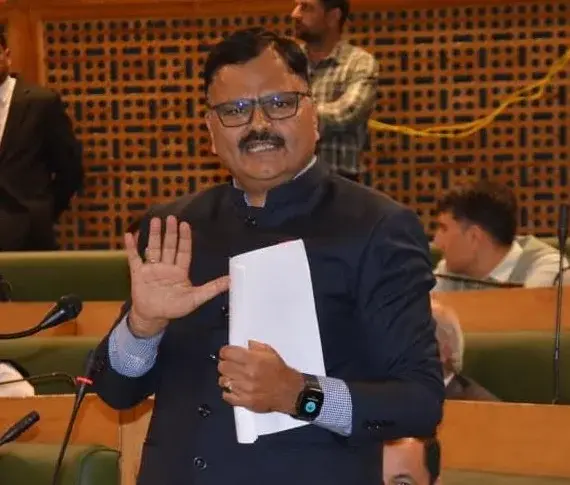
2,486 EWS certificates issued in Kashmir, 24,058 in Jammu: Minister
Jal Shakti Minister Javed Ahmed Rana told the House that 2,486 Economically Weaker Sections certificates were issued in Kashmir Division and 24,058 in Jammu Division over the last two years. He replied on behalf of the Chief Minister, who holds Revenue, to a notice by MLA Sajad Gani Lone. Rana said Tehsildars issue the certificates as per Social Welfare Department criteria. Minister Sakeena Itoo said the criteria are prescribed by the Union Government. Speaker Abdul Rahim Rather said the matter merits examination.
Source
Jammu and Kashmir — CM & govt · read the original report ↗
Desk check · compared with the source
What the desk checked (4)
- 2,486 EWS certificates issued in Kashmir Division and 24,058 in Jammu Division over the last two years. — Figures appear in source, attributed to Jal Shakti Minister Javed Ahmed Rana replying on behalf of the Chief Minister.
- EWS certificates are issued by Tehsildars as per criteria set by the Social Welfare Department. — Attributed to Minister Javed Ahmed Rana in the House; internally consistent.
- Rules for determining the EWS category are prescribed by the Union Government and must be adopted by States and UTs. — Attributed to Social Welfare Minister Sakeena Itoo; contested in the same debate by MLAs Sajad Gani Lone and M Y Tarigami.
- Speaker Abdul Rahim Rather said the matter merits examination and the government should study EWS criteria in other states. — Attributed to the Speaker in the source; no independent record cited.
Analysts’ view opinion
This is less a statistical query than the reopening of an old political argument about how resources are shared between the Jammu and Kashmir divisions. By tabling the notice, Sajad Gani Lone used an opposition perch to frame the gap as discrimination against Kashmir and put moral pressure on the government. The treasury response split in two directions: Minister Sakeena Itoo pointed to Union-prescribed criteria, while Lone and CPI(M)'s Tarigami argued states retain latitude — and that divergence is the politically significant bit.
- The 2,486 versus 24,058 contrast is an easy political weapon for Lone, even though the story does not establish why the gap exists.
- Having the reply delivered by another minister on the Chief Minister's behalf, and anchored in central rules, is a familiar defensive play that lowers the temperature.
- The "Centre prescribes it" line shields the ruling side politically but also concedes limited power to reform the criteria — itself an opening for critics.
- Tarigami, generally seen as sympathetic to the ruling side, undercut that defence on the floor by noting some states have evolved their own criteria.
- The Speaker's direction that the matter merits examination keeps the issue alive rather than closing it — a small procedural win for the opposition.
What to watch — Watch whether the government actually studies other states' EWS criteria and moves toward a review, or shelters behind central rules — that choice will test its credibility on regional balance.
The story does not establish the cause of the disparity — application volumes, demographics, awareness gaps or administrative bias — so discrimination remains an allegation, not a finding.
Deep dive
Research brief · 8 facts · 3 dates · exam-readyThe brief
Context
In the Jammu and Kashmir Legislative Assembly, a Calling Attention Notice by MLA Sajad Gani Lone alleged discrimination against Kashmir Division in the issuance of Economically Weaker Sections (EWS) certificates. Jal Shakti Minister Javed Ahmed Rana, replying on behalf of the Chief Minister who holds the Revenue portfolio, disclosed that 2,486 EWS certificates were issued in Kashmir Division against 24,058 in Jammu Division over the last two years. EWS certificates are issued by Tehsildars as per eligibility criteria prescribed by the Social Welfare Department. The debate turned on whether the criteria are fixed by the Union Government or can be adapted by States and UTs to local socio-economic conditions.
Key facts
- 2,486 EWS certificates were issued in Kashmir Division during the last two years, as stated in the House.
- 24,058 EWS certificates were issued in Jammu Division in the same two-year period.
- Jal Shakti Minister Javed Ahmed Rana replied on behalf of the Chief Minister, who also holds the Revenue Department portfolio.
- The reply came on a Calling Attention Notice tabled by MLA Sajad Gani Lone on alleged discrimination with Kashmir Division in EWS certificate issuance.
- EWS certificates are issued by Tehsildars as per eligibility criteria prescribed by the Social Welfare Department.
- Social Welfare Minister Sakeena Itoo said the rules for determining the EWS category are prescribed by the Union Government and States/UTs must adopt them.
- CPI(M) MLA Mohammad Yousuf Tarigami said some States have evolved their own EWS criteria and J&K could examine practices elsewhere.
- Speaker Abdul Rahim Rather observed the matter merits examination and asked the government to study EWS criteria adopted by different States.
Timeline
- Last two years (period cited in the reply)2,486 EWS certificates issued in Kashmir Division and 24,058 in Jammu Division.
- During the Assembly session (date not stated in the source)MLA Sajad Gani Lone tables a Calling Attention Notice on discrimination in EWS certificate issuance.
- Same sittingMinister Javed Ahmed Rana gives the figures; Sakeena Itoo and Mohammad Yousuf Tarigami intervene; Speaker Abdul Rahim Rather says the matter merits examination.
Who has a stake
- EWS applicants in Kashmir Division — Access to reservation and welfare benefits that require an EWS certificate; the low issuance figure is alleged to reflect discrimination.
- Revenue Department / Tehsildars — They are the issuing authority for EWS certificates and apply the prescribed eligibility criteria.
- Social Welfare Department, J&K (Minister Sakeena Itoo) — Prescribes the eligibility criteria; maintains that the rules flow from the Union Government.
- MLA Sajad Gani Lone — Moved the notice; seeks a uniform and rational EWS definition based on per capita income and socio-economic indicators.
- CPI(M) MLA Mohammad Yousuf Tarigami — Argues criteria are not uniformly applied across States and J&K can frame its own mechanism.
- Speaker Abdul Rahim Rather / J&K Assembly — Directed that the government study EWS criteria adopted by different States.
- Union Government — Cited as the authority prescribing EWS determination rules that States and UTs are to adopt.
Why it matters
An EWS certificate is the gateway to reservation benefits in education and jobs, so a tenfold gap in certificates issued between the two divisions of J&K raises questions of equitable access to affirmative action. The Assembly exchange also exposes an unsettled question: whether EWS eligibility norms are rigidly set by the Union or can be tailored by States and UTs to local incomes and social conditions. The Speaker's direction to study other States' practices could shape how J&K defines its economically weaker sections.
UPSC angle
Prelims pointers
- EWS certificates in J&K are issued by Tehsildars as per Social Welfare Department eligibility criteria.
- Figures cited in the House: Kashmir Division 2,486; Jammu Division 24,058 EWS certificates in two years.
- Javed Ahmed Rana is Minister for Jal Shakti; he replied for the Chief Minister, who holds Revenue.
- Sakeena Itoo is Minister for Social Welfare; Abdul Rahim Rather is Speaker of the J&K Assembly.
- A Calling Attention Notice is the parliamentary device Sajad Gani Lone used to raise the issue.
- Mohammad Yousuf Tarigami is a CPI(M) MLA in the J&K Assembly.
Mains framing
The disparity flagged in the J&K Assembly — 2,486 EWS certificates in Kashmir Division against 24,058 in Jammu Division over two years — turns a routine administrative function into a question of equitable access to affirmative action. Certificates are issued by Tehsildars under criteria prescribed by the Social Welfare Department, which the Social Welfare Minister traced to Union Government rules binding on States and UTs; legislators countered that the criteria are not applied uniformly, that several States have evolved their own norms, and that J&K could similarly account for per capita income, social conditions and other socio-economic indicators. The implications are twofold: uneven certification can translate into uneven capture of EWS reservation benefits within a single Union Territory, and an unclear division of authority between Union prescription and State adaptation weakens accountability for the gap. The way forward indicated in the House itself is the Speaker's direction that the government examine the matter and study EWS criteria adopted by different States, alongside the demand for a uniform, rational and locally grounded definition of the economically weaker sections in J&K. The source does not state the reasons for the divisional gap, which any corrective policy would first need to establish.
Key terms
- EWS (Economically Weaker Sections)
- A category whose determination rules, per the Social Welfare Minister, are prescribed by the Union Government and adopted by States and UTs.
- EWS certificate
- Document certifying EWS status, issued in J&K by Tehsildars as per Social Welfare Department eligibility criteria.
- Calling Attention Notice
- A legislative device by which an MLA draws the House's attention to an urgent matter and seeks a ministerial reply.
- Tehsildar
- Revenue officer at the tehsil level, here the authority empowered to issue EWS certificates in J&K.
- Revenue Department
- Department held by the Chief Minister of J&K, on whose behalf Minister Javed Ahmed Rana answered in the House.
- Supplementary
- A follow-up question raised in the House after a minister's reply, used here by MLA Sajad Gani Lone.
Practice questions
- The J&K Assembly was told that 2,486 EWS certificates were issued in Kashmir Division against 24,058 in Jammu Division in two years. Examine what such intra-region disparities imply for equitable access to affirmative action.
- Discuss the tension between centrally prescribed EWS eligibility norms and the demand for State/UT-specific criteria based on per capita income and local socio-economic conditions.
- Evaluate the role of legislative devices such as Calling Attention Notices in holding the executive accountable for administrative outcomes at the district and tehsil level.
Grounded only in the source report — figures and dates are the source's, not inferred.