
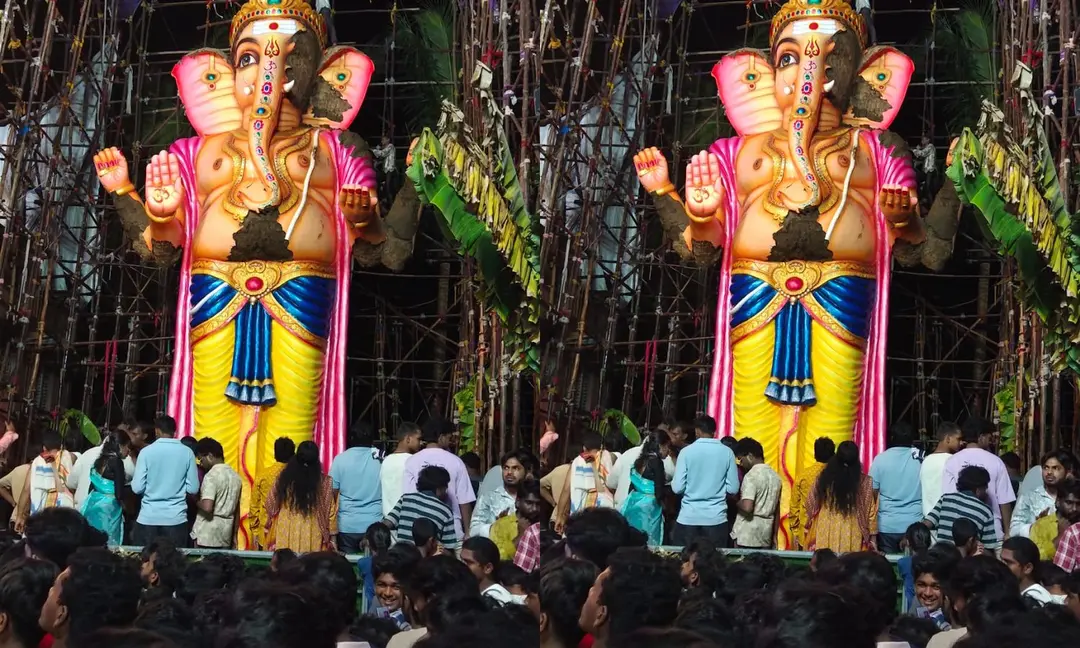
62-foot Ganesh idol immersed at Palakollu, laddu auction held
A 62-foot Ganesh idol installed at Relli Peta in Palakollu as part of the Ganesh festival was immersed, followed by a large-scale anna samaradhana, or community feeding. Local devotees participated in large numbers. In the laddu auction held on the occasion, the deity's first laddu was secured by a devotee, Gubbala Rakesh, for Rs 99,999. The second laddu fetched Rs 86,116, while Singampalli Brothers won the third for Rs 48,000.
Source
Palakollu — స్థానికం · read the original report ↗
Desk check · compared with the source
What the desk checked (4)
- A 62-foot Ganesh idol installed at Relli Peta in Palakollu was immersed. — Figure and location appear in the source; no organiser named as source.
- A mass feeding (anna samaradhana) was held after the immersion with large local participation. — Stated in source without attribution; crowd size not quantified.
- The first laddu was won by devotee Gubbala Rakesh for Rs 99,999. — Name and figure appear in source; no auction organiser cited.
- The second laddu fetched Rs 86,116 and the third went to Singampalli Brothers for Rs 48,000. — Figures appear in source; buyer of the second laddu not named.
Analysts’ view opinion
A 62-foot Ganesh idol at Relli Peta in Palakollu, a mass community feast and a first laddu going for nearly a lakh — these are devotional events, but in coastal Andhra they also double as arenas of local social and organisational clout. Across the state, Ganesh mandapams have become practical tests of how well youth associations and neighbourhood networks can raise money and mobilise crowds. That said, the story names no party or leader, so this is analysis of a structural pattern, not an allegation about anyone involved.
- Pulling off a 62-foot idol plus a large-scale annadanam signals serious local fundraising capacity and a working volunteer network.
- The first laddu fetching Rs 99,999 — won by devotee Gubbala Rakesh — shows how such auctions function as a route to local prestige and visibility.
- The second laddu at Rs 86,116 and the third going to Singampalli Brothers for Rs 48,000 suggest business and family groups also value presence on these public platforms.
- Heavy turnout of local devotees means festivals like this sustain community contact in the long stretches between elections.
- Smooth crowd management and immersion arrangements are, indirectly, a performance test for the local administration as well.
What to watch — Watch whether next year's festival sees taller idols and higher auction bids, and whether any leaders or party cadres openly associate themselves with these mandapams.
The story establishes nothing about political party or leader involvement, how the auction proceeds will be used, or the backgrounds of the bidders — so no political motive can be attributed to anyone here.
Deep dive
Research brief · 7 facts · 5 dates · exam-readyThe brief
Context
Ganesh Chaturthi celebrations in coastal Andhra Pradesh routinely feature tall community-funded idols, public feeding and the auction of the deity's offerings. At Relli Peta in Palakollu, West Godavari region, a 62-foot Ganesh idol installed for the festival was taken for immersion (nimajjanam), followed by a large community feast (anna samaradhana). As is customary, the laddu placed before the idol was auctioned, with bids treated as a mark of devotion and a source of funds for the pandal committee.
Key facts
- A 62-foot Ganesh idol installed at Relli Peta, Palakollu, was immersed as part of the Ganesh festival.
- The immersion was followed by a large-scale anna samaradhana (community feeding).
- Local devotees participated in large numbers in the programme.
- The deity's first laddu was secured by devotee Gubbala Rakesh for Rs 99,999.
- The second laddu fetched Rs 86,116 in the auction.
- The third laddu was won by Singampalli Brothers for Rs 48,000.
- The report was published on 27 September 2026 at 10:58 PM IST.
Timeline
- Ganesh festival period (exact dates not stated in the source)A 62-foot Ganesh idol is installed at Relli Peta, Palakollu.
- Not dated in the sourceImmersion (nimajjanam) of the 62-foot idol is carried out.
- After the immersionA large anna samaradhana is held, attended by local devotees in large numbers.
- On the same occasionLaddu auction held; first laddu goes for Rs 99,999, second for Rs 86,116, third for Rs 48,000.
- 27 September 2026, 10:58 PM ISTReport published.
Who has a stake
- Local Ganesh utsav committee at Relli Peta, Palakollu — Organised the 62-foot idol, immersion, community feeding and laddu auction; auction proceeds support the festival.
- Local devotees of Palakollu — Participated in large numbers in the immersion and the community feast.
- Gubbala Rakesh (devotee) — Secured the deity's first laddu for Rs 99,999.
- Singampalli Brothers — Won the third laddu for Rs 48,000.
- Second laddu bidder — Paid Rs 86,116 for the second laddu; name not stated in the source.
Why it matters
Tall community idols, mass feeding and laddu auctions show how a household festival has grown into a large public event financed by local collections and competitive bidding. The figures — nearly Rs 1 lakh for a single laddu — indicate the scale of money and social prestige now attached to neighbourhood pandals, with attendant questions of crowd management and immersion arrangements for a 62-foot idol.
UPSC angle
Prelims pointers
- Place in news: Palakollu (Relli Peta), Andhra Pradesh — 62-foot Ganesh idol immersed.
- Nimajjanam = ritual immersion of the Ganesh idol at the end of the festival.
- Anna samaradhana = organised mass community feeding held after the immersion.
- Laddu auction bids: first Rs 99,999 (Gubbala Rakesh); second Rs 86,116; third Rs 48,000 (Singampalli Brothers).
- Report dated 27 September 2026.
Mains framing
The Palakollu episode illustrates how Ganesh Chaturthi has evolved from a domestic ritual into an organised public festival driven by neighbourhood committees, with visible markers such as a 62-foot idol, mass anna samaradhana and a laddu auction in which the first offering alone fetched Rs 99,999. The causes lie in community mobilisation, local competition for prestige and the auction's role as a transparent fundraising device for pandal expenses and charity. The implications are twofold: such festivals strengthen social cohesion and voluntary giving, but very tall idols and mass gatherings raise practical concerns about crowd safety, traffic, water-body conditions at immersion points and the materials used in idol-making — issues the source does not detail. A way forward, consistent with the facts available, would be closer coordination between organising committees and civic authorities on immersion logistics and crowd management, and clear accounting of auction proceeds so that the money raised visibly returns to community welfare.
Key terms
- Nimajjanam
- The concluding immersion of the Ganesh idol in water after the festival days.
- Anna samaradhana
- Community feeding of devotees, here held on a large scale after the immersion.
- Laddu auction
- Public bidding for the laddu offered to the deity; winning it is seen as auspicious and funds the festival.
- Relli Peta, Palakollu
- The locality in Palakollu where the 62-foot Ganesh idol was installed and immersed.
Practice questions
- How have community-organised Ganesh festivals, with tall idols and laddu auctions, changed the character of religious celebration in coastal Andhra Pradesh?
- Discuss the administrative challenges involved in managing the immersion of very large idols and the accompanying mass gatherings.
- Examine the role of practices such as laddu auctions and anna samaradhana in mobilising community resources for public festivals.
Grounded only in the source report — figures and dates are the source's, not inferred.