
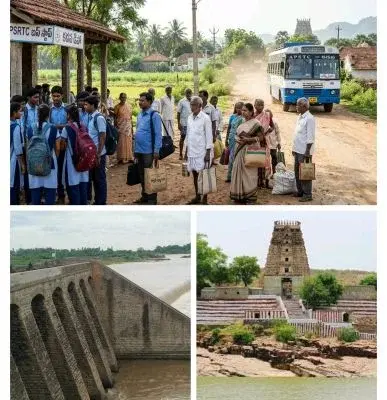
Residents seek restoration of Kadapa-Pushpagiri bus via Vallur
People of nine villages in Vallur mandal say they are facing hardship after the APSRTC bus service from Kadapa to Pushpagiri via Vallur and Adinimayapalli was suspended. Locals said students, women, farmers, employees and small traders are affected, and that people now walk about eight kilometres from Pushpagiri to Vallur. The depot manager said the bus slipped off the road and was damaged in recent rains, repairs are complete and the service will be restored.
Source
Kadapa — స్థానికం · read the original report ↗
Desk check · compared with the source
What the desk checked (5)
- The APSRTC bus service from Kadapa to Pushpagiri via Vallur and Adinimayapalli has been suspended. — Attributed to local residents and confirmed in substance by the depot manager; figure/route appears in source.
- The service directly benefits people of 9 villages in Vallur mandal. — Figure appears in source, attributed to local residents; no official data cited.
- People must walk about eight kilometres from Pushpagiri to Vallur. — Attributed to locals in the source; not independently documented.
- The bus slipped off the road during recent rains and needed major repairs; repairs are complete and the service will be restored. — Attributed to the depot manager, who was contacted by phone; manager not named in source.
- Women get free bus travel but cannot use it without a service to their villages. — Presented as women's statements in the source; scheme details not otherwise sourced.
Analysts’ view opinion
On the surface this is a routine transport complaint; politically it is far more sensitive, because residents are pointing out that a free-bus-travel benefit for women means little if no bus reaches the village at all. In Valluru mandal, students, women, farmers, employees and small traders — effectively every voter segment — have converged on a single demand, which is exactly the kind of issue that builds pressure on local representatives. The depot manager's explanation is technical (a bus damaged after rains), but the public narrative is shifting into a political frame of "schemes exist, services don't".
- Because one service links nine villages plus Pushpagiri pilgrims and Adinimayapalli visitors, the demand carries more constituency-level weight than its small scale suggests.
- The residents' question — what use is free travel for women if no bus arrives — is a potent political line about the gap between welfare announcements and delivery.
- Vivid details such as an eight-kilometre walk are the kind of grievance opposition voices typically amplify, though this story records no party reaction at all.
- The depot manager's assurance that repairs are done and the service will resume is an administrative move to defuse pressure; if it slips, that same assurance becomes the accountability yardstick.
- The underlying tension is between the financial viability of thin rural routes for APSRTC and the political necessity of serving them.
What to watch — Watch how quickly the promised restoration actually happens on the ground, and whether any delay is picked up as a political demand by local representatives or opposition leaders.
The story does not establish a date for restoration, how long the service has been suspended, or any formal response from a party or elected representative — only the single official explanation.
Deep dive
Research brief · 8 facts · 4 dates · exam-readyThe brief
Context
Vallur mandal in Kadapa district of Andhra Pradesh had an APSRTC bus service running from Kadapa to the Pushpagiri temple town via Vallur and Adinimayapalli. That service has stopped, and residents of nine villages along the route say their daily travel for education, health, jobs, trade and farm work has become difficult. The route also serves visitors to the Adinimayapalli dam and pilgrims to Pushpagiri, described locally as the "second Dakshina Kashi". The depot manager says the bus was badly damaged after slipping off the road in recent rains, repairs are done, and the service will be restored.
Key facts
- The suspended APSRTC service ran from Kadapa to Pushpagiri via Vallur and Adinimayapalli.
- Residents say people of 9 villages in Vallur mandal directly benefited from the bus service.
- Locals say they now have to walk about eight kilometres from Pushpagiri to Vallur.
- People say they must flag down passing two-wheelers on the route for lifts in the absence of a bus.
- Affected groups named: students, women, farmers, employees and small traders, plus those working in private hospitals, shopping malls and shops.
- Women ask how the free bus travel facility for women helps them when no bus comes to their villages.
- Farmers say they need the bus to buy seeds, fertilisers, pesticides and equipment, move produce to markets and reach agriculture offices, banks and cooperative societies.
- The depot manager said the bus slipped off the road in recent rains and needed heavy repairs; repairs are complete and the service will be restored as before.
Timeline
- Earlier (before suspension)APSRTC bus ran on the Kadapa-Vallur-Adinimayapalli-Pushpagiri route, serving nine villages.
- During recent rainsThe bus slipped off the road and was severely damaged, so it could not be sent back on the route.
- PresentResidents of nine villages appeal to district officials, elected representatives and senior APSRTC officers to restore the service immediately.
- As stated by the depot managerRepairs completed; APSRTC says the Kadapa-Vallur-Adinimayapalli-Pushpagiri service will be restored as usual.
Who has a stake
- Residents of 9 villages in Vallur mandal — Direct access to Vallur and Kadapa for education, health, employment, trade and farm needs.
- Students — Parents say children struggle to reach schools and colleges on time without the bus.
- Women workers — Daily commute to jobs in private hospitals, malls, shops and other commercial establishments; free bus travel benefit becomes unusable.
- Farmers — Trips for inputs, marketing produce, agriculture offices, banks and cooperative societies; now dependent on private vehicles.
- APSRTC / depot manager — Operational responsibility for the damaged bus and for restoring the route service.
- Pilgrims and tourists — Devotees to Pushpagiri, known as the second Dakshina Kashi, and visitors to Adinimayapalli dam need public transport.
- District officials and elected representatives — Under public pressure to act on the restoration demand.
Why it matters
A single suspended rural route shows how thin last-mile public transport can be: with one bus off the road, nine villages lose routine access to schools, hospitals, markets and government offices. It also shows that welfare entitlements such as free bus travel for women are meaningless where no service runs. The route's pilgrim and tourist traffic adds an economic dimension to the demand.
UPSC angle
Prelims pointers
- APSRTC operates the suspended Kadapa-Vallur-Adinimayapalli-Pushpagiri route in Vallur mandal.
- Pushpagiri is described in the source as a shrine known as the second Dakshina Kashi.
- Adinimayapalli in Vallur mandal has a dam (anakatta) that draws tourists.
- Residents of nine Vallur mandal villages are the petitioners for restoration.
- Locals report walking roughly 8 km between Pushpagiri and Vallur in the absence of the bus.
- Reason cited by APSRTC depot manager: bus slipped off the road and was damaged in recent rains.
Mains framing
The Vallur case illustrates how rural mobility in India often rests on a single vehicle and a single route, making service delivery fragile: recent rains caused the bus to slip off the road, and with no replacement deployed, nine villages lost their only direct public link to Vallur and Kadapa. The consequences are distributive rather than merely logistical - students lose punctuality, women in informal retail and hospital jobs lose affordable daily commuting and effectively cannot use the free bus travel entitlement, farmers are pushed to costlier private vehicles for inputs, marketing and bank or cooperative visits, and small traders lose access to town markets. Pilgrim traffic to Pushpagiri and tourist movement to the Adinimayapalli dam suggest the route has revenue potential as well as a social case. The residents' core question is institutional: why a route once sanctioned was allowed to lapse without a substitute bus during the repair period. The way forward suggested by the story is straightforward - the depot's promised restoration should be implemented, with district officials and elected representatives holding APSRTC to it; the broader lesson is the need for contingency arrangements so that damage to one vehicle does not suspend an entire rural route.
Key terms
- APSRTC
- Andhra Pradesh State Road Transport Corporation, the public bus operator that ran the suspended Kadapa-Pushpagiri route.
- Vallur mandal
- The administrative block in Kadapa area whose nine villages are affected by the withdrawn bus service.
- Pushpagiri
- Pilgrim centre on the route, referred to locally as the second Dakshina Kashi, visited daily by devotees.
- Adinimayapalli anakatta
- Dam/check structure in Vallur mandal on the route that attracts tourists.
- Free bus travel for women
- Existing facility of free bus travel for women, which residents say is unusable where no bus service operates.
- Depot manager
- APSRTC depot-level official who explained the bus damage and promised restoration of the service.
Practice questions
- How does the withdrawal of a single rural bus route affect access to education, healthcare, employment and agricultural markets? Discuss with reference to the Vallur mandal case.
- "Welfare entitlements in transport are only as effective as the service network that carries them." Examine in the light of free bus travel for women and unserved village routes.
- What institutional mechanisms can state transport corporations adopt to prevent suspension of rural routes when a vehicle is damaged or withdrawn?
Grounded only in the source report — figures and dates are the source's, not inferred.