
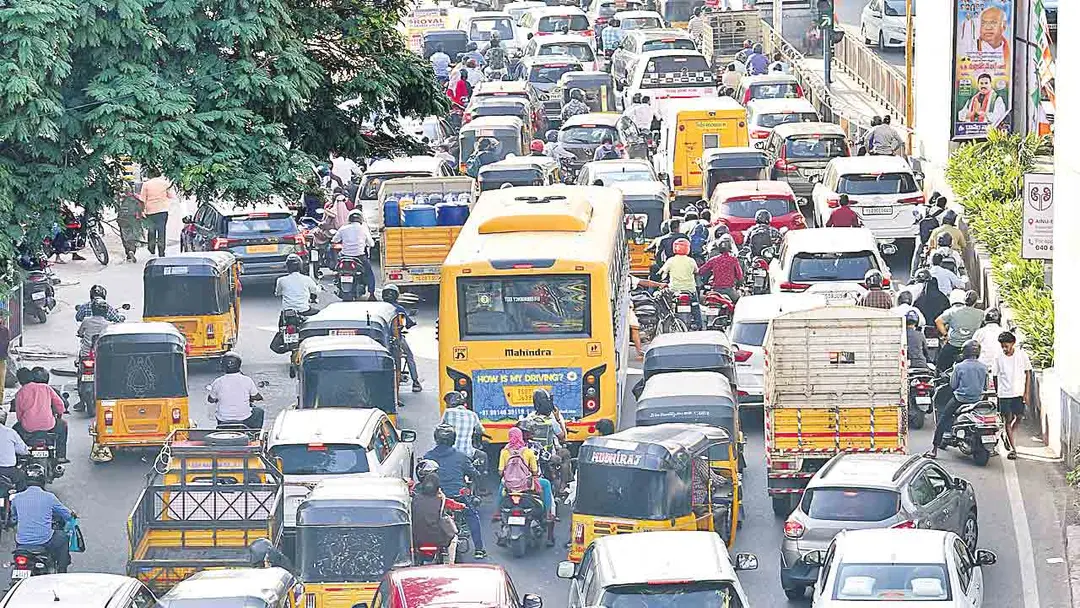
Hyderabad fourth among India's slowest traffic cities: TomTom
Hyderabad ranks fourth among India's slowest-traffic cities in the latest TomTom Global Traffic Index, behind Bengaluru, Kolkata and Pune. The city's congestion level is 55.5%, with 10 km taking an average 32.7 minutes and 39.5 minutes during evening peak hours. Average vehicle speed is 23 km per hour. Residents lose 123 hours a year to traffic and, per Climate Central, 75 hours of sleep — about 198 hours in all.
Source
Namasthe Telangana · read the original report ↗
Desk check · compared with the source
What the desk checked (5)
- Hyderabad ranks fourth among India's slowest-traffic cities, after Bengaluru, Kolkata and Pune — Attributed to TomTom Global Traffic Index report cited in the source.
- 10 km takes 32.7 minutes on average and 39.5 minutes in evening peak hours; congestion level 55.5% — Figures appear in the source, attributed to the TomTom Traffic Index.
- Hyderabad residents lose 123 hours a year in traffic and 75 hours of sleep, totalling about 198 hours — Attributed to TomTom (123 hours) and US-based Climate Central (75 hours), which studied 1,330 cities.
- Average vehicle speed is 23 km/h, falling to 5-10 km/h during rain and peak hours — 23 km/h attributed to the report; the 5-10 km/h drop is attributed to unnamed traffic experts.
- Vehicle numbers in Hyderabad have crossed 80 lakh — No specific source given in the text for this figure.
Analysts’ view opinion
Traffic indices look like technical data, but in a city like Hyderabad they double as a political scorecard on governance. Since every political camp in Telangana campaigns on the "world-class city" brand, a figure like an average speed of 23 km/h is an easy weapon for the opposition and an awkward question for those in office. The point that congestion has not eased despite flyovers and underpasses directly challenges a political narrative built on infrastructure announcements.
- IT-corridor voters — salaried, middle-class, highly vocal — are politically amplified, and when their daily experience matches a report like this, discontent spreads fast.
- Bengaluru topping the list gives the ruling side some cushion; the "we are still better than them" comparison is a natural line of defence.
- The old city's narrow roads and encroachments versus Hi-Tec City's drainage and junction failures are two very different constituency-level problems, making a single political fix hard to sell.
- With vehicle numbers past 80 lakh and public transport underused, funding priorities for metro expansion and bus services could become the substantive political argument.
- Removing encroachments and restoring footpaths antagonises local traders and residents, which is precisely why no party rushes to own such measures.
What to watch — Watch whether opposition parties turn this report into a campaign talking point and whether the government responds with fresh traffic or public-transport announcements, especially in local-body-level politics.
The story reports only the traffic and sleep-loss findings; it establishes nothing about party reactions, any official rebuttal, or whether this issue moves votes.
Deep dive
Research brief · 8 facts · 2 dates · exam-readyThe brief
Context
TomTom, a firm that analyses traffic trends worldwide, has released its latest Global Traffic Index, in which Hyderabad emerges as the fourth slowest-traffic city in India after Bengaluru, Kolkata and Pune. The report shows average vehicle speeds in the IT hub have fallen to 23 km per hour, with residents losing 123 hours a year in congestion. A separate study by US-based Climate Central, covering 1,330 cities, finds Hyderabadis also lose 75 hours of sleep a year due to rising night-time temperatures — together about 198 hours lost annually. The story, dated September 21-22, 2026, links the crisis to over 80 lakh vehicles, low public transport use, encroached footpaths and on-road parking.
Key facts
- Hyderabad ranks fourth among India's slowest-traffic cities in the latest TomTom Global Traffic Index; Bengaluru is first, followed by Kolkata and Pune.
- Hyderabad's traffic congestion level is 55.5%, as per the TomTom report.
- Travelling 10 km takes an average of 32.7 minutes, rising to 39.5 minutes in evening peak hours.
- Average vehicle speed in the city is limited to 23 km per hour; in rain or peak hours it falls to 5-10 kmph, near walking pace, say traffic experts.
- Hyderabadis lose an average of 123 hours a year to traffic congestion (TomTom).
- Climate Central, a US-based body, studied 1,330 cities and found Hyderabadis lose 75 hours of sleep a year; city dwellers generally lose 70-90 hours.
- Combined loss from congestion and sleeplessness is about 198 hours a year (123 + 75 hours).
- Vehicle numbers in Hyderabad have crossed 80 lakh, with thousands of new vehicles added to roads daily.
Timeline
- September 21, 2026City Bureau report filed on the TomTom and Climate Central findings for Hyderabad.
- September 22, 2026, 02:35 AM ISTStory published stating Hyderabad ranks fourth among India's slowest-traffic cities.
Who has a stake
- Hyderabad commuters — Lose about 198 hours a year — 123 hours in traffic and 75 hours of sleep — besides fuel and money.
- IT corridor workers (Madhapur, Gachibowli, Raidurgam, Kukatpally, Ameerpet) — Face severe gridlock between 6 pm and 8 pm daily, worsened by drainage overflow when it rains.
- Old City residents and pedestrians (Charminar, Madina Market, Bahadurpura) — Narrow roads, encroachments and absence of proper footpaths force pedestrians onto the roads.
- TomTom — Global traffic analysis firm whose index benchmarks city congestion levels and travel times.
- Climate Central — US-based body linking climate change and rising night temperatures to sleep loss across 1,330 cities.
- Metro and RTC public transport — Exist but are under-used as a majority rely on own or rented cars and bikes, including single-occupancy cars.
Why it matters
Hyderabad's pitch as a world-class IT hub is being undercut by congestion that reduces average speeds to 23 kmph and costs each resident 123 hours a year. When the heat-island effect is added, the loss rises to roughly 198 hours annually, showing that traffic and climate stress now compound each other in Indian metros. Flyovers and underpasses have not eased the problem, pointing instead to vehicle growth, weak public transport uptake and road encroachment.
UPSC angle
Prelims pointers
- TomTom Global Traffic Index: ranks cities by congestion; Bengaluru first in India, then Kolkata, Pune, Hyderabad.
- Hyderabad congestion level: 55.5%; 10 km takes 32.7 minutes (39.5 minutes in evening peak).
- Average vehicle speed in Hyderabad: 23 kmph; drops to 5-10 kmph in rain/peak hours.
- Annual time loss in Hyderabad: 123 hours (TomTom) + 75 hours of sleep (Climate Central) = about 198 hours.
- Climate Central, a US-based organisation, analysed 1,330 cities worldwide on night-time warming and sleep loss.
- Hyderabad's vehicle population has crossed 80 lakh.
Mains framing
Hyderabad's fourth-place ranking among India's slowest-traffic cities in the TomTom Global Traffic Index illustrates how infrastructure-led urban growth can be outpaced by motorisation. The report attributes persistent congestion — 55.5% congestion level, 32.7 minutes for 10 km, 23 kmph average speed — not to the absence of flyovers and underpasses, which the city has built, but to a vehicle fleet exceeding 80 lakh with thousands added daily, majority reliance on private and rented cars and bikes despite Metro and RTC services, single-occupancy car travel, footpath encroachment and on-road parking that shrink effective carriageway width. Geography compounds this: the IT hub of Madhapur, Gachibowli, Raidurgam and Kondapur has wide roads but chokes at junctions such as City Mall, Mindspace and IIIT, with drainage overflow causing hours-long gridlock after any rain, while the Old City suffers narrow lanes, encroachments and missing footpaths. Climate Central's finding that concretised cities absorb daytime heat and release it at night, costing residents 70-90 hours of sleep annually (75 hours in Hyderabad), shows congestion and urban heat as twin liabilities. The way forward implied by the source lies in raising public transport share, curbing single-occupancy travel, reclaiming footpaths and parking space, and fixing drainage on key corridors.
Key terms
- TomTom Global Traffic Index
- Periodic report by the firm TomTom analysing traffic trends and congestion across cities worldwide.
- Congestion level
- Share by which travel time exceeds free-flow conditions; 55.5% for Hyderabad as per TomTom.
- Climate Central
- US-based organisation that studied 1,330 cities on climate change, night temperatures and sleep loss.
- Urban heat effect (concrete jungle)
- Concrete and roads absorb heat by day and release it at night, raising night temperatures and cutting sleep.
- Gridlock
- Total standstill of traffic; the IT corridor faces hours of it whenever rain floods drains.
- Peak hours
- Evening and office-closing periods, chiefly 6 pm to 8 pm in the IT corridor, when speeds fall sharply.
Practice questions
- Hyderabad has built flyovers and underpasses yet remains among India's slowest-traffic cities. Examine the structural reasons and suggest demand-side measures for urban mobility.
- Discuss how urban heat islands and traffic congestion together impose a measurable time and health cost on Indian city dwellers, using the TomTom and Climate Central findings.
- 'Public transport exists but is under-used.' Critically analyse the factors driving private vehicle dependence in Indian metros and possible policy responses.
Grounded only in the source report — figures and dates are the source's, not inferred.