
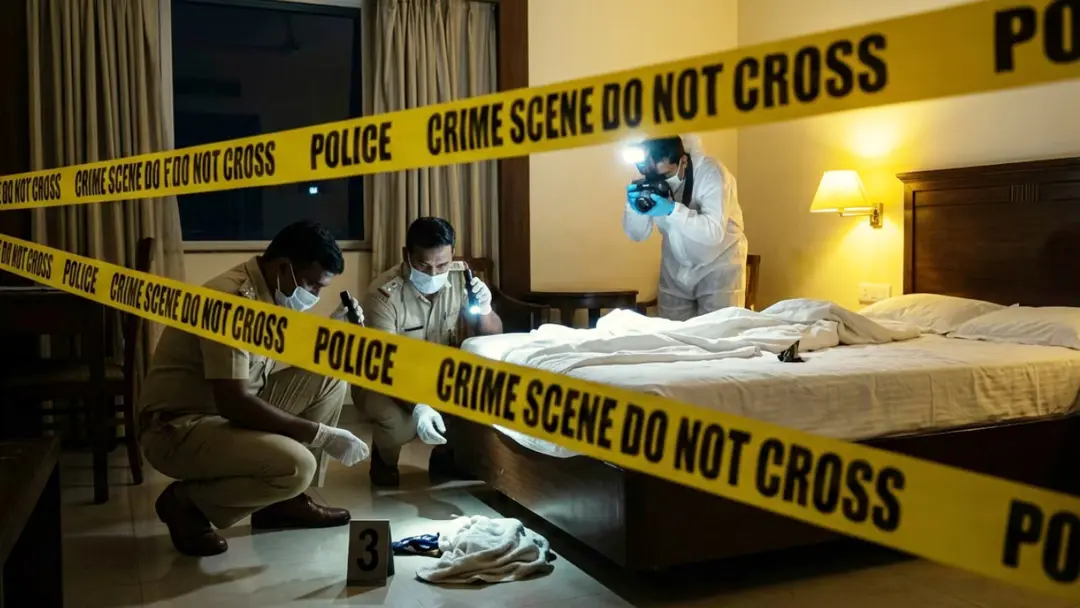
Bank employee found dead in Hyderabad hotel room, man untraced
A 34-year-old bank customer-care executive, B Sirisha, was found dead on Tuesday in a room at Gokul Pride Hotel in Ameerpet, under Hyderabad's SR Nagar police limits. Police said A Srinivas, 38, who was staying with her in Room 103, left the hotel around 3.30 am and remains untraced. Jubilee Hills DCP A Ramana Reddy said investigators suspect a night-time argument and an assault with a blunt object. A murder case was registered under BNS Section 103(1).
Source
Hyderabad — crime · read the original report ↗
Desk check · some claims need care
What the desk checked (5)
- B Sirisha, 34, a bank customer-care executive from Nagasamudram in Vikarabad district, was found dead in Room 103 of Gokul Pride Hotel, Ameerpet. — Attributed to police in source; names, age and hotel details appear consistently in the text.
- A Srinivas, 38, left the hotel around 3.30 am on Tuesday and remains untraced. — Attributed to police, including his statement to reception staff; no independent confirmation available.
- The two checked in under the names Ganesh and Durga using different identity documents. — Attributed to investigators in source; described as reported, not confirmed.
- Sirisha was attacked with a blunt object, possibly a curtain rod. — Police suspicion plus 'another report'; source states cause of death awaits post-mortem and forensic examination.
- A case has been registered under Section 103(1) of the Bharatiya Nyaya Sanhita. — Attributed to SR Nagar police; figure appears in source.
Analysts’ view opinion
This is, at this stage, a First Information Report under Section 103(1) of the Bharatiya Nyaya Sanhita — the murder provision of the new criminal code — and nothing more: a registered case reflects the police's suspicion, not a judicial finding. The legal spine of any eventual prosecution here will be circumstantial, because there is no reported eyewitness to what happened inside Room 103, which means the post-mortem, the forensic material lifted by the Clues Team, the CCTV sequence and the call records will have to form an unbroken chain. The named man's alleged departure at around 3.30 am and the use of different names at check-in are evidentially significant, but in law they are pieces of circumstance, not proof of the offence.
- Section 103(1) BNS is the murder provision and one of the gravest charges on the statute book, but the section invoked in an FIR can be altered, upgraded or dropped once the post-mortem and forensic reports are in.
- Cause of death is the pivot of the case: the story itself says the blunt-object theory, including the curtain-rod detail from another report, is a suspicion to be settled by post-mortem and forensic examination.
- Because there appears to be no eyewitness, this would be a case built on circumstantial evidence, where courts traditionally require the chain of circumstances to be complete and to point only to guilt — CCTV, phone records, hotel registers and forensic traces are the likely load-bearing links.
- Checking in under different names, if established, may attract separate questions around false identification and could be used as conduct evidence, though it is not by itself evidence of homicide.
- The accused's rights remain intact through all of this: he is untraced, not proven absconding in the legal sense, and if located he retains the presumption of innocence, the right to legal representation and the protections governing arrest and remand under the new procedural code.
What to watch — Watch for the post-mortem and forensic findings on cause of death, whether the accused is arrested or the police move for proclamation-type coercive steps, and whether the sections in the FIR are revised when the final report is filed.
The story establishes only that a murder case has been registered and a man is being sought; it does not establish who caused the death, the actual cause of death, or whether the reported temple marriage, earlier separation and past alleged assault have any bearing on the case.
Deep dive
Research brief · 8 facts · 5 dates · exam-readyThe brief
Context
A 34-year-old bank customer-care executive, B Sirisha, was found dead in Room No. 103 of Gokul Pride Hotel on Dharam Karam Road, Ameerpet, within SR Nagar police limits in Hyderabad, on Tuesday. She had been staying with 38-year-old A Srinivas, with whom police say she was in a relationship; both allegedly checked in using false names and identity documents. Srinivas left the hotel at around 3.30 am on Tuesday and remains untraced. Police have registered a murder case under Section 103(1) of the Bharatiya Nyaya Sanhita and suspect a late-night argument that turned violent.
Key facts
- The deceased, B Sirisha, 34, was a bank customer-care executive from Nagasamudram in Vikarabad district.
- She was found dead on the bed in Room No. 103 of Gokul Pride Hotel, Dharam Karam Road, Ameerpet, on Tuesday; a food plate was found near the body.
- A Srinivas, 38, had been staying at the hotel since September 9; Sirisha checked in on September 24.
- The two allegedly used false names and identity documents at check-in: Srinivas as 'Ganesh' and Sirisha as 'Durga'.
- Srinivas left the hotel at about 3.30 am on Tuesday, allegedly telling reception staff that Sirisha would have breakfast and leave later.
- Hotel staff grew suspicious after no response for several hours; police opened the room with a spare key in the presence of staff.
- Jubilee Hills DCP A Ramana Reddy said investigators suspect a night-time argument and an assault with a blunt object; one report cited a curtain rod.
- SR Nagar police registered a murder case under Section 103(1) of the Bharatiya Nyaya Sanhita (BNS).
Timeline
- September 9A Srinivas reportedly begins staying at Gokul Pride Hotel, Ameerpet, registered under the name 'Ganesh'.
- September 24B Sirisha checks into the same hotel, listed as 'Durga', and stays with Srinivas in Room No. 103.
- Tuesday, around 3.30 amSrinivas leaves the hotel, allegedly telling reception that Sirisha would have breakfast and leave later.
- Tuesday, later in the dayAfter no response from the room for hours, staff alert police; the room is opened with a spare key and Sirisha is found dead.
- Tuesday onwardsClues Team collects forensic material, CCTV footage is seized, and special teams are sent to Srinivas's native village and transport hubs.
Who has a stake
- B Sirisha (deceased) — Victim of the suspected murder; her death, personal history and earlier alleged assault are central to the probe.
- A Srinivas, 38 — Prime suspect named in the murder case; untraced after leaving the hotel at 3.30 am.
- SR Nagar police — Registered the murder case under BNS Section 103(1) and are gathering phone records, hotel documents and CCTV evidence.
- Jubilee Hills DCP A Ramana Reddy — Senior officer briefing on the case; stated the assault-after-argument line of investigation.
- Gokul Pride Hotel and its staff — Alerted police; their check-in records are under scrutiny as guests allegedly used false names and IDs.
- Police Clues Team and forensic/post-mortem examiners — Tasked with establishing the exact cause of death and linking physical evidence to the sequence of events.
- Sirisha's family — Seek accountability; reports say she was earlier married and later separated from her husband.
Why it matters
The case highlights how hotel check-ins using false names and identity documents can obscure the movements of guests and complicate investigations. It also raises questions about the handling of an earlier alleged assault on the victim, for which reports say she received hospital treatment, and whether such warning signs were acted upon. The registration of the case under Section 103(1) of the Bharatiya Nyaya Sanhita illustrates how India's new criminal codes now frame everyday policing.
UPSC angle
Prelims pointers
- Section 103(1) of the Bharatiya Nyaya Sanhita (BNS) deals with murder; the BNS has replaced the Indian Penal Code.
- The case falls under SR Nagar police limits, Hyderabad; the briefing officer was Jubilee Hills DCP A Ramana Reddy.
- Ameerpet and Dharam Karam Road are in Hyderabad; the victim hailed from Nagasamudram in Vikarabad district, Telangana.
- A police 'Clues Team' is the unit that examines a crime scene and collects forensic material.
- Cause of death in such cases is established through forensic examination and post-mortem, not police suspicion alone.
Mains framing
The Hyderabad hotel death illustrates several recurring weaknesses in the chain between intimate-partner violence and criminal justice. First, verification failure: the source says the two guests allegedly checked in under assumed names ('Ganesh' and 'Durga') with different identity documents, and police are examining why — a gap that delays identification and tracing of suspects. Second, missed early warning: reports indicate the victim had earlier been treated at a private hospital after an alleged assault and was separated from her husband, and investigators are checking whether those incidents are linked to her death, pointing to the need for systematic follow-up on assault-related hospital cases. Third, investigative reliance on technology and forensics: the probe now rests on CCTV footage, phone records, hotel documents, Clues Team material and the post-mortem, with the exact cause of death yet to be established. The way forward suggested by the facts is stricter identity verification and record-keeping at lodging establishments, prompt tracing of absconding suspects through special teams at native places and transport hubs, and careful corroboration of claims — such as the reported promise of marriage and temple marriage — through evidence rather than local reports.
Key terms
- Bharatiya Nyaya Sanhita (BNS)
- India's criminal code that has replaced the Indian Penal Code; its Section 103(1) covers the offence of murder.
- Section 103(1), BNS
- The provision under which SR Nagar police registered the murder case in this incident.
- Clues Team
- Police unit that inspects the crime scene and collects forensic material such as physical traces and exhibits.
- DCP (Deputy Commissioner of Police)
- Zonal police officer in a commissionerate; here, Jubilee Hills DCP A Ramana Reddy briefed on the case.
- Post-mortem examination
- Medical autopsy that, along with forensic tests, will establish the exact cause of Sirisha's death.
- Untraced accused
- A named suspect whose whereabouts are unknown; special police teams have been deployed to locate Srinivas.
Practice questions
- Discuss how lapses in identity verification at hotels and lodges can obstruct criminal investigations, using the Hyderabad hotel death case as an illustration.
- What institutional mechanisms can ensure that hospital treatment of assault victims triggers timely police follow-up? Examine with reference to reported earlier assault on the victim in this case.
- Explain the role of forensic evidence, CCTV footage and call records in establishing the sequence of events in a murder investigation.
Grounded only in the source report — figures and dates are the source's, not inferred.