
17.6 million voters flagged in SIR as ERONET faces scrutiny
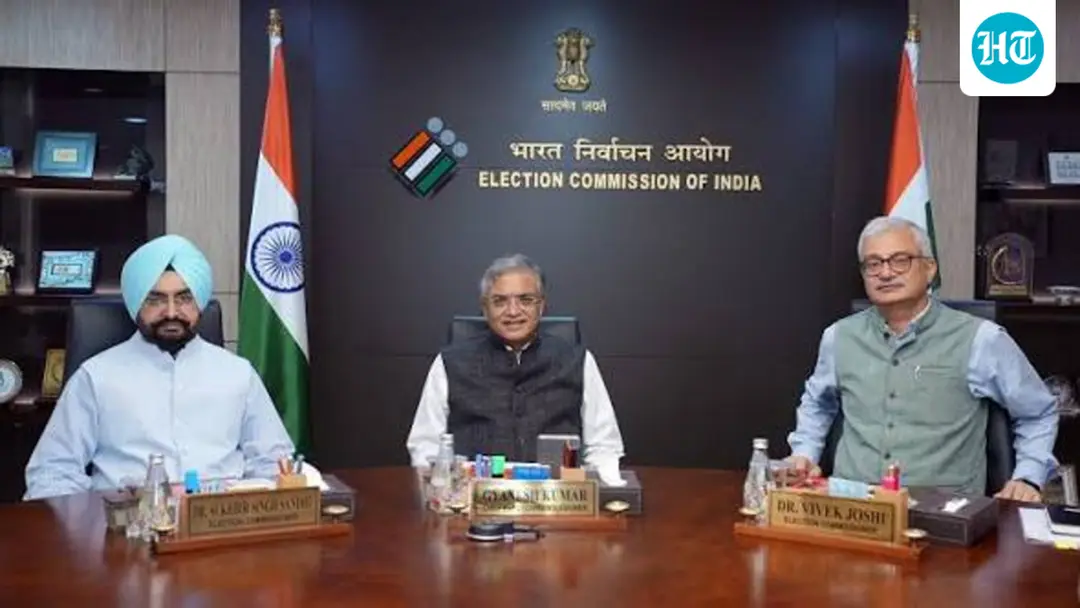
About 17.6 million voters in Telangana, Karnataka, Maharashtra and Delhi have received notices under the 'logical discrepancy' category in the third phase of the Special Intensive Revision (SIR) of electoral rolls. Officials attribute many cases to transcription and age-gap errors when 2002 base rolls were converted into English. An Indian Express investigation said Election Commissioners Vivek Joshi and Sukhbir Sandhu objected at least 14 times in ten months over control of the ERONET software. ECI officials said the software was not faulty.
Source
Hindustan Times — India · read the original report ↗
Desk check · some claims need care
What the desk checked (5)
- About 17.6 million voters in Telangana, Karnataka, Maharashtra and Delhi got notices under 'logical discrepancy'. — Figure appears in source; attributed to SIR phase-3 data reported by HT, no document cited.
- Election Commissioners Vivek Joshi and Sukhbir Sandhu objected at least 14 times to decisions. — Attributed in source to an Indian Express investigation; not independently confirmed in the text.
- In West Bengal six million voters were flagged and 2.71 million eventually disenfranchised. — Figures appear in source without a named originating document; earlier HT reporting referenced.
- Officials say ERONET had only routine updates after West Bengal SIR. — Attributed to an unnamed ECI official quoted directly.
- ECINET, launched January 2026 with 22 Indian languages, integrates ERONET and over 40 ECI applications. — Stated in source as background; attributed to ECI officials.
Analysts’ view opinion
The 17.6 million "logical discrepancy" notices in the third phase of the SIR have stopped being a technical story and become a power story — about who actually controls the electoral roll. Name mismatches thrown up when Telugu, Kannada and Marathi base rolls were rendered into English, plus faulty age-gap calculations, hand regional parties a ready-made grievance about centralisation and linguistic carelessness. And the reported fact that two of the ECI's three members, Vivek Joshi and Sukhbir Sandhu, formally objected at least 14 times in ten months turns opposition suspicion into something that appears to be echoed from inside the institution itself.
- Telangana, Karnataka, Maharashtra and Delhi are all politically contested terrain, so any error rate will be read through a partisan lens regardless of intent.
- The West Bengal precedent — six million flagged, 2.71 million eventually off the rolls — gives critics their central argument that a notice can end in disenfranchisement.
- Errors arising specifically from converting regional-language base rolls into English are tailor-made for regional parties campaigning against centralisation.
- Commissioners themselves reportedly flagged a "gradual centralisation of the electoral roll database" and state officials' lack of full ERONET access, which pushes this into a federalism debate rather than a mere IT complaint.
- The ECI's defence is procedural and technocratic — the software is not faulty, a notice is not a deletion, there is time to correct — but it does not fully answer the political charge that the burden of proof falls on poorer and older voters without documents.
What to watch — Watch the numbers at the November 5 cut-off: how many notice recipients survive on the rolls versus how many are pushed into filing fresh Form 6 applications will set the scale of opposition mobilisation, litigation and parliamentary pressure.
The story does not establish that any software flaw was designed to benefit a political side, nor how many of those noticed will ultimately lose their vote.
Deep dive
Research brief · 8 facts · 7 dates · exam-readyThe brief
Context
The Election Commission of India is conducting a Special Intensive Revision (SIR) of electoral rolls, now in its third phase, in which current electors are matched against 2002 "base rolls". The matching is done by ERONET (Electoral Roll Officers' Network), software rolled out in 2017-18 and since January 2026 integrated into the ECI's unified ECINET platform. In Telangana, Karnataka, Maharashtra and Delhi about 17.6 million voters have been served notices under a category called "logical discrepancy", often because 2002 rolls in Telugu, Kannada or Marathi were transcribed into English, or because of flawed parent-child age-gap calculations. Alongside this, an institutional dispute has broken out inside the Commission over who legally controls access to ERONET.
Key facts
- About 17.6 million voters in Telangana, Karnataka, Maharashtra and Delhi have received notices under the 'logical discrepancy' category in SIR Phase 3.
- In West Bengal's earlier SIR, six million people were flagged for logical discrepancy and 2.71 million were eventually disenfranchised.
- Election Commissioners Vivek Joshi and Sukhbir Sandhu have formally objected at least 14 times in ten months since May, per an Indian Express investigation.
- The 2002 base rolls were in Telugu in Telangana and Andhra Pradesh, Kannada in Karnataka and Marathi in Maharashtra.
- In Hyderabad's Langer House area, at least 205 voters across six booths got notices for name-mismatch reasons; Qamer Fatima's notice cited a mismatch with 'Qemar Fatima'.
- At Joan Fathima's booth in Bengaluru, 87 of 332 notices cited an age gap of less than 15 years between elector and parent.
- In Goa, EROs cleared 97 voters for inclusion but could not change the database before the deadline, leaving all 97 off the final list; the CEO office wrote eight times in one week seeking a rollback facility.
- ECINET, launched in January 2026 with 22 built-in Indian languages, integrates ERONET and more than 40 other ECI applications.
Timeline
- 2002Base electoral rolls prepared in regional languages - Telugu, Kannada, Marathi, Bengali - later used as reference for SIR matching.
- 2017-18ERONET (Electoral Roll Officers' Network) rolled out by the ECI.
- January 2026ECI launches ECINET, integrating ERONET and 40+ applications, one month before completion of SIR in West Bengal.
- May (as reported)Commissioners Vivek Joshi and Sukhbir Sandhu begin formally objecting; Joshi flags 'gradual centralisation of the electoral roll database'.
- AugustSandhu reiterates that state election officials lack 'proper and complete access' to the ERONet portal, and questions DG (IT) Seema Khanna's authority to restrict access.
- September 8Qamer Fatima, 55, of Hyderabad receives a notice from the Telangana CEO over a name mismatch.
- November 5Deadline for Fatima to establish the link, failing which she must file a fresh Form 6 as a first-time voter.
Who has a stake
- Flagged voters (about 17.6 million in four states/UTs) — Risk of deletion from rolls or having to reapply as first-time voters via Form 6 if they cannot prove links to 2002 entries.
- Election Commission of India — Credibility of SIR and of its technology; defends ERONET as not faulty and routinely updated.
- Election Commissioners Vivek Joshi and Sukhbir Sandhu — Objected at least 14 times, alleging centralisation of the electoral roll database beyond what law permits.
- Seema Khanna, ECI Director General (IT) — Her authority to restrict access to ERONET, which statutorily belongs to EROs, has been questioned by a Commissioner.
- Electoral Registration Officers (EROs) — Legal custodians of the roll under Section 13B, RP Act 1950; reportedly lack complete access to the portal they must use.
- Booth Level Officers (BLOs) — Front line of verification; must collect documents for errors they say originate in backend software calculations.
- State CEO offices (Telangana, Karnataka, Delhi, Goa) — Handle complaints and corrections; Goa's office sought a rollback facility that never came.
Why it matters
The right to vote turns on an accurate electoral roll, and here software transcription and age-gap errors are placing the burden of proof on individual citizens, many of whom lack documents such as an 80-year-old parent's age proof. The West Bengal precedent, where 2.71 million of six million flagged voters were eventually disenfranchised, suggests notices can translate into real loss of franchise. The parallel dispute over who controls ERONET raises the constitutional question of whether roll decisions are drifting from statutory officers to a centralised IT wing.
UPSC angle
Prelims pointers
- Article 324 gives the Election Commission control over preparation of electoral rolls; a 1977 Supreme Court ruling held this power belongs to the Commission collectively, not any individual office.
- Section 13B of the Representation of the People Act, 1950 provides for appointment of an Electoral Registration Officer (ERO) for each constituency, the legal custodian of the roll.
- Registration of Electors Rules, 1960: EROs process applications and decide disputes, with the Commission only supervising.
- ERONET = Electoral Roll Officers' Network, rolled out 2017-18; ECINET launched January 2026 with 22 Indian languages, integrating 40+ ECI apps.
- ASDD in SIR terminology = Absent, Shifted, Dead and Duplicate voters.
- Form 6 is the application used by a first-time voter for inclusion in the electoral roll.
Mains framing
The SIR controversy illustrates the risks of automating a rights-bearing administrative function. ERONET's task - matching current electors against 2002 base rolls written in Telugu, Kannada, Marathi or Bengali - produced mass "logical discrepancy" flags when regional-language names were transcribed into English, and further errors when parent-child age gaps of under 15 years were computed wrongly; about 17.6 million notices in four states/UTs follow six million flagged and 2.71 million disenfranchised in West Bengal. The ECI's defence is scale: duplicate detection and progeny mapping cannot be done manually, errors are fixed in real time, and integration with ECINET reduces script-conversion mistakes. But the design shifts the evidentiary burden onto citizens, especially the poor and elderly without documents, while BLOs themselves cannot explain backend outputs. Layered on this is a governance question: with EROs as statutory custodians under Section 13B and the Rules of 1960, and Article 324 power vesting in the Commission collectively per the 1977 Supreme Court ruling, Commissioners Joshi and Sandhu have objected at least 14 times to what they call gradual centralisation and to access restrictions imposed by the DG (IT). The way forward suggested by the source's facts lies in restoring full portal access and rollback facilities to statutory officers, transparent publication of discrepancy data by all states rather than bundling into ASDD, fuzzy-matching tolerance for spelling variants, and audit of algorithmic flags before any deletion.
Key terms
- Special Intensive Revision (SIR)
- ECI exercise revising electoral rolls by matching current electors against older base rolls, now in its third phase.
- Logical discrepancy
- Notice category used when software finds a mismatch between a current elector's details and the corresponding 2002 base-roll entry.
- ERONET
- Electoral Roll Officers' Network, rolled out 2017-18, processes enumeration forms and matches electors with base rolls.
- ECINET
- ECI's unified app and website launched January 2026 with 22 Indian languages, integrating ERONET and 40+ other applications.
- ASDD
- Absent, Shifted, Dead and Duplicate - the broader category into which some states bundle discrepancy numbers.
- Electoral Registration Officer (ERO)
- Officer appointed under Section 13B, RP Act 1950 for each constituency; legal custodian of the roll who decides disputes.
Practice questions
- Critically examine whether the increasing reliance on centralised software such as ERONET and ECINET in electoral roll revision is consistent with the statutory scheme under the Representation of the People Act, 1950 and the Registration of Electors Rules, 1960.
- "Technology can assist but not replace statutory discretion." Discuss with reference to the 'logical discrepancy' notices issued during the Special Intensive Revision of electoral rolls.
- What safeguards should accompany algorithmic flagging of voters to ensure that the burden of proof does not unfairly fall on citizens without documentary records?
Grounded only in the source report — figures and dates are the source's, not inferred.