
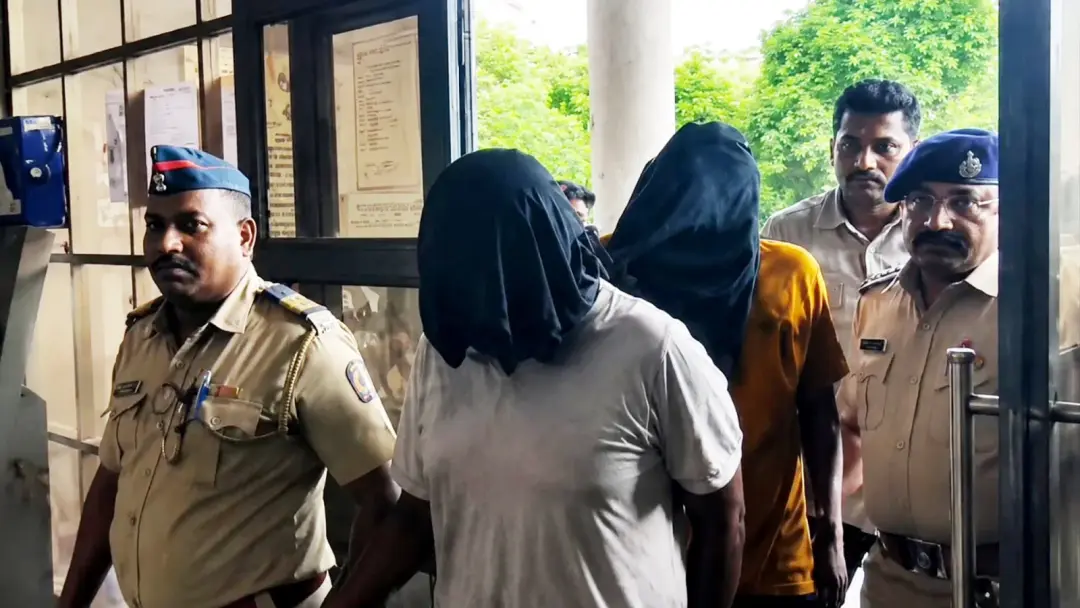
Thane police file chargesheet against 18 in TET paper leak
Thane city police on Thursday filed a nearly 3,500-page chargesheet against 18 accused in the Maharashtra Teachers Eligibility Test (TET) paper leak case, ACP Vijay Marathe said, adding two accused are still wanted. Police allege the paper was smuggled out of Agra-based printing press Mahim Patran Pvt Ltd under employees' shoe insoles for Rs 8,000. Former coaching teacher Bijendra Gupta is named the alleged mastermind. The June 28 exam was postponed.
Source
Indian Express — Cities · read the original report ↗
Desk check · compared with the source
What the desk checked (5)
- Thane city police filed a nearly 3,500-page chargesheet against 18 accused, two still wanted. — Attributed on record to ACP (Bhiwandi division) Vijay Marathe.
- The question paper was smuggled out of Agra-based Mahim Patran Pvt Ltd hidden under employees' shoe insoles for Rs 8,000. — Police allegation as stated in the chargesheet per the source; unproven in court.
- Former coaching class teacher Bijendra Gupta is the alleged mastermind. — Police identification reported in source; remains an allegation.
- The original question paper was recovered from the Bihar residence of a relative of Gupta. — Attributed to an unnamed source close to the investigation.
- The exam scheduled for June 28 was postponed after the leak surfaced two days earlier. — Figure and sequence appear in the source; no fresh exam date given.
Analysts’ view opinion
Filing a chargesheet marks the shift from investigation to the court phase — from here the strength of the case rests not on police statements but on evidence that survives judicial scrutiny. The recovery of the original question paper and the alleged financial trail between the accused are the kind of material evidence prosecutors prefer, though the sheer bulk of a 3,500-page chargesheet is no substitute for evidentiary quality. With two accused still absconding and a supplementary chargesheet promised, the timeline of the trial is likely to stretch.
- Once a chargesheet is filed, the window for default bail generally closes, and the contest typically moves to bail on merits.
- An Agra printing press, a recovery in Bihar and a case registered in Maharashtra means multi-state jurisdictional reach, which usually brings procedural friction in gathering evidence and producing witnesses.
- Labelling someone the alleged mastermind is an investigative conclusion; the burden of proving conspiracy and shared intent rests entirely with the prosecution.
- Whether the trial is severed for the two wanted accused, or a supplementary chargesheet awaits their arrest, is the immediate procedural question before the court.
- If the allegation that press employees were paid only Rs 8,000 holds up, it raises administrative accountability questions about security protocols and oversight in exam paper printing, beyond individual criminal liability.
What to watch — Watch when the court takes the chargesheet on record and frames charges, what orders it passes on the two absconding accused, and when a fresh date for the postponed exam is announced.
These remain police allegations that are yet to be tested in court, and the story does not set out the sections invoked, the court's response, or the defence's position.
Deep dive
Research brief · 8 facts · 5 dates · exam-readyThe brief
Context
The Maharashtra Teachers Eligibility Test (TET), a qualifying examination for teaching posts, was scheduled for June 28 but was postponed after its question paper was found to have leaked two days earlier. Thane city police traced the leak to Mahim Patran Pvt Ltd, an Agra-based printing press where the papers were being printed, alleging employees smuggled the paper out hidden under their shoe insoles for Rs 8,000. On Thursday, police filed a nearly 3,500-page chargesheet against 18 accused, naming former coaching class teacher Bijendra Gupta as the alleged mastermind. Two of the accused remain wanted and a supplementary chargesheet is expected.
Key facts
- Thane city police filed a nearly 3,500-page chargesheet against 18 accused in the TET paper leak case on Thursday.
- Two of the 18 accused are still wanted, and a supplementary chargesheet will be filed later, per ACP (Bhiwandi division) Vijay Marathe.
- The leak source is identified as Mahim Patran Pvt Ltd, an Agra-based printing press where TET papers were being printed.
- Two current employees and one former employee of the press allegedly walked out with the paper concealed under their shoe insoles.
- The employees were allegedly recruited by former coaching class teacher Bijendra Gupta for Rs 8,000.
- The original question paper was recovered from the Bihar residence of a relative of Gupta, who was later arrested.
- The TET exam was scheduled for June 28; the leak surfaced two days earlier and the exam was postponed.
- The case began with a tip-off to DCP (Zone II) Pavan Bansod from a Bhiwandi resident who said three people approached him with a copy of the TET paper.
Timeline
- Two days before June 28Question paper allegedly smuggled out of the Agra printing press; leak comes to light after a tip-off from a Bhiwandi resident and a police raid recovers papers.
- June 28Scheduled date of the Maharashtra TET; the examination is postponed following the leak.
- After the leakOriginal question paper recovered from the Bihar residence of a relative of Bijendra Gupta, who was subsequently arrested.
- Two weeks after the leakMaharashtra had yet to announce a fresh examination date.
- Thursday (chargesheet day)Thane city police file a nearly 3,500-page chargesheet against 18 accused, two of them still wanted.
Who has a stake
- TET aspirants in Maharashtra — Their exam on June 28 was postponed and, as of two weeks after the leak, no fresh date had been announced.
- Thane city police — Investigating agency; traced the leak to the Agra press and must sustain the case with recovered paper and financial trail evidence.
- Bijendra Gupta, former coaching class teacher — Named the alleged mastermind who allegedly recruited press employees for Rs 8,000.
- Mahim Patran Pvt Ltd, Agra printing press — Identified in the chargesheet as the source of the leak; two current and one former employee allegedly involved.
- ACP Vijay Marathe and DCP Pavan Bansod — Officers who confirmed the chargesheet and the strength of evidence; Bansod received the initiating tip-off.
- Bhiwandi resident tipster — Reported that three people approached him with a copy of the TET paper, triggering the raid.
Why it matters
A leak from the printing stage shows that examination integrity can fail well before the paper reaches the hall, affecting thousands of candidates whose teaching careers depend on the TET. The postponement without an announced fresh date leaves aspirants in limbo, while the chargesheet's reliance on the recovered original paper and financial trails will test whether such cases translate into convictions.
UPSC angle
Prelims pointers
- TET (Teachers Eligibility Test) is the qualifying examination for teaching posts; the Maharashtra TET was scheduled for June 28 and postponed after a leak.
- Chargesheet: nearly 3,500 pages against 18 accused, filed by Thane city police; two accused still wanted.
- Alleged leak source: Mahim Patran Pvt Ltd, an Agra-based printing press.
- Alleged mastermind: Bijendra Gupta, a former coaching class teacher; press employees allegedly paid Rs 8,000.
- Original question paper recovered from a relative's residence in Bihar; financial transactions cited as key evidence.
- Officers named: ACP (Bhiwandi division) Vijay Marathe and DCP (Zone II) Pavan Bansod.
Mains framing
The Maharashtra TET paper leak illustrates how the weakest link in high-stakes recruitment examinations often lies in the pre-examination supply chain rather than the examination centre: according to the chargesheet, the question paper walked out of an Agra printing press under the shoe insoles of hired employees for as little as Rs 8,000, allegedly organised by a former coaching class teacher who then used a network of intermediaries to circulate it for money. The case surfaced only because a Bhiwandi resident tipped off the police after three people approached him with a copy, underlining the role of chance disclosure over systemic detection. Implications are threefold: candidates lose time and certainty, as the June 28 exam was postponed with no fresh date announced two weeks later; the credibility of teacher recruitment is dented; and the prosecution now rests on physical recovery of the original paper from Bihar and on financial trails between the accused. The way forward suggested by the source's own facts is tighter vetting and supervision of personnel at printing presses, traceability of printed papers, and swift completion of investigation, including the supplementary chargesheet and arrest of the two wanted accused, so that deterrence follows detection.
Key terms
- TET (Teachers Eligibility Test)
- Qualifying examination for teaching posts; the Maharashtra edition scheduled for June 28 was postponed after the leak.
- Chargesheet
- Final police report of investigation filed before court against the accused; here nearly 3,500 pages against 18 persons.
- Supplementary chargesheet
- An additional chargesheet filed later based on further investigation, as indicated by ACP Vijay Marathe.
- Mahim Patran Pvt Ltd
- Agra-based printing press named in the chargesheet as the source of the TET paper leak.
- Wanted accused
- Persons named in the case but not yet arrested; two of the 18 accused fall in this category.
- Financial trail
- Record of money transactions between the accused, used by police to establish the chain of circulation of the leaked paper.
Practice questions
- Examination paper leaks in India increasingly originate at the printing and transport stage rather than the examination hall. Discuss with reference to the Maharashtra TET case and suggest safeguards.
- How do delays in announcing rescheduled examination dates affect candidates' rights and trust in public recruitment? Examine.
- Evaluate the evidentiary challenges in prosecuting organised paper-leak networks, using the Thane police chargesheet's reliance on recovered papers and financial trails as an example.
Grounded only in the source report — figures and dates are the source's, not inferred.