
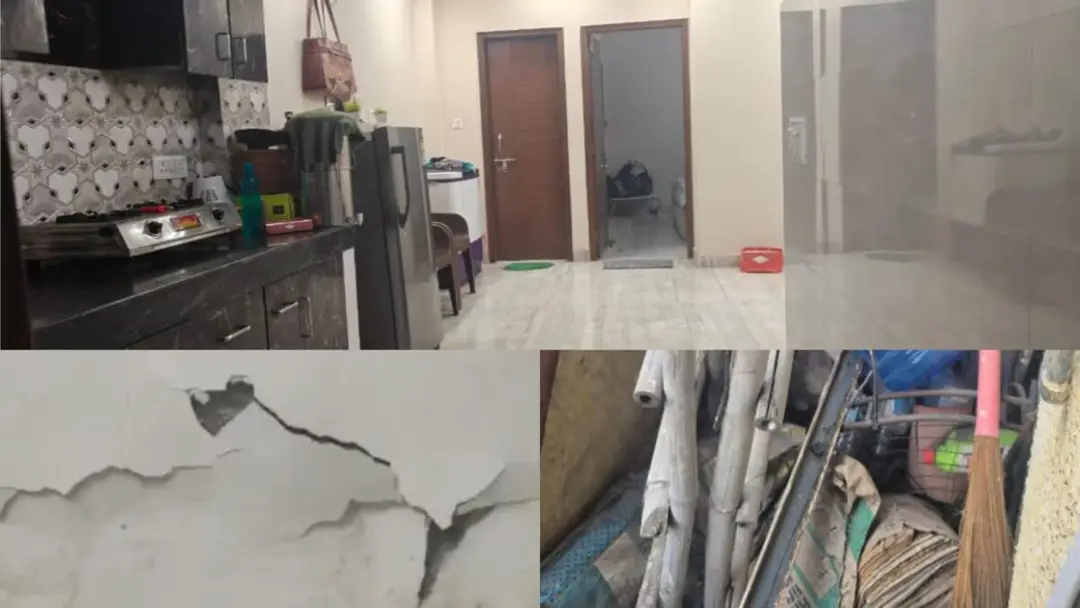
High rents, deposits, poor upkeep strain Delhi-NCR tenants
Rising rents, heavy brokerage and deposits and poor maintenance are making affordable, liveable housing harder to find for tenants across Delhi-NCR, a report says. A Delhi government survey covering about 20.05 lakh households and 1.02 crore people found 32.38% of households live in rented accommodation and 66.63% in their own homes. Tenants paying Rs 20,000 in Mayur Vihar and Rs 25,000 elsewhere cited old wiring, water leakage and rats.
Source
News18 — India · read the original report ↗
Desk check · some claims need care
What the desk checked (5)
- A Delhi government survey covered about 20.05 lakh households and 1.02 crore people. — Figures appear in source and are attributed to a Delhi government survey; no report title or date given.
- 32.38% of Delhi households live in rented accommodation and 66.63% in their own homes. — Figures appear twice in the source, consistent; attributed to the same survey.
- Manik and a friend pay Rs 20,000 a month for a small 2BHK in Mayur Vihar Phase 1 with recurring wiring and plumbing problems. — First-person account attributed to a named tenant; landlord's side not presented.
- Three media professionals pay Rs 25,000 a month and are charged Rs 1.50 extra per unit of electricity, which the landlord attributed to previous tenants' dues. — Stated as an allegation by tenant Aditya; unverified, landlord not quoted directly.
- The recent Satya Niketan building collapse brought tenant safety into focus. — Referenced in source without date, casualty details or official source.
Analysts’ view opinion
The Delhi government's own survey finding that 32.38% of households live in rented homes exposes a political fact: a large slice of the capital's electorate does not own a home and often shifts address. Delhi politics has long revolved around power, water and subsidies, while tenant grievances — brokerage, deposits, absent maintenance — have been treated as private misfortune rather than a policy question. The numbers in this report hint at the potential for tenants to become a political bloc, but that consolidation has not happened yet.
- At 32.38%, renters are no longer a marginal group, and ignoring them could become politically expensive for any party.
- Their weakness so far is structural: renters are geographically scattered and mobile, which makes organised pressure harder to build.
- Landlords and local broker-trader networks, by contrast, are settled, organised ward-level voters — which is why governments tread carefully on ideas like rent or brokerage regulation.
- With authority in Delhi split across central, state and municipal bodies, accountability for building safety and sanitation is easy to pass around.
- Incidents such as the Satya Niketan building collapse push the issue into political conversation briefly, but whether it converts into durable policy is an open question.
What to watch — Watch which party first puts tenant safety, brokerage-deposit regulation and old-building inspection on its agenda, and who uses these survey numbers to court young, middle-class urban voters.
The story documents tenant experiences and survey figures only; it does not establish any party's stance, any policy proposal, or any political reaction to the issue.
Deep dive
Research brief · 8 facts · 4 dates · exam-readyThe brief
Context
Delhi-NCR draws large numbers of migrants for jobs and education, and most of them enter the rental housing market. A recent Delhi government survey covering about 20.05 lakh households and 1.02 crore people found 32.38% of the capital's households live in rented accommodation, while 66.63% live in their own homes. Tenants interviewed by News18 describe steep rents, brokerage even on direct deals, security deposits of about twice the monthly rent, and near-absent maintenance. The recent Satya Niketan building collapse has renewed attention on the safety of older, poorly maintained rented properties.
Key facts
- A Delhi government survey covered around 20.05 lakh households and 1.02 crore people.
- The survey found 32.38% of Delhi households live in rented accommodation and 66.63% in their own homes.
- Manik, a contractual Central Government employee in Samaspur Jagir, Mayur Vihar Phase 1, pays Rs 20,000 a month with a friend for a small 2BHK; he has lived there three years.
- Manik says he was asked to pay brokerage despite renting directly from the owner, and bears electrician and plumbing repair costs himself.
- Prajanya Janhvi, in Delhi since 2019, paid around Rs 17,000 for a 1BHK in Karol Bagh plus brokerage and a security deposit of roughly twice the monthly rent.
- Prajanya said brokers were charging Rs 8,000-Rs 10,000 when she looked for a new home after shifting.
- Three media professionals - Aditya, Rohan and Akhil - pay Rs 25,000 a month for a house with water leakage, waterlogging, poor drainage and a rat problem.
- Aditya alleges they are charged Rs 1.50 extra per unit of electricity, which the landlord attributed to unpaid dues of previous tenants.
Timeline
- 2019Prajanya Janhvi moves to Delhi; first rents a 1BHK in Karol Bagh for about Rs 17,000 plus brokerage and deposit.
- About three years before the reportManik begins living in Samaspur Jagir, Mayur Vihar Phase 1, paying Rs 20,000 a month for a shared 2BHK.
- Recent (date not stated in the source)Satya Niketan building collapse renews focus on tenant safety in older, poorly maintained buildings.
- September 18, 2026News18 report published on rents, deposits and poor upkeep straining Delhi-NCR tenants.
Who has a stake
- Tenants and migrant workers/students in Delhi-NCR — Pay high rents, brokerage and deposits but face unsafe wiring, leakage, pests and poor sanitation with complaints unresolved.
- Landlords and property owners — Accused of refusing repair responsibility, charging brokerage on direct deals and recovering past dues from new tenants.
- Brokers — Earn brokerage of Rs 8,000-Rs 10,000 per deal, adding to tenants' upfront costs.
- Delhi government — Its household survey documents the scale of rented housing; onus for housing quality, safety and civic services.
- Civic and building-safety authorities — Ageing buildings, peeling plaster and collapse incidents such as Satya Niketan raise enforcement questions.
Why it matters
Nearly a third of Delhi's households are tenants, so rental affordability and building safety are mass-scale issues, not individual grievances. When rents of Rs 20,000-Rs 25,000 buy old wiring, leaking plumbing, pests and no maintenance, tenants absorb both financial and safety risk in an earthquake-prone city. The Satya Niketan collapse shows the cost of unaddressed upkeep in older rented properties.
UPSC angle
Prelims pointers
- Delhi government survey: about 20.05 lakh households, 1.02 crore people covered.
- 32.38% of Delhi households are in rented accommodation; 66.63% own their homes.
- Security deposits reported at roughly twice the monthly rent; brokerage of Rs 8,000-Rs 10,000.
- Localities named in the report: Mayur Vihar Phase 1 (Samaspur Jagir), Karol Bagh, Satya Niketan.
- Delhi is described in the report as facing genuine earthquake risk, raising concerns over ageing buildings.
- Rents cited: Rs 20,000 for a shared 2BHK; Rs 17,000 for a 1BHK; Rs 25,000 for a shared house.
Mains framing
The Delhi-NCR rental crunch illustrates how urban housing distress persists even where formal ownership is not the constraint: with 32.38% of Delhi households renting, according to a government survey of 20.05 lakh households and 1.02 crore people, the market's terms are set largely by landlords and brokers. Causes visible in the reportage include acute demand from migrants seeking jobs and education, upfront cost barriers (brokerage charged even on direct deals, deposits of about twice the rent), ageing housing stock with old wiring and plumbing, weak maintenance obligations, and civic failures in drainage, sanitation and water quality. Implications are threefold: a heavy rent burden on incomes, health risks from pests, sewage and poor water, and safety risk in old buildings, dramatised by the Satya Niketan collapse in an earthquake-prone city; tenants also report retaliatory responses such as being told to vacate, and irregular charges like Rs 1.50 extra per electricity unit. The way forward suggested by these accounts lies in clearer, enforceable landlord maintenance duties and written tenancy terms, caps and transparency on brokerage and deposits, accessible grievance redress for tenants, regulated billing of utilities, and structural safety audits plus civic upgrades in dense rental localities. Beyond that, specific policy prescriptions are not stated in the source.
Key terms
- Brokerage
- Fee charged by a property broker for arranging a rental; tenants here report being asked for it even when dealing directly with the owner.
- Security deposit
- Refundable upfront sum held by the landlord; in Karol Bagh it was roughly twice the monthly rent.
- Delhi government household survey
- Survey covering about 20.05 lakh households and 1.02 crore people that measured rented versus owned housing in Delhi.
- Satya Niketan building collapse
- Recent incident in Delhi that renewed attention to safety of older, poorly maintained buildings occupied by tenants.
- Delhi-NCR
- The National Capital Region around Delhi, the wider urban area whose tenants the report covers.
Practice questions
- Nearly one in three Delhi households lives on rent. Examine the affordability, safety and grievance-redress challenges facing urban tenants, using evidence from recent surveys and reportage.
- Discuss how ageing building stock and weak maintenance obligations interact with disaster risk in Indian metropolitan cities. Suggest measures to protect tenants.
- How can transparency in brokerage, security deposits and utility billing be improved in India's rental housing market? Analyse with examples from Delhi-NCR.
Grounded only in the source report — figures and dates are the source's, not inferred.