
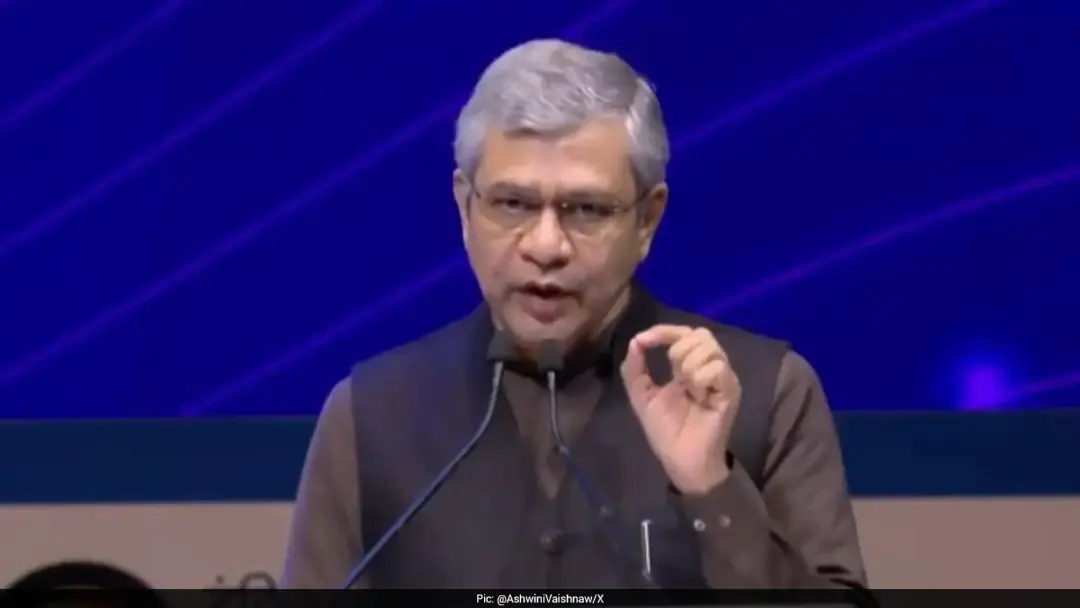
AI brings benefits and risks, regulation has a role: Vaishnaw
IT Minister Ashwini Vaishnaw said on Thursday that the government is working with industry to find the right regulatory approach to keep artificial intelligence safe and protect citizens online. Speaking on the sidelines of SEMICON India 2026, he said every new technology brings positives as well as risks, which is why regulation, primarily about user safety, always has a role. He said AI's user-safety dimension is very large and harder to imagine than for physical technologies such as nuclear.
Source
Railways / IT / I&B — Ashwini Vaishnaw · read the original report ↗
Desk check · compared with the source
What the desk checked (5)
- IT Minister Ashwini Vaishnaw said the government is working with industry to find the right regulatory approach for AI safety. — Directly attributed to Vaishnaw in the source, with quotes.
- The remarks were made on Thursday on the sidelines of SEMICON India 2026. — Stated in source; day and event appear as given, no independent verification possible.
- AI's user-safety dimension is larger and more complex than physical technologies such as nuclear. — Quoted opinion of the minister, attributed.
- Researchers and safety experts at OpenAI and Anthropic recently went public with warnings about risks from powerful AI systems. — Asserted by the source without naming individuals or citing documents.
- The story is published from a syndicated feed and not edited by NDTV staff except the headline. — Disclosed in the source text itself.
Analysts’ view opinion
The minister's remarks suggest India is still at the "how" stage of AI regulation rather than the "what", with industry consultation as the chosen route to clarity. The nuclear comparison is the analytically interesting part: physical technologies come with measurable safety thresholds, whereas software-based models that change with every update are far harder to certify. That this was said on the sidelines of SEMICON India is also telling — the policy conversation is increasingly being framed from chips through to models.
- Framing regulation primarily around "user safety" points to a focus on downstream harms — deepfakes, misinformation, fraud, privacy — rather than hard limits on model capability.
- The nuclear analogy holds up technically: because AI behaviour is hard to predict, audit and test, rules are more likely to be process-based than fixed-threshold based.
- A co-drafting approach with industry tends to be faster and more implementable, but invites the criticism that the regulated are helping write the rules.
- With researchers inside leading AI labs going public with warnings, safety pressure is now coming from within the industry, not just from governments.
- Given the size of India's user base, whatever framework emerges could shape platform product design, content labelling and grievance mechanisms well beyond India.
What to watch — Watch whether this becomes fresh legislation or an extension of existing IT rules and voluntary standards — and whether any timeline is attached.
The story establishes intent, not policy: it confirms no draft rules, no timeline and no detail on which industry players are at the table.
Deep dive
Research brief · 8 facts · 2 dates · exam-readyThe brief
Context
India's IT Minister Ashwini Vaishnaw, speaking on the sidelines of SEMICON India 2026, said the government is working with industry to arrive at the right regulatory approach for artificial intelligence, with user safety as the primary concern. His remarks come amid a global debate on how to capture AI's economic and societal benefits while containing harms such as deepfakes, misinformation, fraud, privacy breaches and bias. The comments gain weight after researchers and safety experts at leading AI firms, including OpenAI and Anthropic, publicly warned about risks from increasingly powerful AI systems. Governments, technology companies and scientists worldwide are grappling with frameworks that protect users without stifling innovation.
Key facts
- IT Minister Ashwini Vaishnaw said on Thursday that the government is working with industry to find the right regulatory approach for AI and online citizen safety.
- Vaishnaw spoke on the sidelines of SEMICON India 2026.
- He said every new technology brings positives as well as several risks, which is why regulation always plays a role, and that regulation is primarily about user safety.
- He said AI's user-safety dimension is 'very big' and described AI safety as a very complex issue.
- He contrasted AI with physical technologies such as nuclear, where 'the imagination of how to be safe is much easier' than for AI.
- The global AI debate spans risks from deepfakes, misinformation and fraud to privacy breaches, bias and potential misuse of powerful AI systems.
- Researchers and safety experts at leading AI companies, including OpenAI and Anthropic, recently went public with stark warnings, some raising the spectre of catastrophic consequences for humanity.
- Governments, major technology companies, researchers and scientists are working on regulatory and safety frameworks that protect users without stifling innovation.
Timeline
- Recently (date not stated in the source)Researchers and safety experts at leading AI companies, including OpenAI and Anthropic, publicly warned about risks from increasingly powerful AI systems.
- Thursday (full date not stated in the source)Vaishnaw says on the sidelines of SEMICON India 2026 that the government is working with industry on the right way to regulate and keep AI safe.
Who has a stake
- Ministry of Electronics and IT / Ashwini Vaishnaw — Must design an AI regulatory approach that keeps users safe online without holding back the technology's benefits.
- Industry / technology companies — Being consulted by the government on the right way of regulating and keeping AI safe; face compliance obligations.
- Citizens and internet users in India — Exposed to deepfakes, misinformation, fraud, privacy breaches and bias; are the intended beneficiaries of user-safety regulation.
- AI labs such as OpenAI and Anthropic — Their own researchers and safety experts have flagged risks from increasingly powerful systems, shaping the regulatory debate.
- Governments, researchers and scientists worldwide — Grappling with safety and regulatory frameworks that protect users without stifling innovation.
Why it matters
AI is being deployed across the economy faster than rules for it can be written, and India is signalling that its approach will be anchored in user safety rather than a hands-off stance. The minister's framing — that AI safety is harder to imagine than nuclear safety — points to why regulation is being co-developed with industry rather than imposed in isolation. How this balance is struck will shape both citizen protection online and India's room to innovate.
UPSC angle
Prelims pointers
- Ashwini Vaishnaw is the Union IT Minister; he made the AI regulation remarks on the sidelines of SEMICON India 2026.
- Vaishnaw's core proposition: regulation of any new technology is 'primarily about user safety'.
- He argued AI's user-safety dimension is larger and harder to imagine than for physical technologies such as nuclear.
- Global AI risks cited: deepfakes, misinformation, fraud, privacy breaches, bias and misuse of powerful AI systems.
- OpenAI and Anthropic researchers/safety experts recently issued public warnings on risks from increasingly powerful AI.
- The stated global policy goal: frameworks that protect users without stifling innovation.
Mains framing
The minister's remarks capture the central dilemma of AI governance: the technology promises significant economic and societal benefits, yet its harms — deepfakes, misinformation, fraud, privacy breaches, bias and misuse of increasingly capable systems — are diffuse, fast-moving and, as Vaishnaw notes, harder to visualise than the risks of a physical technology such as nuclear power. This epistemic difficulty explains why regulation is being framed around user safety and developed in consultation with industry rather than through a single prescriptive statute: the state lacks full visibility into how frontier systems behave, while developers hold that knowledge, as shown by safety researchers at OpenAI and Anthropic going public with warnings. The implication is a governance model that must be adaptive and evidence-driven, protecting citizens in the online world without stifling innovation or domestic capability-building — a balance that also connects to India's broader technology-sovereignty push visible at forums like SEMICON India. A credible way forward, on the source's own terms, lies in continued government-industry collaboration to define what "keeping AI safe" concretely means, with user safety as the organising principle.
Key terms
- SEMICON India 2026
- Industry event on the sidelines of which the IT Minister made his remarks on AI regulation and safety.
- AI safety
- The effort to ensure AI systems do not harm users; described by Vaishnaw as a very complex issue with a very large user-safety dimension.
- Deepfakes
- Synthetic AI-generated audio/video or images used to impersonate or mislead; listed among global AI risks.
- OpenAI and Anthropic
- Leading AI companies whose researchers and safety experts recently issued public warnings about risks from powerful AI systems.
- User safety
- The primary purpose of technology regulation according to Vaishnaw — protecting citizens in the online world.
Practice questions
- "Regulation of new technology is primarily about user safety." Examine this proposition in the context of artificial intelligence, using the risks currently under global debate.
- Why is ensuring AI safety considered more complex than ensuring safety in physical technologies such as nuclear? Discuss the implications for regulatory design in India.
- Discuss the merits and limitations of a government-industry collaborative approach to AI regulation in protecting citizens without stifling innovation.
Grounded only in the source report — figures and dates are the source's, not inferred.