
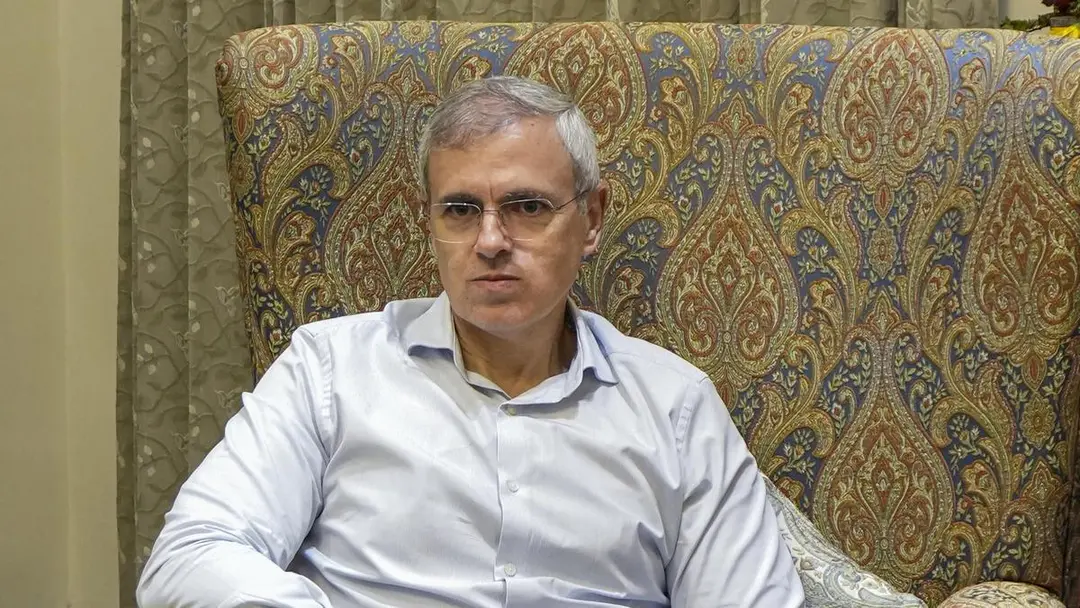
On PM's birthday, Omar Abdullah seeks J&K Statehood restoration
Jammu and Kashmir Chief Minister Omar Abdullah on Thursday (September 17, 2026), Prime Minister Narendra Modi's birthday, sought restoration of Statehood for the Union Territory, saying: "If nothing else, give us the Statehood of Jammu and Kashmir." He said repeated promises made after the elections were verbal, including in Parliament and the Supreme Court, with nothing in writing. Abdullah also backed the Centre's move to charge UPI payments, saying charges would apply to businesses and not be passed to customers, with person-to-person transfers and merchant transactions below ₹2,000 exempt.
Source
The Hindu — National · read the original report ↗
Desk check · compared with the source
What the desk checked (4)
- Omar Abdullah sought restoration of Statehood for Jammu and Kashmir on PM Modi's birthday, September 17, 2026. — Attributed to Abdullah with direct quotes in the source; date appears in source.
- Promises to restore Statehood were made verbally, including in Parliament and the Supreme Court, but nothing was in writing. — Direct quote attributed to Abdullah; no independent documentation cited in source.
- Abdullah backed the Centre's move to charge UPI payments, saying charges would apply to businesses, not customers. — Attributed to Abdullah; no official Centre notification quoted in the source.
- Merchant transactions below ₹2,000 would not carry merchant charges; person-to-person transfers exempt. — Figure appears in source as Abdullah's statement; not independently sourced.
Analysts’ view opinion
Omar Abdullah has turned the Prime Minister's birthday into a political stage, wrapping his central demand — restoration of Statehood — in the language of a wish rather than a confrontation. By choosing courtesy over conflict, he keeps pressure on his signature electoral promise without rupturing his working relationship with the Centre. His pointed remark that assurances were only verbal, never written, is an attempt to place the moral burden squarely on Delhi. At the same time, backing the Centre on UPI charges signals a deliberate mix of cooperation and pressure.
- As an elected Chief Minister operating within a Union Territory framework with limited powers, keeping the Statehood demand alive is a political necessity for Abdullah.
- Choosing a birthday occasion converts criticism into a polite request, lowering the odds of a sharp counter-reaction from the Centre.
- The "nothing in writing" framing is designed to shift the onus of delivering on promises onto the Union government.
- Supporting the Centre's UPI charges decision helps him avoid the image of a leader who opposes Delhi on every front.
- If Statehood restoration continues to be delayed, rival political forces in the region could question the effectiveness of Abdullah's government.
What to watch — Watch whether the Centre offers any formal or written clarity on Statehood or lets the demand pass in silence — that response will shape the next political phase.
The story does not establish the Centre's current position or any timeline on Statehood, and carries no response from the Union government.
Deep dive
Research brief · 8 facts · 3 dates · exam-readyThe brief
Context
Jammu and Kashmir was reorganised into a Union Territory and has since had an elected Assembly, with Omar Abdullah as Chief Minister. A recurring political demand is restoration of full Statehood, which the CM says was promised verbally after the elections but never committed in writing. On September 17, 2026 — Prime Minister Narendra Modi's birthday — Abdullah publicly framed Statehood as his one wish, while also endorsing the Centre's proposal to levy charges on UPI transactions.
Key facts
- On Thursday, September 17, 2026, PM Narendra Modi's birthday, J&K CM Omar Abdullah sought restoration of Statehood for the Union Territory.
- Abdullah's words: "If nothing else, give us the Statehood of Jammu and Kashmir. What else do we need?"
- He said promises to restore Statehood were repeatedly made after the elections but "nothing was put in writing".
- He said assurances were given verbally, "even in Parliament and the Supreme Court".
- Abdullah backed the Centre's move to charge UPI payments.
- He said charges would apply to businesses facilitating transactions, not customers, and the cost could not be passed on to customers.
- He said transactions between individuals would not attract such a charge.
- He said merchant transactions below Rs 2,000 would not carry merchant charges under the arrangement.
Timeline
- After the J&K elections (date not stated in the source)Repeated verbal promises of Statehood restoration, including in Parliament and the Supreme Court, per Abdullah; nothing in writing.
- September 17, 2026 (Thursday)On PM Modi's birthday, CM Omar Abdullah seeks restoration of Statehood and backs the Centre's UPI charges move.
- September 18, 2026The report is published.
Who has a stake
- Omar Abdullah, Chief Minister of Jammu and Kashmir — Seeks written commitment on Statehood restoration; his government's powers depend on the UT-versus-State status.
- Union Government / Prime Minister Narendra Modi — Holds the decision on restoring Statehood; is the addressee of the demand made on the PM's birthday.
- People of Jammu and Kashmir — Statehood determines the extent of elected representation and control over governance in the region.
- Parliament and the Supreme Court — Cited by Abdullah as forums where verbal assurances on Statehood were given.
- Businesses and merchants using UPI — Would bear charges on UPI transactions; merchant transactions below Rs 2,000 exempt as per Abdullah.
- UPI customers / individual users — Person-to-person transfers exempt and costs not to be passed on to customers, per Abdullah.
Why it matters
Statehood restoration is the central political demand of J&K's elected government, and the CM's charge that assurances remain purely verbal highlights the gap between political promises and formal commitments. The choice of the Prime Minister's birthday to press the demand signals that the elected government sees the decision as resting solely with the Centre. Separately, the CM's endorsement of UPI charges places a regional leader on the side of a contentious national digital-payments policy.
UPSC angle
Prelims pointers
- Jammu and Kashmir is currently a Union Territory; its CM as of September 2026 is Omar Abdullah.
- Abdullah said Statehood assurances were verbal, including in Parliament and the Supreme Court, with nothing in writing.
- Demand for Statehood restoration was raised on September 17, 2026, PM Narendra Modi's birthday.
- On UPI charges: charges to apply to businesses facilitating transactions, not customers.
- Person-to-person UPI transfers exempt; merchant transactions below Rs 2,000 to carry no merchant charges.
Mains framing
The demand voiced by J&K Chief Minister Omar Abdullah on September 17, 2026 raises a core question of Indian federalism: what happens when an elected government functions within a Union Territory framework while awaiting restoration of Statehood. Abdullah's specific grievance is procedural as much as political — he claims assurances were made repeatedly after the elections, including in Parliament and before the Supreme Court, but never reduced to writing, leaving the elected government without an enforceable commitment or timeline. This creates uncertainty over the division of powers between the elected government and the Centre-appointed administration, and makes the demand a recurring political flashpoint rather than a settled administrative question. A way forward, on the evidence in the source, lies in converting verbal assurances into a written and time-bound commitment so that expectations are clear to both the elected government and the electorate. Notably, the same CM has backed the Centre's UPI charges proposal, arguing the levy falls on businesses and not consumers, with person-to-person transfers and sub-Rs 2,000 merchant transactions exempt — indicating that Centre-State friction over status need not translate into blanket opposition on economic policy.
Key terms
- Statehood restoration
- The demand that Jammu and Kashmir, currently a Union Territory, be restored to the status of a State.
- Union Territory (UT)
- A territory administered by the Union government; J&K's present status, which Abdullah wants changed to Statehood.
- UPI
- Unified Payments Interface, India's digital payments system, on which the Centre is moving to levy charges.
- Merchant transaction
- A UPI payment made to a business; those below Rs 2,000 would carry no merchant charges as per Abdullah.
- Person-to-person transfer
- A UPI payment between individuals, which Abdullah said would not attract the proposed charge.
Practice questions
- Examine the implications of running an elected government within a Union Territory framework, using the demand for restoration of Jammu and Kashmir's Statehood as a reference point.
- "Verbal assurances in Parliament and before courts are no substitute for written commitments." Critically discuss in the context of Centre-State relations.
- Discuss the equity and adoption implications of levying charges on UPI transactions when person-to-person transfers and small merchant payments are exempted.
Grounded only in the source report — figures and dates are the source's, not inferred.