
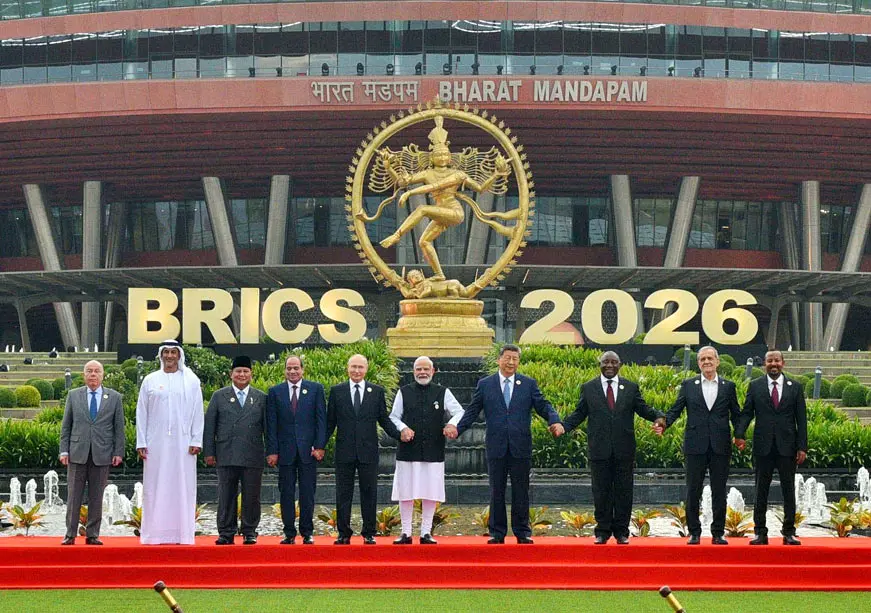
BRICS summit adopts New Delhi Declaration by consensus
The 18th BRICS Leaders' Summit adopted the New Delhi Declaration unanimously, despite speculation that Iran-UAE tensions would block consensus. All 11 members were represented, with Xi Jinping, Vladimir Putin and Cyril Ramaphosa attending; Brazil and Saudi Arabia sent foreign ministers. The 140-point text covered reformed multilateralism, nuclear disarmament, humanitarian access in Gaza and upholding the October 2025 ceasefire, while its West Asia language named no party.
Source
Observer Research Foundation (ORF) · read the original report ↗
Desk check · compared with the source
What the desk checked (5)
- The 18th BRICS Leaders' Summit adopted the New Delhi Declaration unanimously. — Stated repeatedly in the source article; no external document cited.
- All 11 BRICS members were represented, though not all by heads of state or government. — Figure appears in source, with member-wise representation listed.
- Xi Jinping's visit was his first to India in seven years, since the 2019 Mamallapuram informal summit. — Asserted by the authors; no source given.
- Iranian President Pezeshkian met Abu Dhabi Crown Prince Sheikh Khaled bin Mohamed bin Zayed Al Nahyan, the highest-level Iran-UAE engagement since the conflict began in early 2026. — Attributed to the authors' assessment; unverified externally.
- The 140-point declaration covers peace and security, reformed multilateralism, nuclear disarmament and the Palestinian cause without naming any warring party. — Described in detail in the source; wording of the declaration not independently quoted.
Analysts’ view opinion
The real story behind the unanimous adoption of the New Delhi Declaration lies not in the text but in the bilateral diplomacy conducted on the summit's margins. After the Foreign Ministers' Meeting in May failed to produce a joint statement, getting all 11 members to sign off on a 140-point document amid Iran-UAE tensions counts as a diplomatic win for both the grouping and India's presidency. But that consensus came at a price: the West Asia language named no party and stayed at the level of broad principle.
- The refusal to name any party on West Asia is consistent with past BRICS declarations — less a failure of nerve than a structural compromise that holds an enlarged, normatively diverse grouping together.
- Xi Jinping on Indian soil for the first time in seven years, and Putin at his first BRICS summit outside Russia since the Ukraine war began, signal more strategically than any clause in the document.
- The Pezeshkian–Crown Prince Khaled meeting, described as the highest-level Iran-UAE engagement since the conflict began in early 2026, shows BRICS can function as a neutral venue for de-escalation talks.
- Condemnation of non-UNSC-authorised unilateral sanctions, alongside the emphasis on uninterrupted global trade and energy flows, reflects the grouping's shared unease with Western economic pressure tools.
- With China chairing in 2027, the test is whether India's template of principle-based consensus survives a different host and a different set of priorities.
What to watch — Watch whether the Iran-UAE channel opened in Delhi continues beyond the summit, and whether BRICS's call to uphold the October 2025 ceasefire and ensure humanitarian access in Gaza translates into anything operational.
The story does not establish what trade-offs bought the consensus, which members conceded what, or whether any of the declaration's security commitments will be implemented on the ground.
Deep dive
Research brief · 8 facts · 7 dates · exam-readyThe brief
Context
The 18th BRICS Leaders' Summit, hosted by India in New Delhi, adopted the BRICS New Delhi Declaration unanimously, marking the grouping's 20th anniversary. The summit had been closely watched since early 2026 because tensions between two newer members, Iran and the UAE, threatened consensus on several clauses, especially after the Foreign Ministers' Meeting in May failed to produce a joint statement. All 11 members were represented, and intensive bilateral diplomacy on the sidelines helped produce a 140-point text covering reformed multilateralism, peace and security, nuclear disarmament and West Asia.
Key facts
- The 18th BRICS Leaders' Summit adopted the BRICS New Delhi Declaration unanimously, in a 140-point text.
- All 11 BRICS members were represented, though not all by heads of state or government.
- China, Russia and South Africa were represented by Xi Jinping, Vladimir Putin and Cyril Ramaphosa; Brazil and Saudi Arabia sent foreign ministers.
- For Putin, it was his first BRICS summit outside Russia since the war in Ukraine began.
- Xi Jinping's presence marked his first visit to India in seven years, since the 2019 informal summit at Mamallapuram, which predated the 2020 Galwan clash.
- The UAE was represented by Sheikh Khaled bin Mohamed bin Zayed Al Nahyan, Crown Prince of Abu Dhabi; Egypt, Ethiopia, Indonesia and Iran were represented at head of state or government level.
- The declaration called for the October 2025 ceasefire to be upheld and for humanitarian access in Gaza, and asked Israel to withdraw occupying forces from Lebanese territory.
- The West Asia paragraphs named no party, urging maximum restraint and protection of global trade, supply chains and energy flows.
Timeline
- 2019Modi-Xi informal summit at Mamallapuram; Xi's last visit to India before the New Delhi summit.
- 2020Galwan clash freezes India-China relations.
- October 2025Ceasefire that the New Delhi Declaration calls on parties to uphold, along with humanitarian access in Gaza.
- Early 2026Conflict involving Iran and the UAE begins; tensions threaten BRICS consensus.
- May (2026)BRICS Foreign Ministers' Meeting fails to produce a joint statement, raising doubts about the grouping's cohesion.
- Recently (18th summit)New Delhi Declaration adopted by consensus; Pezeshkian and the Abu Dhabi Crown Prince meet on the sidelines.
- 2027China is set to chair the next BRICS Summit.
Who has a stake
- India (host and chair) — Diplomatic credibility as summit host; delivered consensus text and held bilaterals with Russia, Iran, UAE, Vietnam, Malaysia, Ethiopia and UN chief.
- BRICS as a grouping (11 members) — Proving that post-expansion it can still manage geopolitical complexity and produce consensus documents.
- Iran — President Pezeshkian's participation and the first high-level engagement with the UAE since the early-2026 conflict began.
- UAE — Represented by the Crown Prince of Abu Dhabi; used the sidelines for de-escalation talks with Iran.
- China — Xi's first India visit in seven years; will chair the 2027 BRICS Summit.
- Russia — Putin's first BRICS summit outside Russia since the Ukraine war; bilateral talks on defence, energy, space and maritime trade.
- Israel, Lebanon and Palestinians — Declaration language on the October 2025 ceasefire, humanitarian access in Gaza and withdrawal from Lebanese territory.
- United Nations — Declaration upholds UN centrality; Secretary-General Antonio Guterres met PM Modi on the sidelines.
Why it matters
In a fragmented, conflict-ridden global order, BRICS showed that an expanded, loosely institutionalised and consensus-based grouping can still produce a joint document despite members holding diametrically opposing positions. The New Delhi Declaration's approach — anchoring language in broad principles rather than naming parties — offers a template for future consensus, even if critics see it as diluted. For India, delivering consensus after the failed May Foreign Ministers' Meeting was a visible diplomatic win.
UPSC angle
Prelims pointers
- 18th BRICS Leaders' Summit hosted by India adopted the 140-point BRICS New Delhi Declaration by consensus.
- BRICS now has 11 members; the summit marked the grouping's 20th anniversary.
- India's BRICS presidency themes: resilience, innovation, cooperation, sustainability.
- China is to chair the next BRICS Summit in 2027.
- Declaration condemned unilateral coercive measures, including non-UNSC-authorised sanctions, and upheld UN centrality.
- Declaration called for upholding the October 2025 ceasefire and humanitarian access in Gaza.
Mains framing
The unanimous adoption of the 140-point New Delhi Declaration at the 18th BRICS Summit illustrates how a plurilateral, consensus-based grouping manages internal divergence after enlargement. The immediate challenge came from the Iran-UAE conflict that began in early 2026 and from the failure of the May Foreign Ministers' Meeting to issue a joint statement; the deeper structural problem is that BRICS members are normatively dissimilar and hold opposing positions on regional security. The source suggests consensus was engineered through parallel bilateral and leader-level diplomacy — Modi's talks with Putin on defence, energy, space and maritime trade, his meetings with Pezeshkian and the Abu Dhabi Crown Prince, and the Iran-UAE meeting on the sidelines — combined with a drafting strategy that anchored positions in broad principles: reformed multilateralism, UN centrality, opposition to non-UNSC-authorised sanctions, preventive diplomacy and mediation with party consent, nuclear disarmament and non-proliferation, and calls on Gaza and Lebanon. The cost is diluted language: no warring party or the conflict itself is named. The way forward indicated is deepening issue-based cooperation through shared frameworks in areas of mutual interest, so that expansion strengthens rather than paralyses the grouping.
Key terms
- BRICS New Delhi Declaration
- The 140-point outcome document of the 18th BRICS Leaders' Summit, adopted unanimously in New Delhi.
- Reformed multilateralism
- BRICS commitment to reforming global governance and strengthening multipolarity while keeping the UN central to the international system.
- Unilateral coercive measures
- Sanctions or restrictions imposed without UN Security Council authorisation; the declaration condemned them as contrary to international law.
- Preventive diplomacy and mediation
- Early diplomatic engagement, with the consent of relevant parties, to stop international disputes from escalating.
- Mamallapuram informal summit (2019)
- The last Modi-Xi meeting on Indian soil before the New Delhi summit, preceding the 2020 Galwan clash.
- Observer Research Foundation (ORF)
- The think tank where the authors of the analysis, Heena Makhija and Sandra Thachirickal Prathap, are affiliated.
Practice questions
- Does the New Delhi Declaration's refusal to name any party in West Asia represent diplomatic pragmatism or a dilution of BRICS's normative voice? Discuss.
- Examine how BRICS expansion has affected the grouping's ability to build consensus on international peace and security, with reference to the 18th Summit.
- Assess the role of bilateral and leader-level diplomacy on the sidelines in producing outcomes at plurilateral forums such as BRICS.
Grounded only in the source report — figures and dates are the source's, not inferred.